Pesticide Applicator Core Training - Section 3 Correct 100%
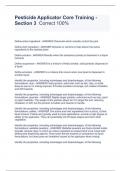
Define active ingredient - ANSWER Chemicals which actually control the pest Define inert ingredient - ANSWER Solvents or carriers to help deliver the active ingredients to the desired pests Define solution - ANSWER Results when the substance (solute) is dissolved in a liquid (solvent) Define suspension - ANSWER Is a mixture of finely divided, solid particles dispersed in a liquid Define emulsion - ANSWER Is a mixture that occurs when one liquid is dispersed in another liquid Identify the properties, including advantages and disadvantages, of the following formulations: dust - ANSWER Finely-ground, solid inert such as talc, clay, or chalk. Easy-to-use w/ no mixing required. Provides excellent coverage, but creates inhalation and drift hazards Identify the properties, including advantages and disadvantages, of the following formulations: granular - ANSWER Slightly larger particle, solid inert such as clay, sand or plant materials. The weight of the particle allows for it to target the soil, reducing inhalation or drift, but the product is bulkier and heavier to handle Identify the properties, including advantages and disadvantages, of the following formulations: pellets - ANSWER The active and inert ingredients form a slurry, a thick liquid mixture. Pellets are typically used for spot applications, provide a high degree of safety to the applicator. They can potentially roll off steep slopes
Escuela, estudio y materia
- Institución
- Indiana Pesticide Applicator
- Grado
- Indiana Pesticide Applicator
Información del documento
- Subido en
- 24 de diciembre de 2023
- Número de páginas
- 3
- Escrito en
- 2023/2024
- Tipo
- Examen
- Contiene
- Preguntas y respuestas
Temas
-
pesticide applicator core
-
pesticide applicator core training section 3 co
-
define active ingredient answer chemicals which
-
define inert ingredient answer solvents or carri

Documento también disponible en un lote