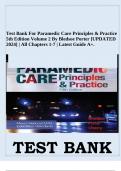
Test Bank For Paramedic Care Principles & Practice 5th Edition Volume 2 By Bledsoe Porter [UPDATED 2024] | All Chapters 1-7 | Latest Guide A+.
Test Bank For Paramedic Care Principles & Practice 5th Edition Volume 2 By Bledsoe Porter [UPDATED 2024] | All Chapters 1-7 | Latest Guide A+. Paramedic Care: Principles & Practice V.2, 5e (Bledsoe) Test Bank Paramedic Care: Principles & Practice, 5th Edition Volume 2: Patient Assessment (Bledsoe) Table Of Contents: CHAPTER 1: Scene Size-Up CHAPTER 2: Primary Assessment CHAPTER 3: Therapeutic Communications CHAPTER 4: History Taking CHAPTER 5: Secondary Assessment CHAPTER 6: Patient Monitoring Technology CHAPTER 7:Patient Assessment in the Field Paramedic Care: Principles & Practice V. 2, 5e (Bledsoe) Test Bank Paramedic Care: Principles & Practice, 5th edition Volume 2: Patient Assessment (Bledsoe) Chapter 1: Scene Size-Up 1) You arrive at a location and begin to read the scene by: A) approaching the patient. B) observing the immediate surroundings. C) conducting a focused exam. D) addressing life threats. Answer: B Diff: 1 Page Ref: 3 Standard: Assessment (Scene Size-Up) Objective: 2 2) Which of the following is a potentially life-threatening patient complaint? A) Fractures of the tibia and radius B) Asthma C) Headache D) Chest pain Answer: D Diff: 2 Page Ref: 15-16 Standard: Assessment (Scene Size-Up) Objective: 7 3) At the scene of a multiple-vehicle collision, which of the following actions should you take first? A) Wait for additional resources to arrive. B) Treat the most seriously injured patient. C) Quickly scan the scene to count patients. D) Go directly to the first patient you see. Answer: C Diff: 2 Page Ref: 14-15 Standard: Assessment (Scene Size-Up) Objective: 6 4) A scene size-up is performed for all of the following reasons EXCEPT: A) to assess the mechanism of injury. B) to assess a baseline mental status. C) to provide information that will guide your medical care. D) to assess the need for additional resources. Answer: B Diff: 1 Page Ref: 3 Standard: Assessment (Scene Size-Up) Objective: 2 5) Which of the following is usually the best source of information about an alert and oriented patient? A) The patient B) Visual cues C) Diagnostic tests D) Family members Answer: A Diff: 1 Page Ref: 16 Standard: Assessment (Scene Size-Up) Objective: 7 6) Which of the following is NOT a consideration when evaluating the mechanism of injury? A) Mass and velocity of objects involved B) Whether the mechanism was blunt or penetrating C) Direction of impact D) Whether it is a rural or an urban setting Answer: D Diff: 2 Page Ref: 15-16 Standard: Assessment (Scene Size-Up) Objective: 7 7) When approaching a potential crime scene, you should: A) enter the scene if no signs of danger are noted. B) quickly enter the scene, retrieve the victim, and withdraw to the vehicle. C) park away from the scene until the police arrive and secure the scene. D) park and wait in front of the scene so the victim knows you are there. Answer: C Diff: 2 Page Ref: 10 Standard: Assessment (Scene Size-Up) Objective: 5 8) Which of the following best describes when you should perform a scene size-up? A) Once you arrive at the patient's side B) Throughout your time on the scene C) When you initially arrive at the scene D) As you are leaving the scene Answer: B Diff: 1 Page Ref: 3 Standard: Assessment (Scene Size-Up) Objective: 2 9) A paramedic should wear a properly fitted HEPA mask when evaluating a patient exhibiting signs and symptoms of: A) influenza. B) asthma. C) COPD. D) tuberculosis. Answer: D Diff: 1 Page Ref: 4 Standard: Assessment (Scene Size-Up) Objective: 4 10) A car has struck a pedestrian at about 45 mph. While assessing the patient, you note bilateral tibia and fibula fractures. Which of the following best describes why the patient should be transported to a trauma center? A) Pain from the fractures cannot be treated in the prehospital setting. B) Other serious injuries are likely. C) These fractures cannot be treated in a community hospital. D) Fractures always require immediate surgery. Answer: B Diff: 2 Page Ref: 16 Standard: Assessment (Scene Size-Up) Objective: 8 11) Which of the following is NOT an example of a mechanism of injury? A) An episode of chest pressure B) A fall from a ladder C) A low-speed motor vehicle collision D) A high-velocity gunshot wound Answer: A Diff: 1 Page Ref: 15-16 Standard: Assessment (Scene Size-Up) Objective: 1 12) Your patient is a 75-year-old man who is alert and responds to your questions. Which of the following is the best source of information about this patient? A) Family or friends B) The medical record C) The patient D) The physician Answer: C Diff: 1 Page Ref: 16 Standard: Assessment (Scene Size-Up) Objective: 7 13) A paramedic should wear protective eyewear when caring for a patient who is: A) coughing up blood-tinged sputum. B) complaining of dizziness. C) unresponsive. D) all of the above. Answer: A Diff: 1 Page Ref: 4 Standard: Assessment (Scene Size-Up) Objective: 4 14) All of the following mechanisms of injury yield a high level of suspicion for life-threatening injury EXCEPT: A) a stab wound distal to the knee. B) a collision between a motorcycle and a pedestrian. C) falling off the top of a 30-foot extension ladder. D) a patient ejection from a motor vehicle after a collision. Answer: A Diff: 2 Page Ref: 15-16 Standard: Assessment (Scene Size-Up) Objective: 7 15) Which of the following provides a clue to the nature of an illness? A) Medication bottles on the nightstand B) Length of a knife C) Caliber of ammunition D) Surface on which a patient fell Answer: A Diff: 1 Page Ref: 16 Standard: Assessment (Scene Size-Up) Objective: 7 16) Which of the following is most likely to result in life-threatening hemorrhage? A) Epistaxis B) Lacerated femoral artery C) Fractured radius and ulna D) Bleeding hemorrhoids Answer: B Diff: 1 Page Ref: 15 Standard: Assessment (Scene Size-Up) Objective: 7 17) Which of the following factors may influence your index of suspicion of a patient's condition? Select the letter choice with the best combination of the following factors: 1. Age 2. Gender 3. Race 4. Forces involved with the mechanism of injury A) 1, 2, and 4 B) 1, 3, and 4 C) 1, 2, 3, and 4 D) 4 only Answer: D.
Escuela, estudio y materia
- Institución
- Paramedic Care Principles 5th Edition
- Grado
- Paramedic Care Principles 5th Edition
Información del documento
- Subido en
- 18 de enero de 2024
- Número de páginas
- 91
- Escrito en
- 2023/2024
- Tipo
- Examen
- Contiene
- Preguntas y respuestas
Temas
-
test bank for paramedic care principles 5th ed
-
paramedic care principles 5th edition
-
paramedic care principles 5th edition all chapters
-
paramedic care principles 5th edition latest guide

Documento también disponible en un lote