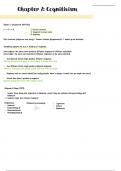
Chapter 7: Cognitivism
Robert S. Woodworth 1869-1962
E —> O —> R E: Present situation
O: Organism’s actual status
R: Response
Past situations (subjective own story) + Present situation (psychometric) => makes up an individual
Variability explains the lack of linearity of responses
Inter-subjects: the same stimuli produces different responses in different individuals
Intra-subejct: the same stimuli produces different responses in the same individual
• Two identical stimuli might produce different responses
Offering a burger to someone in the morning vs during lunch time
• Two different stimuli might produce identical responses
Hearing a funny joke and getting tickled; both can make you laugh
• Response with no stimuli related (not really possible, there is always a stimuli, but you might not notice)
• Stimuli that doesn’t produce a response
Ignoring background noise while reading a book
Seligman & Hager (1972):
• Genetic factor being arre important in behaviour control they are mediators between biology and
behaviour
—> Genetics might also influence response
Dispositions: Influence by increasing • Cognitions
• Genetical • Affects
• Endocrinological • Behaviours
• Neuroanatomical
• Neurophysiological
, Mediation models: levels of processing
• Craik & Lockhart (1972)
• Organism as an active processor of experiences
• Focuses on the depth of processing involved in memory, and predicts the deeper information is
processed, the longer a memory trace will last
We can process information is 3 ways:
1- Shallow Processing:
Structural processing (perceptual): we encode only the physical qualities of something
Is the word written in capital letters?
2- Intermediate Processing:
Phonetic processing: we encode its sound
Does the word rhyme with weight?
3- Deep Processing:
Semantic processing: we encode the meaning of a word and leave it to similar words with similar
meaning
Would the word fit in the sentence: “He met a ___ on the street”?
Behaviour
Personal factors
(Cognitive, affective and Environmental factors
biological events)
Robert S. Woodworth 1869-1962
E —> O —> R E: Present situation
O: Organism’s actual status
R: Response
Past situations (subjective own story) + Present situation (psychometric) => makes up an individual
Variability explains the lack of linearity of responses
Inter-subjects: the same stimuli produces different responses in different individuals
Intra-subejct: the same stimuli produces different responses in the same individual
• Two identical stimuli might produce different responses
Offering a burger to someone in the morning vs during lunch time
• Two different stimuli might produce identical responses
Hearing a funny joke and getting tickled; both can make you laugh
• Response with no stimuli related (not really possible, there is always a stimuli, but you might not notice)
• Stimuli that doesn’t produce a response
Ignoring background noise while reading a book
Seligman & Hager (1972):
• Genetic factor being arre important in behaviour control they are mediators between biology and
behaviour
—> Genetics might also influence response
Dispositions: Influence by increasing • Cognitions
• Genetical • Affects
• Endocrinological • Behaviours
• Neuroanatomical
• Neurophysiological
, Mediation models: levels of processing
• Craik & Lockhart (1972)
• Organism as an active processor of experiences
• Focuses on the depth of processing involved in memory, and predicts the deeper information is
processed, the longer a memory trace will last
We can process information is 3 ways:
1- Shallow Processing:
Structural processing (perceptual): we encode only the physical qualities of something
Is the word written in capital letters?
2- Intermediate Processing:
Phonetic processing: we encode its sound
Does the word rhyme with weight?
3- Deep Processing:
Semantic processing: we encode the meaning of a word and leave it to similar words with similar
meaning
Would the word fit in the sentence: “He met a ___ on the street”?
Behaviour
Personal factors
(Cognitive, affective and Environmental factors
biological events)