NCLEX Archer Fluids, electrolytes, EKGs, labs, nutrition Exam Verified 100%
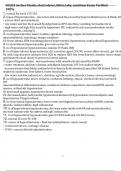
NCLEX Archer Fluids, electrolytes, EKGs, labs, nutrition Exam Verified 100% 1. normal Na level: 135-145 2. types of hypernatremia: - low water and normal Na (caused by hyperventilation, loss of fluids, DI > excess thirst and urination) - low water and low Na (caused by dehydration, NPO, diarrhea, vomiting, burns, diuretics) - high water and high Na (caused by hypertonic IVF, sodium bicarb, increased sodium intake, corticosteroids, cushing's) 3. sx of hypernatremia: neuro: restless, agitation, lethargy, stupor, drowsiness, coma musculoskeletal: twitching, cramps, weakness CV: fever; edema, HTN, bounding pulses if hypervolemic; hypotension, weak pulses if hypovolemic 4. tx of euvolemic hypernatremia: give more water PO 5. tx of hypovolemic hypernatremia: isotonic IV fluids (NS) 6. tx of hypervolemic hypernatremia: d/c causative agent (3% NS, excess aldos- terone), get rid of Na with loop diuretics and give free H20 to replace H2O lost from diuretic, monitor neuro status and titrate Na level slowly to prevent cerebral edema 7. types of hyponatremia: - increased water with same Na level (caused by SIADH > water retention, addison's disease, polydipsia, hypotonic IVF, low sodium intake) - increased water that dilutes sodium level so there is fluid retention (caused by CHF, kidney failure, nephrotic syndrome, liver failure, water intoxication - low water and low sodium (n/v, diarrhea, ng tube suction, diuretics, burns, excess sweating) 8. sx of hyponatremia: neuro: seizures, confusion, lethargy, stupor, cerebral ede- ma, increased ICP musculoskeletal: abdominal cramps, weakness, shallow respirations, decreased DTR, muscle spasms, orthostatic hypotension GI: decreased appetite, hyperactive bowel sounds CV: decreased pulse, tachycardia, hypotension dizziness if hypovolemic; increased pulse and hypertension if hypervolemic 9. tx of euvolemic hyponatremia: lower water and slightly increase sodium with FR, osmotic diuretic, sodium tablets, high sodium diet 10. tx of hypervolemic hypotnatremia: decrease water intake with FR and osmotic diuretics, increase sodium with Na tablets and high sodium diet 11. tx of hypovolemic hyponatremia: give 0.9 NS if mild and 3% NS if severe 12. normal Cl level: 96-108 13. causes of hyperchloremia: - fluid loss (dehydration, vomit, sweat) - corticosteroid use, cushing's disease - IV NS > excess chloride administration 14. sx of hyperchloremia: (same as hypernatremia) neuro: restless, agitation, lethargy, stupor, drowsiness, coma musculoskeletal: twitching, cramps, weakness CV: fever; edema, HTN, bounding pulses if hypervolemic; hypotension, weak pulses if hypovolemic 15. tx of hyperchloremia: - tx underlying cause - bicarb administration - d/c Na-containing meds - give LR instead of NS - monitor electrolyte levels 16. causes of hypochloremia: - vol overload from CHF and water intoxication - salt loss from burns, sweating, n/v, diarrhea, CF, addison's disease 17. sx of hypochloremia: (same as hyponatremia) neuro: seizures, confusion, lethargy, stupor, cerebral edema, increased ICP musculoskeletal: abdominal cramps, weakness, shallow respirations, decreased DTR, muscle spasms, orthostatic hypotension GI: decreased appetite, hyperactive bowel sounds CV: decreased pulse, tachycardia, hypotension dizziness if hypovolemic; increased pulse and hypertension if hypervolemic 18. tx of hypochloremia: - tx underlying cause - give NS - monitor all electrolytes 19. normal K level: 3.5-5 (elevated K is acidic) 20. causes of hyperkalemia: - excess K moves from intracellular to extracellular d/t cell membrane damage (burns, tissue damage, DKA, hypoaldosteronism) - renal failure - excess K intake - ACEs, K sparing diuretics 21. sx of hyperkalemia: - muscle weakness - tall peaked T wave on EKG - heart block, V fib > cardiac arrest - decreased cardiac output d/t decreased contractility - cramping, hyperactive bowels > diarrhea - numbness - shallow respirations - decreased DTR 22. tx of hyperkalemia: move K back into cells - D5W + regular insulin - albuterol - bicarb lower K - kayexelate - thiazide diuretics, furosemide - dialysis monitor cardiac rhythm - d/c K supplements - low K diet (no avocados, beans, salmon, oranges, banana, or dairy) - give IV Ca gluconate if EkG changes are present 23. causes of hypokalemia: - K wasting drugs (kayexalate laxative, diuretics, cor- ticosteroids) - low K intake, anorexia, alcoholism - increased H2O from polydipsia or IVF - decreased fluids (NG suction, vomiting, wound drainage) 24. sx of hypokalemia: - prominent U wave on EKG - weak pulse, ortho hypotension - hypoactive bowel sounds, constipation, distention - decreased DTR - muscle weakness - cramps - flaccid muscles - shallow respirs - increased urine output 25. tx of hypokalemia: - hold digoxin to prevent toxicity - hold K wasting diuretics (furosemide) - give K (IV, oral supplements with food, increased K in diet) - tele 26. normal Ca level: 8.4-10.2 27. what does ca have a direct relationship with: PTH and Vit D 28. what does ca have an indirect relationship with: P 29. causes of hypercalcemia: - increased Ca intake - increased PTH - increased vit D intake - Vit D toxicity - hypophosphatemia - bone cancer (bone breakdown)
Escuela, estudio y materia
- Institución
- NCLEX Archer Fluids, electrolytes, EKGs, labs,
- Grado
- NCLEX Archer Fluids, electrolytes, EKGs, labs,
Información del documento
- Subido en
- 27 de abril de 2024
- Número de páginas
- 10
- Escrito en
- 2023/2024
- Tipo
- Examen
- Contiene
- Preguntas y respuestas
Temas
-
hypernatremia
-
nclex archer fluids electrolytes ekgs labs nut
-
2types of hypernatremia low water and normal
-
musculoskeletal twitching cramps weakness
-
6tx of hypervolemic hypernatremia dc causative

Documento también disponible en un lote