EQUILIBRIUM I
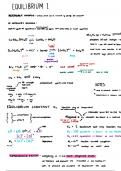
REVERSIBLE CHANGE-process which can be reversed by altering the conditions
LE CHATELIER'S PRINCIPLE :
Isurroundings change)
when a system at
equilibrium is disturbed, the system will correct itself to resture equilibrium
-
shake Q1) (Hy (g) + H20 (g) I
-
CuSOu SH20 . CuSOn + SH20 phosphoric (v) acid catalyst -
re
+
H20
42) 300 % -
over 300 would be faster
( +
heat
molecules seft
[Co(H206]2 Cheat => [CoCh]2
excess steam-more on
+ 41 + + 6H28
cold 60-70 atm-high pressure increas
pink 1 + m0) blue
purple
lequilibrium)
+ a cid Y
equilibrium pushed
Brz H,0 E HOBr + Bri + H
+
acid 1 to
added
left
allavi
+
equilibrium pushed
orange -
>
-
alkali added to the right USES H+ IONS
-
N2 + 3H2 - 2NH3
> Fe catalyst compromised yield/cost/rate
reach
S 200 atm NOTES :
°
450 C
equilibrium ↳
faster rate of forward reaction-r
↳
NH3 + HC -
> NHyCl concentrations of reactants and
(g) (g) (s)
>
-
NHyCl NH3 + HC
(s) (g) (g)
EQUILIBRIUM CONSTANT KC dependant only on temperature
not concentration
[Jz
↳↓ indicates how far to the le
3
concentration
non-interchangeable Magnitude of Ke indicates the extent of a chemical
1) - pressure No n2o
if/SONIDs
REACTANT
X
MR Kc = 1 equilibrium half way between rea
~
aA + bB = C + dD Kc = 100 equilibrium in favour of the produc
[C]" x [D]a temperature Uc = 0 . 01 equilibrium in favour of the reacta
xc = [A]" x [BJb dependent .
Kc = 1010 reaction reached completion
mol du Uc =
10-10 takel
reaction not place
HOMOGENEOUS SYSTEM -
everything is in the same physical state
all reactants and products are included in the expression
conc of products and reactionts at equilibrium are used
REVERSIBLE CHANGE-process which can be reversed by altering the conditions
LE CHATELIER'S PRINCIPLE :
Isurroundings change)
when a system at
equilibrium is disturbed, the system will correct itself to resture equilibrium
-
shake Q1) (Hy (g) + H20 (g) I
-
CuSOu SH20 . CuSOn + SH20 phosphoric (v) acid catalyst -
re
+
H20
42) 300 % -
over 300 would be faster
( +
heat
molecules seft
[Co(H206]2 Cheat => [CoCh]2
excess steam-more on
+ 41 + + 6H28
cold 60-70 atm-high pressure increas
pink 1 + m0) blue
purple
lequilibrium)
+ a cid Y
equilibrium pushed
Brz H,0 E HOBr + Bri + H
+
acid 1 to
added
left
allavi
+
equilibrium pushed
orange -
>
-
alkali added to the right USES H+ IONS
-
N2 + 3H2 - 2NH3
> Fe catalyst compromised yield/cost/rate
reach
S 200 atm NOTES :
°
450 C
equilibrium ↳
faster rate of forward reaction-r
↳
NH3 + HC -
> NHyCl concentrations of reactants and
(g) (g) (s)
>
-
NHyCl NH3 + HC
(s) (g) (g)
EQUILIBRIUM CONSTANT KC dependant only on temperature
not concentration
[Jz
↳↓ indicates how far to the le
3
concentration
non-interchangeable Magnitude of Ke indicates the extent of a chemical
1) - pressure No n2o
if/SONIDs
REACTANT
X
MR Kc = 1 equilibrium half way between rea
~
aA + bB = C + dD Kc = 100 equilibrium in favour of the produc
[C]" x [D]a temperature Uc = 0 . 01 equilibrium in favour of the reacta
xc = [A]" x [BJb dependent .
Kc = 1010 reaction reached completion
mol du Uc =
10-10 takel
reaction not place
HOMOGENEOUS SYSTEM -
everything is in the same physical state
all reactants and products are included in the expression
conc of products and reactionts at equilibrium are used