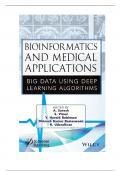
"The main topics addressed in this book are big data analytics problems in bioinformatics research such as microarray data analysis, sequence analysis, genomics-based analytics, disease network analysis, techniques for big data analytics, and health information technology.
Bioinformatics and Medic...
,Table of Contents
1. Cover
2. Title Page
3. Copyright
4. Preface
5. 1 Probabilistic Optimization of Machine Learning Algorithms for Heart Disease Prediction
1. 1.1 Introduction
2. 1.2 Literature Review
3. 1.3 Tools and Techniques
4. 1.4 Proposed Method
5. 1.5 Conclusion
6. References
6. 2 Cancerous Cells Detection in Lung Organs of Human Body: IoT-Based Healthcare 4.0
Approach
1. 2.1 Introduction
2. 2.2 Literature Review
3. 2.3 Proposed Systems
4. 2.4 Experimental Results and Analysis
5. 2.5 Novelties
6. 2.6 Future Scope, Limitations, and Possible Applications
7. 2.7 Recommendations and Consideration
8. 2.8 Conclusions
9. References
7. 3 Computational Predictors of the Predominant Protein Function: SARS-CoV-2 Case
1. 3.1 Introduction
2. 3.2 Human Coronavirus Types
3. 3.3 The SARS-CoV-2 Pandemic Impact
4. 3.4 Computational Predictors
5. 3.6 Future Implications
6. 3.7 Acknowledgments
7. References
8. 4 Deep Learning in Gait Abnormality Detection: Principles and Illustrations
1. 4.1 Introduction
2. 4.2 Background
3. 4.3 Related Works
4. 4.4 Methods
5. 4.5 Conclusion and Future Work
6. 4.6 Acknowledgments
7. References
9. 5 Broad Applications of Network Embeddings in Computational Biology, Genomics,
Medicine, and Health
1. 5.1 Introduction
2. 5.2 Types of Biological Networks
3. 5.3 Methodologies in Network Embedding
4. 5.4 Attributed and Non-Attributed Network Embedding
, 5. 5.5 Applications of Network Embedding in Computational Biology
6. 5.6 Limitations of Network Embedding in Biology
7. 5.7 Conclusion and Outlook
8. References
10. 6 Heart Disease Classification Using Regional Wall Thickness by Ensemble Classifier
1. 6.1 Introduction
2. 6.2 Related Study
3. 6.3 Methodology
4. 6.4 Implementation and Result Analysis
5. 6.5 Conclusion
6. References
11. 7 Deep Learning for Medical Informatics and Public Health
1. 7.1 Introduction
2. 7.2 Deep Learning Techniques in Medical Informatics and Public Health
3. 7.3 Applications of Deep Learning in Medical Informatics and Public Health
4. 7.4 Open Issues Concerning DL in Medical Informatics and Public Health
5. 7.5 Conclusion
6. References
12. 8 An Insight Into Human Pose Estimation and Its Applications
1. 8.1 Foundations of Human Pose Estimation
2. 8.2 Challenges to Human Pose Estimation
3. 8.3 Analyzing the Dimensions
4. 8.4 Standard Datasets for Human Pose Estimation
5. 8.5 Deep Learning Revolutionizing Pose Estimation
6. 8.6 Application of Human Pose Estimation in Medical Domains
7. 8.7 Conclusion
8. References
13. 9 Brain Tumor Analysis Using Deep Learning: Sensor and IoT-Based Approach for
Futuristic Healthcare
1. 9.1 Introduction
2. 9.2 Literature Survey
3. 9.3 System Design and Methodology
4. 9.4 Novelty in Our Work
5. 9.5 Future Scope, Possible Applications, and Limitations
6. 9.6 Recommendations and Consideration
7. 9.7 Conclusions
8. References
14. 10 Study of Emission From Medicinal Woods to Curb Threats of Pollution and Diseases:
Global Healthcare Paradigm Shift in 21st Century
1. 10.1 Introduction
2. 10.2 Literature Survey
3. 10.3 The Methodology and Protocols Followed
4. 10.4 Experimental Setup of an Experiment
5. 10.5 Results and Discussions
15. 11 An Economical Machine Learning Approach for Anomaly Detection in IoT
Environment
, 1. 11.1 Introduction
2. 11.2 Literature Survey
3. 11.3 Proposed Work
4. 11.4 Analysis of the Work
5. 11.5 Conclusion
6. References
16. 12 Indian Science of Yajna and Mantra to Cure Different Diseases: An Analysis Amidst
Pandemic With a Simulated Approach
1. 12.1 Introduction
2. 12.2 Literature Survey
3. 12.3 Methodology
4. 12.4 Results and Discussion
5. 12.5 Interpretations and Analysis
6. 12.6 Novelty in Our Work
7. 12.7 Recommendations
8. 12.8 Future Scope and Possible Applications
9. 12.9 Limitations
10. 12.10 Conclusions
11. 12.11 Acknowledgments
12. References
17. 13 Collection and Analysis of Big Data From Emerging Technologies in Healthcare
1. 13.1 Introduction
2. 13.2 Data Collection
3. 13.3 Data Analysis
4. 13.4 Research Trends
5. 13.5 Conclusion
6. References
18. 14 A Complete Overview of Sign Language Recognition and Translation Systems
1. 14.1 Introduction
2. 14.2 Sign Language Recognition
3. 14.3 Dataset Creation
4. 14.4 Hardware Employed for Sign Language Recognition
5. 14.5 Computer Vision–Based Sign Language Recognition and Translation Systems
6. 14.6 Sign Language Translation System—A Brief Overview
7. 14.7 Conclusion
8. References
19. Index
20. End User License Agreement
List of Illustrations
1. Chapter 1
1. Figure 1.1 Heatmap of input attributes.
2. Figure 1.2 Age distribution.
3. Figure 1.3 Presence of cardiovascular disease.
4. Figure 1.4 Cholesterol type distribution.
Los beneficios de comprar resúmenes en Stuvia estan en línea:
Garantiza la calidad de los comentarios
Compradores de Stuvia evaluaron más de 700.000 resúmenes. Así estas seguro que compras los mejores documentos!
Compra fácil y rápido
Puedes pagar rápidamente y en una vez con iDeal, tarjeta de crédito o con tu crédito de Stuvia. Sin tener que hacerte miembro.
Enfócate en lo más importante
Tus compañeros escriben los resúmenes. Por eso tienes la seguridad que tienes un resumen actual y confiable.
Así llegas a la conclusión rapidamente!
Preguntas frecuentes
What do I get when I buy this document?
You get a PDF, available immediately after your purchase. The purchased document is accessible anytime, anywhere and indefinitely through your profile.
100% de satisfacción garantizada: ¿Cómo funciona?
Nuestra garantía de satisfacción le asegura que siempre encontrará un documento de estudio a tu medida. Tu rellenas un formulario y nuestro equipo de atención al cliente se encarga del resto.
Who am I buying this summary from?
Stuvia is a marketplace, so you are not buying this document from us, but from seller RobertCuong. Stuvia facilitates payment to the seller.
Will I be stuck with a subscription?
No, you only buy this summary for 4,91 €. You're not tied to anything after your purchase.