lOMoARcPSD|193 393 05
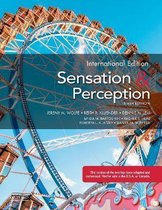
Summary Sensation and Perception Chapter
1-15
Utrecht University – Cognitie Minor
,lOMoARcPSD|193 393 05
, lOMoARcPSD|193 393 05
Chapter 1: Introduction
Sensation and perception
- Sensation: the ability to detect a stimulus and, perhaps, to turn that detection into a private
experience
- Perception: the act of giving meaning to a detected sensation
- Condillac: mental life relies on information from our senses
Methods used in the study of the senses
- Thresholds
- Scaling: measuring private experience
o Quale: in philosophy, a private conscious experience of sensation or perception
- Signal detection theory – measuring difficult decisions
- Sensory neuroscience
- Neuroimaging – an image of the mind
Thresholds and the dawn of psychophysics
- Dualism: the idea that the mind has an existence separate from the material world of the
body
- Materialism: the idea that the only thing that exists is matter, and that all things, including
the mind and consciousness, are the results of interactions between bits of matter
- Panpsychism: the idea that the mind exist as a property of all matter, that is, that all matter
has consciousness (Fechner)
- Psychophysics: the science of defining quantitative relationships between physical and
psychological (subjective) events (Fechner)
- Two-point touch threshold: the minimum distance at which two stimuli are just perceptible
as separate (Weber)
- Just noticeable difference/ difference threshold: the smallest detectable difference between
two stimuli, or the minimum change in a stimulus that enables it to be correctly judged as
different from a reference stimulus (Weber)
- Weber’s law: the principle describing the relationship between stimulus and resulting
sensation that says the JND is a constant fraction of the comparison stimulus (e.g. 1:100 for
length, 1:40 for weight)
o Clear objective measurement, we know how much the stimulus varied and the
observer can either tell that it changed or not
- Fechner’s law: a principle describing the relationship between stimulus and resulting
sensation that says the magnitude of subjective sensation(S) increases proportionally to the
logarithm of the stimulus intensity(R) (S = k log R)
o Describes the relationship between mind and matter
o The smallest detectable change in a stimulus can be considered as a unit of the mind,
because this is the smallest bit of change that is perceived
o Assumes that all JNDs are perceptually equivalent, which turns out to be incorrect
- Absolute threshold: the min amount of a stimulation necessary for a person to detect a
stimulus 50% of the time
, lOMoARcPSD|193 393 05
o Detected 50% of the time due to the variability in the nervous system, stimuli near
the threshold will be detected sometimes and missed other times there is no hard
boundary
Psychophysical methods
- Method of constant stimuli: a psychophysical method in which many stimuli ranging from
rarely to almost always perceivable, are presented one at a time and participants respond to
each presentation: yes/no or same/different
- Method of limits: a psychophysical method in which the particular dimension of a stimulus,
or the difference between two stimuli, is varied incrementally until the participant responds
differently
o Tones are presented in increasing or decreasing intensity; increasing: report when
you first hear the tone; decreasing: report when the tone is no longer heard. The
threshold is set at the average of the crossover points
- Method of adjustment: a method of limits in which the participant controls the change in the
stimulus
Scaling methods and supertasters
- Magnitude estimation: a psychophysical method in which the participant assigns values
according to perceived magnitudes of the stimuli
o Steven’s power law: a principle describing the relationship between stimulus and
resulting sensation that says the magnitude of subjective sensation(S) is proportional
to the stimulus magnitude(I) raised to an exponent(b) ( S = aIb )
Measures subjective ratings, and we can check whether these are reasonable
and consistent but there is no way of knowing whether they are objectively
right or wrong
- Cross-modality matching: the ability to match the intensities of sensations that come from
different sensory modalities. This ability enables insight into sensory differences. For
example, a listener might adjust the brightness of a light until it matches the loudness of a
tone, the relationship between modalities appears to be similar across individuals
Signal detection theory
- Signal detection theory: a psychophysical theory that quantifies the response of an observer
to the presentation of a signal in the presence of noise (internal noise, the static in your
nervous system). Measures obtained from a series of presentations are sensitivity (d’) and
criterion of the observer
o Criterion: an internal threshold set by the observer. If the internal response is above
the criterion, the observer gives one response (yes) and below the criterion the
observer gives another response (no)
Correct rejection, hit, false alarm, miss
o Sensitivity: a value that defines the ease with which an observer can tell the
difference between the presence and absence of a stimulus or the difference
between stimulus 1 and stimulus 2 (d’ or d-prime)
Summary Sensation and Perception Chapter
1-15
Utrecht University – Cognitie Minor
,lOMoARcPSD|193 393 05
, lOMoARcPSD|193 393 05
Chapter 1: Introduction
Sensation and perception
- Sensation: the ability to detect a stimulus and, perhaps, to turn that detection into a private
experience
- Perception: the act of giving meaning to a detected sensation
- Condillac: mental life relies on information from our senses
Methods used in the study of the senses
- Thresholds
- Scaling: measuring private experience
o Quale: in philosophy, a private conscious experience of sensation or perception
- Signal detection theory – measuring difficult decisions
- Sensory neuroscience
- Neuroimaging – an image of the mind
Thresholds and the dawn of psychophysics
- Dualism: the idea that the mind has an existence separate from the material world of the
body
- Materialism: the idea that the only thing that exists is matter, and that all things, including
the mind and consciousness, are the results of interactions between bits of matter
- Panpsychism: the idea that the mind exist as a property of all matter, that is, that all matter
has consciousness (Fechner)
- Psychophysics: the science of defining quantitative relationships between physical and
psychological (subjective) events (Fechner)
- Two-point touch threshold: the minimum distance at which two stimuli are just perceptible
as separate (Weber)
- Just noticeable difference/ difference threshold: the smallest detectable difference between
two stimuli, or the minimum change in a stimulus that enables it to be correctly judged as
different from a reference stimulus (Weber)
- Weber’s law: the principle describing the relationship between stimulus and resulting
sensation that says the JND is a constant fraction of the comparison stimulus (e.g. 1:100 for
length, 1:40 for weight)
o Clear objective measurement, we know how much the stimulus varied and the
observer can either tell that it changed or not
- Fechner’s law: a principle describing the relationship between stimulus and resulting
sensation that says the magnitude of subjective sensation(S) increases proportionally to the
logarithm of the stimulus intensity(R) (S = k log R)
o Describes the relationship between mind and matter
o The smallest detectable change in a stimulus can be considered as a unit of the mind,
because this is the smallest bit of change that is perceived
o Assumes that all JNDs are perceptually equivalent, which turns out to be incorrect
- Absolute threshold: the min amount of a stimulation necessary for a person to detect a
stimulus 50% of the time
, lOMoARcPSD|193 393 05
o Detected 50% of the time due to the variability in the nervous system, stimuli near
the threshold will be detected sometimes and missed other times there is no hard
boundary
Psychophysical methods
- Method of constant stimuli: a psychophysical method in which many stimuli ranging from
rarely to almost always perceivable, are presented one at a time and participants respond to
each presentation: yes/no or same/different
- Method of limits: a psychophysical method in which the particular dimension of a stimulus,
or the difference between two stimuli, is varied incrementally until the participant responds
differently
o Tones are presented in increasing or decreasing intensity; increasing: report when
you first hear the tone; decreasing: report when the tone is no longer heard. The
threshold is set at the average of the crossover points
- Method of adjustment: a method of limits in which the participant controls the change in the
stimulus
Scaling methods and supertasters
- Magnitude estimation: a psychophysical method in which the participant assigns values
according to perceived magnitudes of the stimuli
o Steven’s power law: a principle describing the relationship between stimulus and
resulting sensation that says the magnitude of subjective sensation(S) is proportional
to the stimulus magnitude(I) raised to an exponent(b) ( S = aIb )
Measures subjective ratings, and we can check whether these are reasonable
and consistent but there is no way of knowing whether they are objectively
right or wrong
- Cross-modality matching: the ability to match the intensities of sensations that come from
different sensory modalities. This ability enables insight into sensory differences. For
example, a listener might adjust the brightness of a light until it matches the loudness of a
tone, the relationship between modalities appears to be similar across individuals
Signal detection theory
- Signal detection theory: a psychophysical theory that quantifies the response of an observer
to the presentation of a signal in the presence of noise (internal noise, the static in your
nervous system). Measures obtained from a series of presentations are sensitivity (d’) and
criterion of the observer
o Criterion: an internal threshold set by the observer. If the internal response is above
the criterion, the observer gives one response (yes) and below the criterion the
observer gives another response (no)
Correct rejection, hit, false alarm, miss
o Sensitivity: a value that defines the ease with which an observer can tell the
difference between the presence and absence of a stimulus or the difference
between stimulus 1 and stimulus 2 (d’ or d-prime)