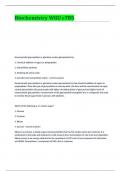
Biochemistry WGU c785 with correct answers
Biochemistry WGU c785 Nonenzymatic glycosylation or glycation creates glycoproteins by: 1. Chemical addition of sugars to polypeptides 2. Extracellular synthesis 3. Attaching 20 amino acids 4. Secretion into extracellular matrix - correct answer1 Nonenzymatic glycosylation or glycation creates glycoproteins by the chemical addition of sugars to polypeptides. Since this type of glycosylation is nonenzymatic, the time and the concentration of sugar control glycosylation. Because people with higher circulating levels of glucose have higher levels of nonenzymatic glycosylation, measurement of the glycosylated hemoglobin A1c is a diagnostic test used to monitor blood sugar levels in persons with diabetes. Which of the following is a 5-carbon sugar? 1. Glucose 2. Fructose 3. Ribose 4. Sucrose - correct answer3 Ribose is a pentose, a simple sugar (monosaccharide) that has five carbon atoms per molecule. It is synthesized in the body and obtained in small amounts from consumption of ripe fruits and vegetables. Ribose serves as an energy substrate for the resynthesis of ATP and is a key component of ribonucleic acid (RNA). Deoxyribose, a component of DNA, also is a pentose. The optimum pH of pepsin is: 1. 5 2. 7.1 3. 8.1 4. 2 - correct answer4 The optimum pH for enzymes varies for different enzymes and even enzymes with similar actions may have different optimal pH based on where they act. For example, trypsin, a digestive enzyme that acts in the small intestine has an optimal pH of 8 while pepsin, which acts in the more acidic milieu of the stomach, has an optimal pH of 2. A catabolic enzyme: 1. Joins two or more substances into a larger molecule 2. Cleaves a molecule into two or more parts 3. Inserts a substance between two or more existing molecules 4. Acts as a chemical messenger between amino cells - correct answer2 A catabolic enzyme engages in destructive metabolism, which involves degrading or breaking down complex molecules into simpler ones with the resulting release of energy. In the body, the breakdown of food in the gastrointestinal tract by a variety of digestive enzymes is an example of a catabolic process. The opposite of catabolism is anabolism. An anabolic enzyme: 1. Cleaves a molecule into two or more parts 2. Inserts a substance between two or more existing molecules 3. Joins two or more substances into a larger molecule 4. Acts as a chemical messenger between amino cells - correct answer3 Anabolism is the opposite of catabolism and is a set of metabolic pathways that serve to create, construct, or synthesize larger molecules from smaller ones, such as the synthesis of carbohydrates, proteins and fatty acids. Anabolic processes consume or require energy rather than releasing energy. Examples of anabolic processes include gluconeogenesis, glyoxylate cycle, and glycosylation. An allosteric enzyme has which of the following properties? 1. It can only operate in an acidic environment, 2. It can only operate in an alkaline environment, 3. It becomes active only when it binds with a specific cofactor, 4. It can function either as a catabolic or anabolic enzyme. - correct answer3 Allosteric enzymes change their configurations when they bind with cofactors. Their catalytic activity is altered - either enhanced or reduced - by binding of specific ligands at sites other than the substrate-binding site. When catalytic activity of the enzyme is enhanced, the effector is termed an activator; when it is diminished or eliminated, it is called a deactivator or inhibitor. A proteolytic enzyme has the following action: 1. It cleaves complex sugars into simple sugars. 2. It joins fatty acids into proteins. 3. It joins proteins to sugars to form glycoproteins. It cleaves protein molecules into smaller units - correct answer4 Proteolytic enzymes, also known as proteases, catalyze the splitting or breakdown of proteins into smaller peptide fractions and amino acids. The process of accomplishing this breakdown is called proteolysis. Peptidases are a subgroup of proteases that that catalyze the hydrolysis of peptide linkages; they are present in plants and yeast and in the body. In the body, they are involved in digestion. Amylase has all of the following properties except: 1. It breaks down starches into sugars. 2. It cleaves proteins into amino acids. 3. It is a component of human saliva. 4. High serum levels may indicate pancreatic inflammation. - correct answer2 Amylase is the class of enzymes involved in the breakdown and digestion of starches - complex carbohydrates - into simple sugars to supply energy. Amylases are glycoside hydrolases and act on ?-1,4-glycosidic bonds. Plants and some bacteria make amylases. In the body, they are present in saliva and are produced by salivary glands and the pancreas. The function of a protein is determined primarily by: 1. Its molecular weight 2. The number of amino acids it contains 3. Its spatial conformation 4. Its affinity for hydrocarbons - correct answer3 The stable three-dimensional shape and orientation of a protein (its unique folds, termed its native configuration) determine its function and chemical reactivity. Proteins are composed of series of as many as twenty different L-?-amino acids. Proteins are distinguished by their configurations into three broad classes - globular proteins, fibrous proteins, and membrane proteins. . Which of the following is not involved in the biosynthesis of a protein molecule? 1. Codon 2. Ribosome 3. Messenger RNA 4. Amylase - correct answer4 The biosynthesis of a protein molecule uses information encoded in genes. The amino acid sequence of the protein is delineated by the nucleotide sequence of the gene that encodes the protein. Codons, sequences of three adjacent nucleotides along a DNA or messenger RNA molecule, designate the specific amino acid to be incorporated into a polypeptide.
Escuela, estudio y materia
- Institución
- WGU
- Grado
- WGU
Información del documento
- Subido en
- 2 de agosto de 2023
- Número de páginas
- 4
- Escrito en
- 2023/2024
- Tipo
- Examen
- Contiene
- Preguntas y respuestas
Temas
-
biochemistry wgu c785 with correct answers 2023

Documento también disponible en un lote