BBH 315 Exam 2 Questions With Complete Solutions
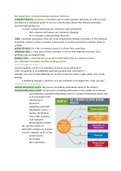
Adolescence correct answer: -GRADUAL period of transition from childhood to adulthood -Process of "soft" events rather than discrete events -Difficult to characterize precise onset and offset Puberty correct answer: -Attainment of sexual maturation -Just one of many adolescent transitions (initial puberty and late puberty) -Onset of the BIOLOGICAL CHANGES associated with adolescence in humans that often signals onset of adolescence, although timing varies among human adolescents Critical Periods correct answer: a time in the lifespan when it is MORE sensitive to environmental influences or stimulation than at other times during its life; begins and ends abruptly Sensitive Periods correct answer: *begins and ends gradually, period of maximal sensitivity* Time or stage in a person's development when they are more responsive to certain stimuli and quicker to learn particular skills Plasticity correct answer: adaptability of an organism to change in its environment, ability for the brain to change over time, bounce back Changes in prefrontal cortex prior to puberty correct answer: -Prefrontal cortex grows just before puberty -a prepubescent child's brain overproduces synapses, similar to occurrence seen in babies -the brain overproduces and then begins to cut back in order to strengthen brain and consolidate learning -As prefrontal cortex matures, organization, memory and then last develops more impulse control, and make more informed decisions What prefrontal cortex controls/modulates and what order different parts mature in correct answer: The role of the prefrontal cortex is that it controls planning, working memory, organization, and modulates mood --parts of the sensory processing mature first and impulse control & planning develop last --as prefrontal matures, people reason better, develop more impulse control, and make more informed decisions "Pruning" related to synapses—what's pruned, how, why correct answer: Baby's brain overproduces synapses, AND so does the child's in pre-puberty (age 11 in girl and age 12 in boys) At both times, brain overproduces during pre-puberty and then begins to cut back (prune) in order to strengthen brain and consolidate learning (1) sensory processing matures (2) impulsive control and planning matures LAST Brain differences between adolescents and adults in sensation-seeking and risk-taking correct answer: Compared to adults, adolescents have: -higher levels of reward and sensation seeking, peer interactions, and risk-taking, due to *hyperactive limbic systems* (pleasure seeking) -less sensitivity to unpleasant stimuli and different responses to cues and contexts associated with stimuli -greater emotional variability -sensitivity to positive rewards peak in adolescence When brains become fully mature correct answer: -The part of the brain (prefrontal cortex) responsible for impulse control matures LAST in adolescents and young adults -Brains grows to maturity in early 20's -MALE brains mature later than females Key ability changes in adolescence correct answer: -Understand abstract ideas (math) and develop sense of morality, rights, responsibilities, and privileges -Establish and maintain relationships by learning to share intimacy without worry or inhibition -Move toward mature sense of self -Question old values without losing identity -Use speech to express one's self (express what thoughts are happening in the head and why) -Development of children 12-18 includes predictable and mental changes as well Physical changes in adolescence- boys correct answer: -Testicles/scrotum grow as early as 9 -Penis begins to lengthen -Voice changes -Nocturnal emissions marks beginning of puberty -Typically ages 13-17, *average=14.5*, coincide with height sprout Physical and mental changes in adolescence- girls correct answer: -Breast buds develop as early as 9, breasts fully develop 12-18 -Pubic, armpit, and leg hair begin to grow age 9-10, reach adult patterns 13-14 -Menarche begins 2 years after early breast and pubic hair appear -As early as 10, as late as 15, *average=12.5*, height spurt 9.5-14.5, peaking around 12 Mental changes in adolescence- boys and girls correct answer: -Behavior: physical changes lead to worries about body changes especially difficult without proper health education separate from parents peers become more important -Separate: feelings of strength, independence, limited future orientation and need for peer approval may lead to risk-taking -Sexuality: increase interest in sexual topics (not necessarily sexual activity) establish own sexual identity experiment with expression and receiving sexual advances -Power struggles with parents: establish need for independence Key points from Pipher (1994): Spear (2011) correct answer: *suggests that risk-taking has both negative consequences and positive benefits* -early risk-taking or sensation-seeking may be quite adaptive by giving teens and young adults practice in evaluating risks and their consequences which may help to increase their self-confidence in decision-making around uncertain situations down the road. -argues that adolescents are different from adults in many ways. -tend to look at stimuli that are rewarding and not-so-rewarding very differently than adults, in part because their brains are structured differently. Adolescents have heightened sensitivity to rewards, and particularly strong rewards, so that they are more likely than adults to go after those rewards and sensations, and take more risks to do so. -This is largely a function of their pleasure-seeking brain regions—the limbic systems—that are more active in adolescence than in adulthood. -argued that adolescents are more emotionally volatile than adults. Their emotionality and greater reward-seeking can lead to greater risk-taking of all sorts. The thrill of the risk-taking may be enhanced by the presence of peers lowered levels of "sober second thought" associated with the prefrontal cortex, leading teens to downplay potentially negative consequences related to that risk-taking. -Those differences may have been quite adaptive earlier in human history, when it was needed for survival (e.g., water, food, sexual reproduction), but perhaps less so in modern times. how differences in adolescent brains may relate to risk-taking correct answer: Risky behaviors in adolescents may be due in part to immature frontal cortex... -Mortality rates jump between early & late adolescents -Crime rates in general highest in younger males -May be over simplification though: risky behaviors in adolescence aren't necessarily universal -Behaviors shaped by genes, childhood experiences, environmental factors and brain changes Definition and purpose of myelination correct answer: -Myelin is natural fat insulation that grows outside brain cells -Finding ways to insulate neurons to let them connect better across parts of the brain -Takes years to build and insulate connections between brain domains -Last place to be fully myelinated, connected, is prefrontal and frontal cortex (ex of pruning) How addiction and effects of substances differ in adolescent vs adult brain correct answer: -Addiction is form of learning: Occurs in reward-seeking part of the brain aka limbic system Repeated exposure results in stronger and longer addiction More "efficient" in teen brain -Effects of substances on the brain: Impairs learning because of sedative effect More toxic in teens than adults More permanent in teens than adults How drinking effects adolescent brains correct answer: Drinking risks may be more problematic in adolescence and young adulthood -Brain and liver effects -Growth and endocrine effects Impairs learning due to sedative effect -More toxic in teens than adults
Escuela, estudio y materia
- Institución
- Pennsylvania State University - All Campuses
- Grado
- BBH 315
Información del documento
- Subido en
- 20 de septiembre de 2023
- Número de páginas
- 38
- Escrito en
- 2023/2024
- Tipo
- Examen
- Contiene
- Preguntas y respuestas
Temas
-
bbh 315 exam 2
-
adolescence
-
sensitive periods
-
plasticity
-
bbh 315 exam 2 questions with complete solutions
-
changes in prefrontal cortex prior to puberty
-
what prefrontal cortex controlsmodulates and what

Documento también disponible en un lote