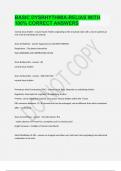
BASIC DYSRHYTHMIA-RELIAS WITH 100% CORRECT ANSWERS.
normal sinus rhythm heart rhythm originating in the sinoatrial node with a rate in patients at rest of 60 to 100 beats per minute Sinus Arrhythmia Appearance is ALMOST NORMAL: Respiratory - Circulatory interaction Rate INCREASES with INSPIRATION (IN=IN) Brainpower Read More Previous Play Next Rewind 10 seconds Move forward 10 seconds Unmute 0:00 / 0:00 Full screen Sinus Bradycardia <60 normal sinus rhythm Sinus Tachycardia >100 (100-150) normal sinus rhythm Premature Atrial Contraction (PAC) Heart Rate: Depends on underlying rhythm Regularity: Interrupts the regularity of underlying rhythm P-Wave: can be flattened, notched, or unusual. May be hidden within the T wave PRI: measures between .12-.20 seconds and can be prolonged; can be different from other complexes QRS: <.12 seconds Sinus Arrest/Pause - SA node doesn't fire - notice absence of P-wave for a complete cycle (a missed cycle) length of pause ≠ multiple of normal rate (block) Atrial Fibrillation (A-Fib) an irregular and often very fast heart rate originating from abnormal conduction in the atria Atrial Flutter irregular beating of the atria; often described as "a-flutter with 2 to 1 block or 3 to 1 block" Junctional Rhythm 40-60 Regular! -impulse from AV node w/ retro/antegrade transmission - P wave often inverted/buried/follow QRS - slow rate - narrow QRS (not wide like ventricular) Junctional Tachycardia >60 bpm (ms. K; 150-250) - KEY: will be regular (consistent) - AV junction produces a rapid sequence of QRS-T cycles - p-wave often inverted/buried/follow QRS Premature Junctional Contraction Inverted p wave or hidden p wave PRI<0.12 or none Normal QRS Supraventricular Tachycardia (SVT) an abnormal heart rhythm arising from aberrant electrical activity in the heart; originates at or above the AV node First degree heart block atrioventricular (AV) block in which the atrial electrical impulses are delayed by a fraction of a second before being conducted to the ventricles 2nd degree heart block type 1 (Wenkebach) Progressively longer PR interval until the P wave is not followed by a QPR 2nd Degree Heart Block (Mobitz II) Rare, but more serious Sudden appearance of a nonconducted P-wave P-waves are nl, but some aren't followed by a QRS complex PR & RR intervals are constant 3rd degree heart block no obvious correlation between p and qrs, need pace maker premature ventricular contraction (PVC) a ventricular contraction preceding the normal impulse initiated by the SA node (pacemaker) Bigeminy PVC every other beat is a PVC PVC couplets PVC occurring in pairs, no adequate C.O. when this occurs monomorphic ventricular tachycardia presents with wide QRS complexes of a common shape. Torsades de pointes Rate: 120 - 200 usually P wave: Obscured by ventricular waves QRS: Wide QRS - "Twisting of the Points" Conduction: Ventricular only Rhythm: Slightly irregular Ventricular fibrillation (V-fib) abnormal heart rhythm which results in quivering of ventricles Idioventricular Rhythm <40 looks like vtach but slow - no P waves (from vent foci) - Wide QRS (serious, death like rhythm) - called "dying heart" rhythm...occasional ventric beat b4 death (asystole) Accelerated Idioventricular Rhythm Rate: 50 - 100 usually (usually slow) P wave: Obscured by ventricular waves (occur during ventricular contraction) - SA node slower than faster ventricular pacing than should be QRS: Wide QRS Conduction: Ventricular only Rhythm: Regular - benign rhythm that is sometimes seen during acute MI or early after
Escuela, estudio y materia
- Institución
- ECG Rhythm Recognition relias
- Grado
- ECG Rhythm Recognition relias
Información del documento
- Subido en
- 29 de diciembre de 2023
- Número de páginas
- 4
- Escrito en
- 2023/2024
- Tipo
- Examen
- Contiene
- Desconocido
Temas
-
basic dysrhythmia relias

Documento también disponible en un lote