Name: Score:
6 Multiple choice questions
Term 1 of 6
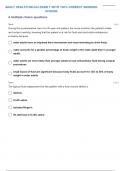
During the postoperative care of a 76-year-old patient, the nurse monitors the patient's intake
and output carefully, knowing that the patient is at risk for fluid and electrolyte imbalances
primarily because
older adults have an impaired thirst mechanism and need reminding to drink fluids.
water accounts for a greater percentage of body weight in the older adult than in younger
adults.
older adults are more likely than younger adults to lose extracellular fluid during surgical
procedures.
small losses of fluid are significant because body fluids account for 45% to 50% of body
weight in older adults.
Term 2 of 6
The typical fluid replacement for the patient with a fluid volume deficit is
dextran.
0.45% saline.
lactated Ringer's.
5% dextrose in 0.45% saline.
, Term 3 of 6
It is important for the nurse to assess for which clinical manifestation(s) in a patient who has just
undergone a total thyroidectomy (select all that apply)?
a. Confusion
b. Weight gain
c. Depressed reflexes
d. Circumoral numbness
e. Positive Chvostek's sign
d. small losses of fluid are significant because body fluids account for 45% to 50% of body
weight in older adults.
a. Confusion
d. Circumoral numbness
e. Positive Chvostek's sign
d. instruct the patient to change positions, raise arm, and cough.
d. respiratory alkalosis.
Term 4 of 6
The lungs act as an acid-base buffer by
increasing respiratory rate and depth when CO2 levels in the blood are high, reducing
acid load.
increasing respiratory rate and depth when CO2 levels in the blood are low, reducing base
load.
decreasing respiratory rate and depth when CO2 levels in the blood are high, reducing
acid load.
decreasing respiratory rate and depth when CO2 levels in the blood are low, increasing
acid load.
6 Multiple choice questions
Term 1 of 6
During the postoperative care of a 76-year-old patient, the nurse monitors the patient's intake
and output carefully, knowing that the patient is at risk for fluid and electrolyte imbalances
primarily because
older adults have an impaired thirst mechanism and need reminding to drink fluids.
water accounts for a greater percentage of body weight in the older adult than in younger
adults.
older adults are more likely than younger adults to lose extracellular fluid during surgical
procedures.
small losses of fluid are significant because body fluids account for 45% to 50% of body
weight in older adults.
Term 2 of 6
The typical fluid replacement for the patient with a fluid volume deficit is
dextran.
0.45% saline.
lactated Ringer's.
5% dextrose in 0.45% saline.
, Term 3 of 6
It is important for the nurse to assess for which clinical manifestation(s) in a patient who has just
undergone a total thyroidectomy (select all that apply)?
a. Confusion
b. Weight gain
c. Depressed reflexes
d. Circumoral numbness
e. Positive Chvostek's sign
d. small losses of fluid are significant because body fluids account for 45% to 50% of body
weight in older adults.
a. Confusion
d. Circumoral numbness
e. Positive Chvostek's sign
d. instruct the patient to change positions, raise arm, and cough.
d. respiratory alkalosis.
Term 4 of 6
The lungs act as an acid-base buffer by
increasing respiratory rate and depth when CO2 levels in the blood are high, reducing
acid load.
increasing respiratory rate and depth when CO2 levels in the blood are low, reducing base
load.
decreasing respiratory rate and depth when CO2 levels in the blood are high, reducing
acid load.
decreasing respiratory rate and depth when CO2 levels in the blood are low, increasing
acid load.