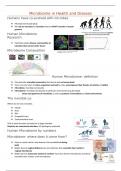
Microbiome in Health and Disease
Humans have co-evolved with microbes
Microbes live in and on us
We rely on microbes for functions that we DON’T encode in human
genome
Human Microbiome
Research
Field that studies diverse communities of
microbes that call our body ‘home’
Microbiome Composition
Human Microbiome- definition
Characteristic microbial community that lives in and on human body
Term not only refers to micro-organisms involved but also encompasses their theatre of activity or habitat
Microbiota- microbial community
Microbiome- microbial community in particular environment (e.g the body)
o Genes and genomes of microbiota as well as products of microbiota and host environment
The invisible us:
Where do we have microbes:
Mouth
Nose
Skin
Urogenital tract
Gastrointestinal tract
95% of total microbes on body live in large intestine
Majority are commensal microbes- NO pathogenic potential
Human Microbiome by numbers
Microbiome- where does it come from?
Fetus is mostly sterile- microbiome is first established during
birth
Babies born by vaginal delivery have microbiomes that resemble their mother’s
vaginal microbiome
Babies born by Caesarean section (C-section)- have less diverse microbiomes and these
resemble their mother’s skin microbiome
Humans have co-evolved with microbes
Microbes live in and on us
We rely on microbes for functions that we DON’T encode in human
genome
Human Microbiome
Research
Field that studies diverse communities of
microbes that call our body ‘home’
Microbiome Composition
Human Microbiome- definition
Characteristic microbial community that lives in and on human body
Term not only refers to micro-organisms involved but also encompasses their theatre of activity or habitat
Microbiota- microbial community
Microbiome- microbial community in particular environment (e.g the body)
o Genes and genomes of microbiota as well as products of microbiota and host environment
The invisible us:
Where do we have microbes:
Mouth
Nose
Skin
Urogenital tract
Gastrointestinal tract
95% of total microbes on body live in large intestine
Majority are commensal microbes- NO pathogenic potential
Human Microbiome by numbers
Microbiome- where does it come from?
Fetus is mostly sterile- microbiome is first established during
birth
Babies born by vaginal delivery have microbiomes that resemble their mother’s
vaginal microbiome
Babies born by Caesarean section (C-section)- have less diverse microbiomes and these
resemble their mother’s skin microbiome