Civic Literacy Court Cases Complete Guide
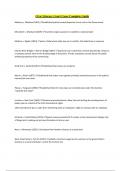
Civic Literacy Court Cases Complete Guide Marbury v. Madison (1803) Established judicial review/Supreme Courts role in the Government McCulloch v. Maryland (1819) Granted congress powers to establish a national bank Gibbons v. Ogden (1824) when a federal and state law are in conflict, the federal law is supreme Charles River Bridge v. Warren Bridge (1837) Supreme Court ruled that a charter granted by a State to a company cannot work to the disadvantage of the public. Private companies cannot injure the public welfare/prosperity of the community. Dred Scot v. Sanford (1857) Established that slaves are property Munn v. Illinois (1877) Established that states may regulate privately owned businesses in the public's interest/set max rates Plessy v. Ferguson (1896) Established that Jim Crow laws are constitutional under the doctrine "separate but equal" Lochner v. New York (1905) Declared unconstitutional a New York act limiting the working hours of bakers due to a denial of the 14th Amendment rights. 14th amendments bars a state from interfering with an employee's right to contract with an employer Schenck v. United States (1919) Speech may be punished if it creates a clear-and-present-danger test of illegal acts. handing out anti-war literature in time or war. Near v. Minnesota (1931) protected the freedom of press at a state level West Coast Hotel v. Parrish (1937) upheld a minimum wage law for women on the ground that a business is a social institution. end of the Lochner era Brown v. Board of Education (1954) The Supreme Court overruled Plessy v. Ferguson, declared that racially segregated facilities are inherently unequal and ordered all public schools desegregated. the end of "separate but equal" Mapp v. Ohio (1961) illegally obtained evidence cannot be used in court Baker v. Carr (1962) "One man, one vote." Ordered state legislative districts to be as near equal as possible in population Engle v. Vitale (1962) Held that public schools cannot require students to say prayers Gideon v. Wainwright (1963) Defendants in criminal cases have an absolute right to counsel New York Times v. Sullivan (1964) To libel a public figure, there must be "actual malice". unless the words are penned with "knowingly falsity" a writer cannot be sued by a public figure for libel. Griswold v. Connecticut (1965) Established that there is an implied right to privacy in matters of contraception between married people Miranda v. Arizona (1966) The court ruled that those subjected to in-custody interrogation be advised of their constitutional right to an attorney and their right to remain silent. Tinker v. Des Moines (1969) Guaranteed a student's right to protest (wearing armbands). San Antonio Independent School District vs. Rodriguez (1973) the Constitution does not guarantee a fundamental right to education. boundaries on governments actions. Roe v. Wade (1973) Abortion rights fall within the privacy implied in the 14th amendment. states can restrict the right to choose only later in the pregnancy United States v. Nixon (1974) Limited the scope of a President's use of executive privilege. No one is above the law. Texas v. Johnson (1989) Flag-burning is symbolic speech with a political purpose and is protected by 1st Amendment. Cruzan v. Director, Missouri Department of Health (1990) the state can choose to continue life
Escuela, estudio y materia
- Institución
- Civic Literacy Court Cases Complete
- Grado
- Civic Literacy Court Cases Complete
Información del documento
- Subido en
- 5 de abril de 2024
- Número de páginas
- 3
- Escrito en
- 2023/2024
- Tipo
- Examen
- Contiene
- Preguntas y respuestas
Temas
-
civic literacy court cases complete guide

Documento también disponible en un lote