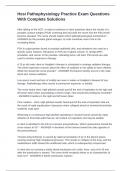
Hesi Pathophysiology Practice Exam Questions With Complete Solutions
After talking w/ the HCP, a male pt continues to have questions about the results of a prostatic surface antigen (PSA) screening test and asks the nurse how the PSA levels become elevated. The nurse should explain which pathophysiological mechanism? - ANSWER-As the prostate gland enlarges, its cells contribute more PSA in the circulating blood PSA is a glycoprotein found in prostatic epithelial cells, and elevations are used as a specific tumor markers. Elevations in PSA are r/t gland volume, ie. benign BPH, prostatitis, and cancer of the prostate, indicating tumor cell load. PSA levels are also used to monitor response to therapy A 26 yr old male client w/ Hodgkin's disease is scheduled to undergo radiation therapy. The clinet expresses concern about the effect of radiation on his ability to have children. What info should the nurse provide? - ANSWER-Permanent sterility occurs in the male client who receive radiation Low sperm count and loss of motility are seen in males w/ Hodgkin's disease b/f any therapy. Radiotherapy often results in permanent aspermia, or sterility The nurse hears short, high-pitched sounds just b/f the end of inspiration in the right and left lower lobes when auscultating a client's lungs. How should this finding be recorded? - ANSWER-Crackles in the right and left lower lobes Fine crackles - short, high-pitched sounds heard just b/f the end of inspiration that are the result of rapid equalization of pressure when collaped alveoli or terminal bronchioles suddenly snap open Wheezing is a continuous high-pitched squeaking or musical sound caused by rapid vibration of bronchial walls that are 1st evident on expiration and may be audible A client is admitted to the ER w/ a tension pneumothorax. Which assessment should the nurse expect to ID? - ANSWER-A deviation of the trachea toward the side opposite of the pneumothorax Tension pneumothorax is caused by rapid accumulation of air in the pleural space, causing severely high intrapleural pressure. This results in collapse of the lung, and the mediastinum shifts toward the unaffected side, which is subsequently compressed A client who is receiving a whole blood transfusion dv's chills, fever, and a HA 30 min after the transfusion is started. The nurse shold recognize these sx as characteristic of what rxn? - ANSWER-A febrile transfusion reaction
Escuela, estudio y materia
- Institución
- Hesi Pathophysiology Practice
- Grado
- Hesi Pathophysiology Practice
Información del documento
- Subido en
- 11 de junio de 2024
- Número de páginas
- 8
- Escrito en
- 2023/2024
- Tipo
- Examen
- Contiene
- Preguntas y respuestas
Temas
-
hesi pathophysiology practice exam questions with
-
hesi pathophysiology practice exam stuvia
-
after talking w the hcp a male pt continues to h

Documento también disponible en un lote