100% de satisfacción garantizada Inmediatamente disponible después del pago Tanto en línea como en PDF No estas atado a nada 4.2 TrustPilot
logo-home
Examen

Community Health Nursing Midterm Questions and Answers correct

Puntuación
-
Vendido
-
Páginas
8
Grado
A+
Subido en
20-04-2025
Escrito en
2024/2025

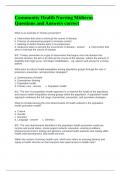
Community Health Nursing Midterm Questions and Answers correct What is an example of Tertiary prevention? a. Intervention that aims to interrupt the course of disease b. Process of empowering people to increase control c. Seeking to detect disease early in its progression d. Measures taken to prevent the occurrence of disease a. Intervention that aims to interrupt the course of disease B/C: Tertiary prevention is a type of intervention that begins once the disease has become obvious; the aim is to interrupt the course of the disease, reduce the amount of disability that might occur, and begin rehabilitation. --eg: speech and physio for a stroke patient What aims to reduce health inequalities among population groups through the use of protection, prevention, and promotion strategies? a. Determinants of Health b. Downstream thinking c. Population health d. Primary care c. Population health B/C: The aim of a population health approach is to improve the health of the population and reduce health inequalities among groups within the population. A population health approach embraces the full range of protection, prevention, and promotion strategies. What is included among the nine Determinants of Health outlined in the population health promotion model? a. Culture b. Gender c. Genetics d. Language c. Genetics B/C: The nine determinants identified in the population health promotion model are income and social status, social support network, education, working conditions, physical environment, biology and genetics, personal health practices and coping skills, health child development, and health services. Within the context of primary health care, which term refers to ensuring fairness and equity in health services so that everyone has equal access to health care? a. Distributive justice b. Beneficence c. Global health d. Social Justice d. Social Justice B/C: Taking action for social justice means attempting to reduce system-wide differences that disadvantage certain groups and prevent equal access to Determinants of Health and to health care services. Which is a social determinant of health? a. Biology b. Genetics c. Personal health d. Income d. Income B/C: The social Determinants of Health are the economic and social conditions that influence the health of individuals and the population as a whole. Employment of nurse practitioners (NPs) in underserviced areas and the use of telehealth to respond to client health care concerns are examples of which principles of primary health care? a. Equitable distribution of essential health services to all populations b. Emphasis on health promotion and disease prevention, rather than curative, services c. Integration of health development with social and economic development d. Appropriate utilization of health care resources d. Appropriate utilization of health care resources B/C: The use of appropriate technology, including human resources and technology, calls for finding the most cost-effective ways to provide appropriate health care to everyone in the community. NPs can help reduce the demands on the health care system by using their skills and abilities in preventing and treating common conditions encountered in the clinic. The use of telehealth technology by nurses to respond to client health concerns often reduces the strain on emergency departments. The CHN who considers the Determinants of Health and other relevant economic, sociopolitical, and environmental factors that might affect health is using which approach(es)? (Select all that apply) a. Downstream thinking b. Macroscopic focus c. Microscopic focus d. Upstream thinking b. Macroscopic focus d. Upstream thinking B/C: Whereas downstream thinking focuses on the individual, upstream thinking looks beyond the individual to take a macroscopic, big-picture population focus. When working with clients, CHNs using upstream thinking would consider the Determinants of Health and other relevant economic, sociopolitical, and environmental factors that may influence the health of the client. Climate change is an example of which one of the following? a. A determinant of health b. A transitional health issue c. A social justice issue d. An international health issue d. An international health issue B/C: Climate change affects all people worldwide. It is a global health concern because it will impact the health needs of the people on the entire planet. The CHN who advocates for safe playground equipment on school property is demonstrating recognition of which perspectives? a. Advocacy is necessary to champion the purchase of expensive equipment b. Healthy child development requires exposure to structures physical play c. The human-built environment directly affects the health of children d. School boards are primarily concerned about academic matters c. The human-built environment directly affects the health of children B/C: Physical environments refer to human-built environments, such as playgrounds, and are health-determining factors that relate to outcomes such as disability and death. Disease prevention, health protection, health maintenance, and palliation are distinct parts of which of the Canadian Community Health Nursing Standards of Practice? a. Building individual and community capacity b. Building relationships c. Facilitating access and equity d. Promoting health d. Promoting health B/C: CHNs promote health using the following strategies: health promotion, disease prevention and health protection, health maintenance, restoration, and palliation. What was established in 2004 to support a sustainable health care system in Canada? a. Health Canada b. Community Health Nurses of Canada c. Canadian Institutes of Health Research d. Public Health Agency of Canada d. Public Health Agency of Canada Which organization involved in global health efforts assists with economic and technical development in middle and low-income countries? a. Global Health Council b. United Nations Children's Emergency Fund c. World Bank d. World Health Organization c. World Bank What is considered to be the most important determinant of health? a. Employment and working conditions b. Health and social services c. Personal health practices and coping skills d. Income and social status d. Income and social status B/C: Income and social status have consistently been shown in the literature to be the most important Determinants of Health. As income and social status are raised, the health status of Canadians has been seen to improve. However, it is the distribution, rather than the actual amount, of wealth that is associated with healthier people among the population. What is the CHN practising when the primary focus is on populations that live in the community, as opposed to those in institutions, with an emphasis on strategies for health promotion, health maintenance, and disease prevention? a. Population health b. Public health c. Primary care d. Primary health care b. Public health Mass screening programs to assess dental health and hearing in elementary schoolchildren exemplifies which type of prevention? a. Primary prevention b. Primordial prevention c. Secondary prevention d. Tertiary prevention c. Secondary prevention B/C: Secondary prevention is a type of intervention that seeks to detect disease early in its progression, before clinical signs and symptoms become apparent, so that an early diagnosis can be made. The foundation for current programs and policies pertaining to disease prevention is based on the guiding principles and courses of action that developed as a result of which event? a. The cholera epidemics that occurred in Ontario and Quebec in the 1800s b. The introduction of organized public health in the early 1900s c. The social changes that occurred during the industrial revolution d. The Lalonde Report and development of Public Health Agency of Canada a. The cholera epidemics that occurred in Ontario and Quebec in the 1800s B/C: The first cholera epidemic in 1832 in Ontario and Quebec provided guidelines for disease prevention and control when cholera recurred in 1834, 1849, 1854, and 1866. The governing bodies identified the importance of the following: strong leadership at central and local levels, clear communication about the disease and nature of it, and description of the steps required to prevent or control it. There was also recognition that each outbreak would spawn a response from society based on the society's cultural values and perceptions of danger. These guiding principles and courses of action remain the foundation for current programs and policies pertaining to disease prevention. What percentage of all nurses in Canada is anticipated to be practising in the community by 2020? a. 33% b. 44% c. 55% d. 66% d. 66% Which occurrence marked a change in public health strategies from illness prevention to health promotion in the community? a. Emphasis on the PHN's role in the prevention of chronic illness b. Introduction of primary health care practitioners in the health care system c. Emergence of nursing unions and collective bargaining units d. A shift from institutional care to community care for clients with mental illness a. Emphasis on the PHN's role in the prevention of chronic illness In the 1920s, outpost nursing stations were established in Canada's north to meet the needs of Indigenous people and new settlers in remote parts of Canada. These nursing stations were established by which group? a. The federal government b. Public health c. Canadian Red Cross d. Private funding c. Canadian Red Cross The economic depression of the 1930s led to what outcomes? a. A shift in focus on maternal-child health, resulting in expanded roles for PHNs b. Recognition of the importance of, and opportunities for, health promotion by nurses in all work settings c. Federal government initiation of social assistance and provincial focus on public health programs d. Pharmacological advances that shifted the focus from prevention and care to a medical focus on cure c. Federal government initiation of social assistance and provincial focus on public health programs Which report made the recommendation that public health nursing should become a specialty area in advanced education? a. Lalonde Report (1974) b. Weir Report (1932) c. Epp Report (1986) d. Romanow Report (2002) b. Weir Report (1932) B/C: In 1932, Professor G.M. Weir of the University of British Columbia released a report entitled Survey of Nursing Education in Canada, on nursing education and public health nursing. This landmark study evaluated the first educational programs in nursing, and one of its significant recommendations was that public health nursing should become a specialty area in advanced education. Which historical nursing figure contributed to establishing the foundation for community health and nursing in community health by working in military field hospitals, using a population-based approach that improved nursing care and environmental conditions? a. Florence Nightingale b. Eunice Dyke c. Lillian Wald d. Edna Moore a. Florence Nightingale B/C: During the Crimean War (), the British military established hospitals for the sick and wounded soldiers in Scutari in Asia Minor. The care provided in these hospitals was poor, took place in cramped quarters, and was plagued by poor sanitation, lice and rats, insufficient food, and inadequate medical supplies. The British public demanded improved conditions, and Florence Nightingale made a request to be sent to work in Scutari. Her personal wealth, social and political connections, and knowledge of hospitals influenced the British government to send her to Asia Minor with 40 other women, 117 hired nurses, and 15 hired servants. In Scutari, Florence succeeded in significantly improving the soldiers' health by using a population-focused approach that included better environmental conditions and excellent nursing care. Using simple epidemiology measures, she documented a mortality rate that decreased from the beginning of the war to the end of the war. What were early public health efforts driven by in Canada? a. The need to deal with epidemics b. The decay of urban culture c. The recognition of human dignity and worth d. The need to regulate the lives of the poor a. The need to deal with epidemics

Mostrar más Leer menos
Institución
240 Community Nursing
Grado
240 Community Nursing


Ups! No podemos cargar tu documento ahora. Inténtalo de nuevo o contacta con soporte.

Escuela, estudio y materia

Institución
240 Community Nursing
Grado
240 Community Nursing

Información del documento

Subido en
20 de abril de 2025
Número de páginas
8
Escrito en
2024/2025
Tipo
Examen
Contiene
Preguntas y respuestas

Temas

Vista previa del contenido

Community Health Nursing Midterm
Questions and Answers correct
What is an example of Tertiary prevention?

a. Intervention that aims to interrupt the course of disease
b. Process of empowering people to increase control
c. Seeking to detect disease early in its progression
d. Measures taken to prevent the occurrence of disease - answer a. Intervention that
aims to interrupt the course of disease

B/C: Tertiary prevention is a type of intervention that begins once the disease has
become obvious; the aim is to interrupt the course of the disease, reduce the amount of
disability that might occur, and begin rehabilitation. --eg: speech and physio for a stroke
patient

What aims to reduce health inequalities among population groups through the use of
protection, prevention, and promotion strategies?

a. Determinants of Health
b. Downstream thinking
c. Population health
d. Primary care - answer c. Population health

B/C: The aim of a population health approach is to improve the health of the population
and reduce health inequalities among groups within the population. A population health
approach embraces the full range of protection, prevention, and promotion strategies.

What is included among the nine Determinants of Health outlined in the population
health promotion model?

a. Culture
b. Gender
c. Genetics
d. Language - answer c. Genetics

B/C: The nine determinants identified in the population health promotion model are
income and social status, social support network, education, working conditions,
physical environment, biology and genetics, personal health practices and coping skills,
health child development, and health services.

Within the context of primary health care, which term refers to ensuring fairness and
equity in health services so that everyone has equal access to health care?

, a. Distributive justice
b. Beneficence
c. Global health
d. Social Justice - answer d. Social Justice

B/C: Taking action for social justice means attempting to reduce system-wide
differences that disadvantage certain groups and prevent equal access to Determinants
of Health and to health care services.

Which is a social determinant of health?

a. Biology
b. Genetics
c. Personal health
d. Income - answer d. Income

B/C: The social Determinants of Health are the economic and social conditions that
influence the health of individuals and the population as a whole.

Employment of nurse practitioners (NPs) in underserviced areas and the use of
telehealth to respond to client health care concerns are examples of which principles of
primary health care?

a. Equitable distribution of essential health services to all populations
b. Emphasis on health promotion and disease prevention, rather than curative, services
c. Integration of health development with social and economic development
d. Appropriate utilization of health care resources - answer d. Appropriate utilization
of health care resources

B/C: The use of appropriate technology, including human resources and technology,
calls for finding the most cost-effective ways to provide appropriate health care to
everyone in the community. NPs can help reduce the demands on the health care
system by using their skills and abilities in preventing and treating common conditions
encountered in the clinic. The use of telehealth technology by nurses to respond to
client health concerns often reduces the strain on emergency departments.

The CHN who considers the Determinants of Health and other relevant economic,
sociopolitical, and environmental factors that might affect health is using which
approach(es)? (Select all that apply)

a. Downstream thinking
b. Macroscopic focus
c. Microscopic focus
d. Upstream thinking - answer b. Macroscopic focus
d. Upstream thinking

$16.49
Accede al documento completo:

100% de satisfacción garantizada
Inmediatamente disponible después del pago
Tanto en línea como en PDF
No estas atado a nada


Documento también disponible en un lote

Conoce al vendedor

Seller avatar
Los indicadores de reputación están sujetos a la cantidad de artículos vendidos por una tarifa y las reseñas que ha recibido por esos documentos. Hay tres niveles: Bronce, Plata y Oro. Cuanto mayor reputación, más podrás confiar en la calidad del trabajo del vendedor.
Pogba119 Harvard University
Seguir Necesitas iniciar sesión para seguir a otros usuarios o asignaturas
Vendido
48
Miembro desde
1 año
Número de seguidores
2
Documentos
4956
Última venta
1 mes hace
NURSING TEST

BEST EDUCATIONAL RESOURCES FOR STUDENTS

3.9

9 reseñas

5
4
4
2
3
2
2
0
1
1

Recientemente visto por ti

Por qué los estudiantes eligen Stuvia

Creado por compañeros estudiantes, verificado por reseñas

Calidad en la que puedes confiar: escrito por estudiantes que aprobaron y evaluado por otros que han usado estos resúmenes.

¿No estás satisfecho? Elige otro documento

¡No te preocupes! Puedes elegir directamente otro documento que se ajuste mejor a lo que buscas.

Paga como quieras, empieza a estudiar al instante

Sin suscripción, sin compromisos. Paga como estés acostumbrado con tarjeta de crédito y descarga tu documento PDF inmediatamente.

Student with book image

“Comprado, descargado y aprobado. Así de fácil puede ser.”

Alisha Student

Preguntas frecuentes