Hurst Readiness Exam 2: Questions & Answers; Well Elaborated: Latest Updated
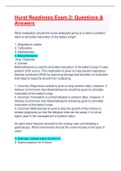
What medication should the nurse anticipate giving to a client in preterm labor to stimulate maturation of the baby's lungs? 1. Magnesium sulfate 2. Terbutaline 3. Methotrexate 4. Betamethasone (Ans- Rationale 4. Correct: Betamethasone is used to stimulate maturation of the baby's lungs in case preterm birth occurs. This medication is given to help prevent respiratory distress syndrome (RDS) by improving storage and secretion of surfactant that helps to keep the alveoli from collapsing. 1. Incorrect: Magnesium sulfate is given to stop preterm labor, however, if delivery is imminent, then Betamethasone should be given to stimulate maturation of the baby's lungs. 2. Incorrect: Terbutaline is contraindicated in preterm labor, however, if delivery is imminent, then Betamethasone should be given to stimulate maturation of the baby's lungs. 3. Incorrect: Methotrexate is used to stop the growth of the embryo in ectopic pregnancy so that the fallopian tube can be saved. It is not an agent used in the management of preterm labor. An adult client has just returned to the nursing care unit following a gastroscopy. Which intervention should the nurse include on the plan of care? 1. Vital sign checks every 15 min x 4 2. Supine position for 6 hours 3. NPO until return of gag reflex 4. Irrigate NG tube every 2 hours 5. Raise four side rails (Ans- Rationale 1., & 3. Correct: Vital signs post procedure are important to monitor for any post-procedure complications such as bleeding or any signs of respiratory compromise. VS are checked frequently for the first hour post procedure. Any client who has a scope inserted down the throat and has received numbing medication in the back of the throat to depress the gag reflex should be kept NPO until the gag reflex returns. 2. Incorrect: Supine position for 6 hours is contraindicated. The HOB should be elevated. In the event the client vomits, he/she is less likely to aspirate with the HOB elevated. Supine position for 6 hours is used after a heart catheterization. 4. Incorrect: A client who is going for a gastroscopy procedure cannot have a nasal gastric tube. An NG tube would interfere with the procedure. 5. Incorrect: Raising all side rails is a form of restraint. Have the bed in low locked position. Raise three side rails, and have call light within reach. A 70 year old client was admitted to the vascular surgery unit during the night shift with chronic hypertension. At 0830, the unlicensed nursing assistant (UAP) reports that the client's BP is 198/94. What would be the best action for the charge nurse to delegate at this time? 1. Ask the UAP to put the client back in bed immediately. 2. Tell the UAP to take the BP in the opposite arm in 15 minutes. 3. Have the LPN/LVN administer the 0900 furosemide and enalapril now. 4. Ask the LPN/LVN to assess the client for pain. (Ans- Rationale 3. Correct: The nurse should recognize the need for measures to reduce the blood pressure. Administering the client's blood pressure medicine is aimed at correcting the problem. It is appropriate to administer the medications at this time in relation to the time that the next dose is due. 1. Incorrect: This is an appropriate action, but does not address the problem of lowering the client's blood pressure. 2. Incorrect: This is an appropriate action, but does not address the problem of lowering the client's blood pressure. 4. Incorrect: This is an appropriate action, but does not address the problem of lowering the client's blood pressure. A client suffers from migraine headaches. What assessment finding would the nurse expect to find during a migraine attack? 1. Unilateral, pulsating pain quality. 2. Bilateral, pressing/tightening pain quality. 3. Ipsilateral nasal congestion and rhinorrhea. 4. Headache occurs after recovering from a headache treated with narcotics. (Ans- Rationale 1. Correct: Migraine headaches have a pulsating pain quality, unilateral location, moderate or severe pain intensity, aggravated by or causing avoidance of routine physical activity (walking, climbing stairs). During headache at least one of the following accompanies the headache: nausea and/or vomiting; photophobia and phonophobia. 2. Incorrect: This is seen in tension headaches. Headaches last 30 minutes to 7 days. Pain is mild or moderate in intensity. It is not aggravated by routine physical activity. Nausea/vomiting, photophobia and phonophobia are not common manifestations with tension headaches. These usually start gradually, often in the middle of the day. 3. Incorrect: This is associated with cluster headaches, which are severe or very severe unilateral orbital, supraorbital and/or temporal pain lasting 15-180 minutes. Symptoms include stabbing pain in one eye with associated rhinorrhea (runny nose) and possible drooping eyelid on the affected side. The headaches tend to occur in "clusters": typically one to three headaches per day (but may be as many as eight) during a cluster period. 4. Incorrect: Overuse of painkillers for headaches, can, ironically, lead to rebound headaches. Culprits include over the counter medications such as aspirin, acetaminophen or ibuprofen, as well as prescription medications. Too much medication can cause the brain to shift into an excited state, triggering more headaches. Also, rebound headaches are a symptom of withdrawal as the level of medicine drops in the bloodstream. Rebound headaches may have associated issues such as difficulty concentrating, irritability and restlessness but does not typically include photophobia or visual disturbances as seen with migraines. The nurse is caring for a client who was admitted to the hospital following a severe motor vehicle crash (MVC) in which the client was trapped in the car for several hours. The client is being closely monitored for the development of renal failure. Which assessment finding would warrant immediate reporting? 1. Creatinine 1.1 mg/dl (97.24 mmol/L) 2. Urinary output of 150 mL per hour. 3. Gradual increase of BUN levels. 4. Calcium levels of 9.0 mg/dL (2.25 mmol/L) (Ans- Rationale 3. Correct. Gradual accumulation of nitrogenous wastes results in elevated BUN and serum creatinine. This is an indication of impaired renal function. 1. Incorrect. This is a normal creatinine level. Gradual accumulation of nitrogenous wastes from impaired renal function results in elevated BUN and serum creatinine. 2. Incorrect. This is a normal output level. This level alone would not necessarily be an indicator of acute renal failure and that value alone would not warrant reporting it to the primary healthcare provider. 4. Incorrect. Calcium level of 9.0 mg/dL (2.25 mmol/L) is considered normal. When observing for renal functioning you would assess the BUN and creatinine levels. In addition, the calcium level may drop (hypocalcemia) in renal failure inverse relationship change due to the rising serum phosphate levels. However, the calcium level presented is within normal limits (WNL). A client has been admitted for exacerbation of ulcerative colitis with severe dehydration. What is the best indicator that this client has an actual fluid deficit? 1. Stool count of 10 episodes of diarrhea in 24 hours. 2. Weight increase of 2 kg and a 24 hour output of 1000 mL. 3. Admission weight of 74.3 kg and 2 days later a weight of 72 kg. 4. Daily intake of 2400 mL and an output of 1600 mL, plus diarrheal stools. (Ans- Rationale 3. Correct: Any acute weight gain or loss is fluid. Weight is the best measurement for fluid loss or gain. Acute weight losses correspond to fluid volume deficits. This client has lost 2.3 kg over a 2 day period, indicating a fluid volume deficit (FVD). 1. Incorrect: Although 10 loose stools would result in fluid loss, the stool count of 10 episodes of diarrhea is an inaccurate measurement. The amount of fluid loss can vary depending on the amount of diarrhea, 10 "episodes" does not indicate how much fluid is lost. 2. Incorrect: Weight gains indicate fluid volume retention and excess. This question asks about fluid volume deficit. Also, it does not take into account the client's intake. Only the output is considered, so output has less meaning without being compared to the intake. 4. Incorrect: Daily I&O is good information to have when assessing fluid status, but the diarrhea stools are an inaccurate measurement. The weight remains the best measurement for indicating a fluid deficit. The nurse is working with a LPN/VN and an unlicensed assistive personnel (UAP). Which clients would be appropriate for the nurse to assign to the LPN/VN? 1. In Bucks traction requiring frequent pain medication. 2. 24 hours post appendectomy. 3. Diagnosed with cholelithiasis and scheduled for surgery in the AM. 4. Admitted 6 hours ago in adrenal insufficiency. 5. Client newly diagnosed with Type 2 diabetes. (Ans- Rationale 1., 2., & 3. Correct These clients are stable and require predictable care that can be done appropriately by the LPN/VN. 4. Incorrect: This client has adrenal insufficiency. Primary adrenal insufficiency occurs when at least 90 percent of the adrenal cortex has been destroyed generally from autoimmune disorders. Secondary adrenal insufficiency can be caused by such things as abrupt stoppage of corticosteroid medications and surgical removal of pituitary tumors. As a result, often both glucocorticoid (cortisol) and mineralocorticoid (aldosterone) hormones may be lacking. This puts the client at risk for fluid volume deficit (FVD) and shock. This requires the higher level assessment skills of the RN. 5. Incorrect: A newly diagnosed client may be unstable and would require assessment, care plan development and teaching for the newly diagnosed diabetic which cannot be performed by the PN. The triage nurse in the emergency department (ED) assesses 4 clients. Which client is in need of emergent care? 1. A 52 year old who has a partially amputated finger. 2. A 9 month old with temperature of 103°F (39.4°C). 3. A two year old with excessive drooling and a weak cough. 4. A 28 year old experiencing a migraine headache for three days. (Ans- Rationale
École, étude et sujet
- Établissement
- Hurst Readiness
- Cours
- Hurst Readiness
Infos sur le Document
- Publié le
- 3 décembre 2022
- Nombre de pages
- 97
- Écrit en
- 2022/2023
- Type
- Examen
- Contient
- Questions et réponses
Sujets
-
what medication should the nurse anticipate giving to a client in preterm labor to stimulate maturation of the babys lungs 1 magnesium sulfate 2 terbutaline 3 methotrexate 4 betamethason

Document également disponible en groupe