SSM Basic Dysrhythmia Review (A+ Rated Solution Guide)
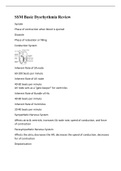
SSM Basic Dysrhythmia Review SSM Basic Dysrhythmia Review Systole Phase of contraction when blood is ejected Diastole Phase of relaxation or filling Conduction System Inherent Rate of SA node 60-100 beats per minute Inherent Rate of AV node 40-60 beats per minute AV node acts as a "gate keeper" for ventricles Inherent Rate of Bundle of His 40-60 beats per minute Inherent Rate of Ventricles 20-40 beats per minute Sympathetic Nervous System Affects atria & ventricle, increases SA node rate, speed of conduction, and force of contraction Parasympathetic Nervous System Affects the atria, decreases the HR, decreases the speed of conduction, decreases for of contraction Depolarization Cells receive a stimulus, changes in electrical charges occur resulting in a electrical flow which spreads in a wavelike motion resulting in contraction - systole Repolarization Return of the electrical charge to their original postion, recovery state Absolute Refractory Portion of the cardiac cycle where NO stimulus, no matter how strong, can excite the cardiac tissue Relative Refractory Portion of cardiac cycle when all cells are not fully repolarized, a strong enough stimulus can excite the cardiac tissue, also referred to as the vulnerable period Positive Deflection Current flowing toward a + electrode gives a + deflection (above baseline) Negative Deflection Current flowing away from a + electrode gives a - deflections (below baseline) P wave Reflects atrial depolarization PR interval Represents the interval from the time the impulse leaves the SA node, the delay at the AV node. QRS Represents ventricular depolarization. The time required for the impulse to travel through R & L ventricles Normal PR interval 0.12-0.20 seconds Normal QRS 0.04 -.10 or <0.12 T wave Represents ventricular repolarization QT interval Represents total ventricular activity (depolarization to repolarization) ST segment Represents time between completion of ventricular depolarization and beginning or repolariation Sinus Rhythm Rate is 60-100, it is regular, normal PR and QRS interval. One P wave for every QRS Normal Sinus Rhythm Sinus Bradycardia Rate is < 60, rhythm is regular, P wave for every QRS. May be normal is some people, especially atheletes Sinus Bradycardia Sinus Tachycardia
École, étude et sujet
- Établissement
- SSM Basic Dysrhythmia
- Cours
- SSM Basic Dysrhythmia
Infos sur le Document
- Publié le
- 20 avril 2023
- Nombre de pages
- 14
- Écrit en
- 2022/2023
- Type
- Examen
- Contient
- Questions et réponses
Sujets
-
basic dysrhythmia review
-
ssm basic dysrhythmia review

Document également disponible en groupe