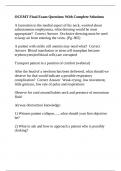
CNIM PRACTICE QUESTIONSWITH CORRECT ANSWERS
ANASTAMOSIS? - Answer- -CONNECTION or opening BETWEEN two things (especially cavities or passages) that are normally diverging or branching, such as between blood vessels. -COMMUNICATION BETWEEN ARTERIES What causes the most airborne bacteria in OR? a. blood on gown b. blood spill c. skin shed d. patient vent - Answer- c. skin shed Nerve that innervates 4th and 5th fingers? - Answer- Ulnar Nerve Problem with Bilateral Synchronus Stim? - Answer- Can mask unilateral problems No N20 at baseline could mean? - Answer- Stroke What should you check 1st if you lose all waves? - Answer- Stimulator Which of the following devices measures electrode resistance? 1. Ammeter 2. Ohmmeter 3. Voltmeter 4. Photometer - Answer- 2. Ohmmeter If an evoked potential has a voltage of 10uV and the associated noise has a voltage of 50uV, what is the signal to noise ratio after 100 averaged responses? 1. 1:1 2. 1:2 3. 2:1 4. 5:1 - Answer- 3. 2:1 To display median nerve SSEP response as an upward deflection, which of the following must be known? 1. Waveform polarity and latency of the response 2. Waveform polarity and polarity convention of the amplifier inputs 3. Polarity convention of amplifier inputs and amplitude of the response 4. Latency of the response and polarity convention of the amplifier inputs - Answer- 2. Waveform polarity and polarity convention of the amplifier inputs If an amplifier is rated as having 120 dB common mode rejection rate, which of the following ratios of in-phase to out-of-phase signals would be expected? 1. 10,000:1 2. 100,000:1 3. 500,000:1 4. 1,000,000:1 - Answer- 4. 1,000,000:1 Which of the following cranial nerves innervates the extraocular muscles? 1. Optic 2. Facial 3. Abducens 4. Trigeminal - Answer- 3. Abducens Which of the following is an example of a SSEP far-field subcortical potential? 1. N20 2. N34 3. Erbs point 4. Popliteal Fossa - Answer- 2. N34 Which of the following opposes any change in current? 1. Capacitance 2. Impedance 3. Inductance 4. Resistance - Answer- 3. Inductance Which of the following electrode materials has little electrode potential drift and a long time constant? 1. Tin 2. Gold 3. Silver 4. Stainless Steel - Answer- 2. Gold Where should epidural electrodes be placed? 1. On the dura 2. In the spinal cord 3. Within the dural membrane 4. Between the dura and the spinal cord - Answer- 1. on the dura With referential recording, maximal amplitude cortical evoked potentials following stimulation of the left posterior tibial nerve usually would be found between? 1. C3 and CZ 2. C4 and P4 3. FZ and CZ 4. C4 and CZ - Answer- 1. C3 and CZ For preoperative posterior tibial somatosensory evoked potentials, which of the following would be the best ipsilateral location for the ground electrode? 1. Forearm 2. Calf 3. Shoulder 4. Palm - Answer- 2. Calf To record the afferent volley after posterior tibial nerve stimulation, an electrode should be placed on the? 1. Mastoid 2. Erbs point 3. T5 spine 4. Index Finger - Answer- 3. T5 spine Impedances of applied electrodes should be? 1. balanced and below 5,000 ohms 2. balanced and above 5,000 ohms 3. unbalanced and below 5,000 ohms 4. unbalanced and above 5,000 ohms - Answer- 1. balanced and below 5,000 ohms An increase in stimulation intensity cause a linear increase of which of the following SSEP components? 1. N20 2. N45 3. P31 4. P37 - Answer- 3. P31 Epidural electrodes are made of platinum because? 1. it is the most durable metal 2. it is the lowest impedance metal 3. the chance of allergic reaction is eliminated 4. other metals may become toxic when currents are applied - Answer- 4. other metals may become toxic when currents are applied During a median nerve preoperative study, a patient has discomfort at the wrist. Stimulation electrodes are 10mm gold disk, stimulus intensity is 20 mA, and stimulus duration is 100 usec. Which of the following would most likely reduce the patient's discomfort while maintaining adequate stimulation? 1. Increase stimulus duration 2. Decrease number of repetitions 3. Use smaller stimulating electrodes 4. Decrease stimulus intensity below motor threshold - Answer- 2. Decrease number of repititions Which of the following would enhance Wave I of the BAEP? 1. Increase the rate 2. Increase the intensity 3. Decrease the analysis time 4. Decrease the number of repetitions - Answer- 2. Increase the intensity In BAEPs wave I can most easily be differentiated from cochlear microphonics based upon? 1. amplitude 2. morphology 3. click polarity 4. absence in contralateral recording - Answer- 3. click polarity What is the interstimulus interval of a 50hz click stimulus? 1. 0.02 msec 2. 0.20 msec 3. 0.50 msec 4. 20.00 msec - Answer- 4. 20.00 msec Contralateral masking should be used during BAEPs to? 1. help the patient relax 2. enhance wave 1 amplitude 3. seperate wave IV/V complex 4. prevent crossover responses - Answer- 4. prevent crossover responses The complete absence of a BAEP is most likely the result of? 1. sedation 2. multiple sclerosis 3. severe hearing loss 4. a normal age variant - Answer- 3. severe hearing loss Identification of Wave V of the BAEP may require? 1. tympanic electrodes 2. bilateral stimulation 3. decreasing stimulus intensity 4. use of nonncephalic reference - Answer- 3. decreasing stimulus intensity In spinal surgery, the primary purpose of the popiteal fossa recording electrode is to? 1. verify adequacy of stimulus 2. limit current spread 3. confirm amplitude integrity 4. provide evidence of a muscle twitch - Answer- 1. verify adequacy of stimulus While performing a posterior tibial SSEP, hypothermia of the lower extremities is most likely to cause? 1. increased L3-P37 latency 2. increased T12-P37 latency 3. slowed peripheral conduction velocity 4. abnormal prolongation of the P37-N45 complex - Answer- 3. slowed peripheral conduction velocity Which of the following peaks in tibal nerve SSEPs is most analogous to P14 of median nerve SSEP? 1. N20 2. N34 3. P31 4. P37 - Answer- 3. P31 During posterior fossa surgery, when BAEPs are used for monitoring brainstem function, it is important to? 1. record cranial nerve VII action potentials 2. monitor cranial nerve V function ipsilaterally 3. stimulate and record from the operative side only 4. stimuate and record from the contralateral side - Answer- 4. stimuate and record from the contralateral side Which of the following cranial nerves are most appropriate to monitor during resection of a 4cm vestibular schwannoma? 1. Optic 2. Facial 3. Abducens 4. Oculomotor - Answer- 2. Facial During Carotid endarterectomy, what SSEP modality is recommended for monitoring cerebral function? 1. Femoral 2. Median 3. Posterior Tibial 4. Common Peroneal - Answer- 2. Median If the EEG is preserved during carotid endarterectomy surgery, it indicates? 1. inadequate level of anesthesia 2. diffuse neuronal dysfunction 3. accurate electrode placement 4. adequate cortical perfusion and oxygenation - Answer- 4. adequate cortical perfusion and oxygenation SSEPs to posterior tibial nerve stimulation are most appropriate to monitor during surgery for? 1. scoliosis 2. hemifacial spasm 3. middle cerebral artery aneurysm 4. cerebellar pontine angle tumor - Answer- 1. scoliosis In recording electrocochleograms, it is best to stimulate using? 1. tone pips 2. tone bursts 3. alternating clicks 4. rarefaction clicks and condensation - Answer- 4. rarefaction clicks and condensation A post-incision baseline recording is used to? 1. evaluate hemodynamic status 2. determine long-term prognosis 3. establish a standard for the patient 4. compare patient's values to laboratory normative date - Answer- 3. establish a standard for the patient Which of the following would most likely be normal in the pre-operative baseline upper extremity SSEP of a patient with a lesion in the dorsal column? 1. N20 2. P22 3. Erbs point potential 4. Central Conduction Time - Answer- 3. Erbs point potential Selection of the nerve to be stimulated for preoperative baseline SSEPs is determined by the? 1. patient age 2. surgical procedure 3. dermatomal innervation 4. anesthesiologist - Answer- 2. surgical procedure For preoperative posterior tibial somatosensory evoked potential, which of the following would be the best ipsilateral location for the ground electrode? 1. arm 2. calf 3. mastoid 4. sole of the foot - Answer- 2. calf To record the afferent volley during preoperative baseline studies after posterior tibial stimulation, an electrode should be placed on the? 1. Patella 2. metatarsal 3. popiteal fossa 4. medial malleolus - Answer- 3. popiteal fossa Routine intraoperative electrophysiological monitoring documentation should include? 1. heart rate 2. blood pressure 3. respiratory rate 4. blood plasma volume - Answer- 2. blood pressure If a technologist accidentally touches a sterile table, which of the following is the most appropriate action? 1. Change scrub suit immediately 2. remain silent until procedure is completed 3. Notify the scrub or circulating nurse at once 4. maintain safe distance from sterile field - Answer- 3. Notify the scrub or circulating nurse at once In a bipolar montage, the key element in localization is the? 1. instrument phase reversal 2. relative voltage in each channel 3. common mode rejection of in-phase noise 4. synchronization of discharges - Answer- 1. Instrument phase reversal SCALP-TO-NONCEPHALIC REFERENCE? 1. Fz-C5S 2. CPz-Fz 3. EPi-EPc 4. CPc-CPi - Answer- 1. Fz-C5S According to the ACNS guidelines, system bandpass settings for monitoring facial nerve spontatneous muscle activity should be? 1. 1-250 to 1500Hz 2. 10-30 to Hz 3. 10-30 to 16,000Hz 4. 100-200 to Hz - Answer- 3. 10-30 to 16000Hz According to the ACNS guidelines, facial nerve monitoring electrodes should be placed in which of the following muscles? 1. Masseter and trapezius 2. Frontalis and trapezius 3. Laryngeal and nasalis 4. Orbicularis oculi and oribularis oris - Answer- 4. Orbicularis oculi and orbicularis Harrington instrumentation includes? 1. rods 2. pedicle screws 3. sublaminal wires 4. segmental wires - Answer- 1. rods Intraoperative evoked potential monitoring criteria of abnormality are based on a comparison of amplitude and latency to? 1. preinduction baseline 2. postincision baseline 3. intraoperative normative date 4. laboratory normative date - Answer- 2. postincision baseline Which of the following anesthetic agents may increase the amplitude of cortical potentials? 1. Etomidate 2. Halothane 3. Pentobarbital 4. Nitrous Oxide - Answer- 1. Etomidate FENTANYL? 1. Narcotic agent 2. Volatile agent 3. Barbiturate agent 4. Neuromuscular blocking agent - Answer- 1. Narcotic agent The combination of nitrous oxide and volatile anesthetic gases affects SSEPs by? 1. increasing latency and decreasing amplitude 2. increasing latency and increasing amplitude 3. decreasing latency and increasing amplitude 4. decreasing latency and decreasing amplitude - Answer- 1. increasing latency and decreasing amplitude During posterior fossa surgery, wave V of the BAEPs may increase in latency due to? 1. Spinal drainage 2. warming of the nerve 3. retraction of the cerebellum 4. use of neuromuscular blocking agent - Answer- 3. retraction of the cerebellum Which of the following nerve injuries usually does NOT produce spontaneous EMG activity during intraoperative monitoring? 1. Heat 2. Pressure 3. Ischemia 4. Irrigation - Answer- 3. Ischemia Which of the following is the method for monitoring the facial nerve? 1. BAEPs 2. Blink reflex 3. Free run EMG 4. Visual observation of facial movement - Answer- 3. Free run EMG When monitoring facial nerve EMG, which of the following is an indicator of potential nerve damage? 1. Ocassional burst of fibrillation potentials 2. Continuous train of neurotonic discharges 3. CMAP to direct stimulation 4. Ocassional muscle faciculations - Answer- 2. Continuous train of neurotonic discharges What is the recommended bandpass setting for facial nerve compound muscle action potential recording? 1. 1-250 to 1500hz 2. 5-30 to 3000hz 3. 10-30 to 16,000hz 4. 100-200 to 1000hz - Answer- 1. 1-250 to 1500hz Neuromuscular blocking agents should NOT be used when recording which of the following evoked responses? 1. BAEPs 2. Peroneal SSEPs 3. Facial nerve EMG 4. ECochG - Answer- 3. Facial nerve EMG What is the most likely effect of isoflurane at MAC 1.5 on tibialis anterior CMAP amplitude in response to spinal stimulation? 1. Marked increase 2. Marked decrease 3. Minimal decrease 4. Minimal increase - Answer- 2. Marked decrease It is most important for intraoperative monitoring records to include notions of? 1. Surgical events 2. periodic impedance checks 3. serial changes in hematocrit 4. changes in anesthesia personnel - Answer- 1. Surgical events Which of the following is a critical surgical event? 1. Drilling of burr hole in skull 2. Decortication of vertebral elements 3. Placing of muscle plug in the internal auditory canal 4. Resecting of tumor fragments during acoustic neuroma resection - Answer- 4. Resecting of tumor fragments during acoustic neuroma resection Which of the following should be reported to the surgeon? 1. Loss of response 2. Change in time base 3. Switch to backup electrodes 4. increase in stimulus intensity - Answer- 1. loss of response D waves are recorded from which of the following electrodes? 1. Epidural electrodes over the spinal cord 2. Subdural electrodes over the motor strip 3. Surface electrodes over peripheral nerves 4. Needle electrodes in distal extremity muscles - Answer- 1. Epidural electrodes over the spinal cord An objective measure of meaningful change to use to warn the surgeon is the ? 1. latency decrease 2. 50% amplitude decrease 3. IPL decrease 4. 10% amplitude decrease - Answer- 2. 50% amplitude decrease Changes can be reported to the surgeon as quickly as possible when the surgeon is asked to? 1. alert the technologist when cautery is in use 2. keep the field dry of fluids 3. inform the technologist when critical structures are approached 4. avoid monopolar cautery use - Answer- 3. inform the technologist when critical structures are approached Pedicle screws are used for? 1. Spinal fixation 2. correction of curve 3. anterior fusion 4. derotation of spine - Answer- 1. spinal fixation The purpose of interbody cages is often? 1. employ multiple point fixation 2. restore lost disc height 3. restore sagittal contours 4. prevent migration prior to fixation - Answer- 2. restore lost disc height Transcranial motor evoked potentials are best elicited when using? 1. a train of stimuli 2. complete neuromuscular blockade 3. halogenated agents 4. stimulus rates above 20/sec - Answer- 1. a train of stimuli In Compressed Density Spectral Array, frequency is depicted by? 1. Y-axis 2. X-axis 3. Epoch 4. Data Points - Answer- 2. X-Axis Transcranial electrical motor evoked potentials are best recorded with which of the following anesthetic regiments? 1. Nitrous oxide 50% + midazolam bolus 2. Isoflurane .5 MAC + midazolam infusion 3. Nitrous oxide 50% + isoflurane <0.5 MAC 4. Propofol + Fentanyl infusion - Answer- 4. Propofol + Fentanyl infusion During carotid endarterectomies Spectral Edge Frequency is usually set to? 1. 60-67% 2. 70-77% 3. 80-87% 4. 90-97% - Answer- 4. 90-97% Which of the following anesthetic agent will obliterate the transcranial electric motor evoked potential? 1. Propofol 2. Desflurane 3. Fentanyl 4. Nitrous Oxide - Answer- 2. Desflurane Which of the following temperatures should be annotated as being hypothermic? 1. 34 degrees Celsius 2. 35 degrees Celsius 3. 38 decrees Celsius 4. 40 degrees Celsius - Answer- 1. 34 degrees Celsius Which of the following systolic blood pressure is most likely to attenuate the evoked potential? 1. 150 mm/Hg 2. 140 mm/Hg 3. 130 mm/Hg 4. 120 mm/Hg - Answer- 4. 120 mm/Hg One contraindication for the use of transcranial electrical motor evoked potential is? 1. epilepsy 2. trigeminal neuralgia 3. scoliosis 4. cervical myelopathy - Answer- 1. epilepsy RADICULOPATHY? 1. Meninges 2. Spinal cord 3. Nerve roots 4. Peripheral Nerves - Answer- 3. Nerve roots SPONDYLOSIS? 1. Tethered cord 2. Avulsed nerve roots 3. Spinal cord tumor 4. Degenerative spine disease - Answer- 4. Degenerative spine disease DIABETES MELLITUS? 1. Ankylosis 2. Hearing loss 3. Facial palsy 4. Peripheral Neuropathy - Answer- 4. Peripheral Neuropathy Which of the following is a common complication of microvascular decompression of cranial nerve VII? 1. Visual loss 2. Hearing loss 3. Lower extremity weakness 4. Upper extremity weakness - Answer- 2. Hearing loss When monitoring evoked potentials during surgery, which of the following would most likely correlate with a postoperative abnormality or deficit? 1. Transient change in latency 2. Transient change in amplitude 3. Persistent decrease in latency and amplitude 4. Persistent increase in latency and decrease in amplitude - Answer- 4. Persistent increase in latency and decrease in amplitude When monitoring intraoperative evoked potentials, which of the following is most likely to correlate with postoperative deficits? 1. No change in latency or amplitude 2. Latency decreases and amplitude increases 3. Transient changes of latency or amplitude 4. Persistent loss of waveforms - Answer- 4. Persistent loss of waveforms Which of the following best describes a false negative case? 1. Evoked Potentials disappear but reappear within 15 minutes 2. Evoked Potential have a greater than 50% decrease of amplitude with no neurological deficit 3. Evoked Potentials remain relatively stable, but postoperative neurologic deficits occur 4. Evoked Potentials disappear during surgery and patient has no postoperative deficit - Answer- 3. Evoked Potentials remain relatively stable, but postoperative neurologic deficits occur When monitoring Brainstem auditory evoked potentials intraoperatively it is recommended to warn the surgeon when an increase of the following occurs? 1. the latency of wave V of less than 1.0 millisecond 2. the latency of wave I of 1 millisecond 3. the latency of wave V of 1.0 or greater 4. the interpeak latency of 1-V of 1.0 or less - Answer- 3. the latency of wave V of 1.0 or greater The use of intraoperative monitoring during scoliosis surgery may replace the? 1. Hoffman sign 2. Stagnara test 3. Romberg test 4. Babinski sign - Answer- 2. Stagnara test (wake up test - pt moves feet) HOFFMAN SIGN? - Answer- -Assess Myelopathy (spinal cord compression) -The test is done by quickly snapping or flicking the patient's middle fingernail. The test is positive for spinal cord compression when the tip of the index finger, ring finger, and/or thumb suddenly flex in response. ROMBERG TEST? - Answer- -TESTS BALANCE -PROPRIOCEPTION, VESTIBULAR FUNCTION & VISION Upon sudden loss of ipsilateral posterior tibial cortical and subcortical data which of the following should be performed? 1. Calibration 2. Stagnara test 3. Train of four 4. Tetanic stimulation - Answer- 2. Stagnara test Which of the following is a source of intraoperative physiologic artifacts? 1. Cell saver 2. Blood warmer 3. Electrocardiogram 4. Electrooculogram - Answer- 3. Electrocardiogram If there is a 60hz interference in all channels when recording preoperative median nerve SSEPs, which of the following electrodes should be adjusted first? 1. CPi 2. EPc 3. Grounding electrode 4. Stimulating electrode - Answer- 3. Grounding electrodes Which of the following would most affect the ability to record BAEPs? 1. Drill 2. Retractor 3. Coagulator 4. Anesthetic agent - Answer- 3. Coagulator Evoked potential data is obilterated with? 1. midas rex drilling 2. monopolar cautery 3. C-arm use 4. transcranial dopper use - Answer- 2. monopolar cautery Which of the following most often causes a temporary threshold shift on the Brainstem auditory evoked potentials during CPA surgery? 1. Drilling 2. bipolar cautery 3. warm irrigation 4. CUSA - Answer- 1. drilling To avoid a false positive the baseline is best taken? 1. In preoperative holding 2. post-incision 3. pre-intubation 4. post-intubation - Answer- 2. post-incision Vascular compromise of the posterior cerebral artery will most likely have what effect on the MNSEP? 1. loss of P14/N18 2. loss of N20/P22 3. loss of N13 4. loss of Erb's point - Answer- 1. loss of P14/N18 Standard (universal) precautions are used to reduce the transmission of? 1. Hepatitis A virus 2. reproductive spores 3. bloodborne pathogens 4. Mycobacterium tuberculosis - Answer- 3. bloodborne pathogens Which of the following diseases results from infection by a bloodborne pathogen? 1. Varicella 2. Hepatitis B 3. Mononucleosis 4. Herpes Zoster - Answer- 2. Hepatitis B When is leakage current present in an evoked potential instrument? 1. Only if the ground is broken 2. Only when used with an extension cord 3. Only when a ground loop is present 4. Whenever the instrument is connected to a power source - Answer- 4. Whenever the instrument is connected to a power source What is the maximum allowable leakage of evoked potential instrument chassis current? 1. 100 microamperes 2. 200 microamperes 3. 300 microamperes 4. 500 microamperes - Answer- 1. 100 microamperes The monitoring team must ensure that stimulus parameters are within safe limits to? 1. avoid tissue damage 2. protect equipment form breakdown 3. minimize 60hz interference 4. prevent chassis current leakage - Answer- 1. avoid tissue damage The pneumatic drill has which of the following effects on BAEP'S? 1. None 2. Prolongs Wave V 3. Increases I-III interpeak latency 4. Increase III-V interpeak latency - Answer- 2. Prolongs Wave V In posterior fossa craniotomy surgery for a large tumor with unilateral hearing loss, the appropriate modalities to monitor would be: a) Contralateral BAEP, median nerve and facial nerve b) Ipsilateral BAEP and facial nerve c) Facial nerve and contralateral median nerve d) Ipsilateral BAEP - Answer- a) Contralateral BAEP, median nerve and facial nerve During middle or posterior fossa surgery, what structure is most at risk? a) Cerebellum b) Brainstem c) Optic Nerve d) Spinal Cord -
École, étude et sujet
- Établissement
- CNIM
- Cours
- CNIM
Infos sur le Document
- Publié le
- 14 juin 2023
- Nombre de pages
- 94
- Écrit en
- 2022/2023
- Type
- Examen
- Contient
- Questions et réponses
Sujets
-
cnim practice questionswith correct answers

Document également disponible en groupe