NSG 233 Med Surge 3 Final Exam 2023 Questions and Answers 100% Correct
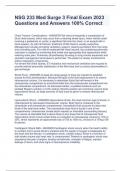
NSG 233 Med Surge 3 Final Exam 2023 Questions and Answers 100% CorrectNSG 233 Med Surge 3 Final Exam 2023 Questions and Answers 100% CorrectNSG 233 Med Surge 3 Final Exam 2023 Questions and Answers 100% CorrectNSG 233 Med Surge 3 Final Exam 2023 Questions and Answers 100% CorrectNSG 233 Med Surge 3 Final Exam 2023 Questions and Answers 100% Correct Chest Trauma- Complications - ANSWER-Flail chest is frequently a complication of blunt chest trauma, which may occur from a steering wheel injury, motor vehicle crash involving a pedestrian or cyclist, a significant fall onto the chest, or an assault with a blunt weapon. As with rib fracture, treatment of flail chest is usually supportive. Management includes providing ventilatory support, clearing secretions from the lungs, and controlling pain. For mild-to-moderate flail chest injuries, the underlying pulmonary contusion is treated by monitoring fluid intake and appropriate fluid replacement while relieving chest pain. Pulmonary physiotherapy focusing on lung volume expansion and secretion management techniques is performed. The patient is closely monitored for further respiratory compromise. For severe flail chest injuries, ET intubation and mechanical ventilation are required to provide internal pneumatic stabilization of the flail chest and to correct abnormalities in gas exchange. Shock Fluid - ANSWER-At least two large-gauge IV lines are inserted to establish access for fluid administration. Because the goal of the fluid replacement is to restore intravascular volume, it is necessary to administer fluids that will remain in the intravascular compartment to avoid fluid shifts from the intravascular compartment into the intracellular compartment. As discussed earlier, crystalloid solutions such as lactated Ringer's solution or 0.9% sodium chloride solution are commonly used to treat hypovolemic shock, as large amounts of fluid must be given to restore intravascular volume. Hypovolemic Shock - ANSWER-Hypovolemic shock, the most common type of shock, is characterized by decreased intravascular volume. Body fluid is contained in the intracellular and extracellular compartments. Intracellular fluid accounts for about two thirds of the total body water. The extracellular body fluid is found in one of two compartments: intravascular (inside blood vessels) or interstitial (surrounding tissues). The volume of interstitial fluid is about three to four times that of intravascular fluid. Hypovolemic shock occurs when there is a reduction in intravascular volume by 15% to 30%, which represents an approximate loss of 750 to 1500 mL of blood in a 70-kg (154-lb) person Cardiogenic Shock S&S - ANSWER-Cardiogenic shock occurs when the heart's ability to contract and to pump blood is impaired and the supply of oxygen is inadequate for the heart and the tissues. In cardiogenic shock, cardiac output, which is a function of both stroke volume and heart rate, is compromised. Patients in cardiogenic shock may experience the pain of angina, develop arrhythmias, complain of fatigue, express feelings of doom, and show signs of hemodynamic instability.
École, étude et sujet
- Établissement
- NSG 233
- Cours
- NSG 233
Infos sur le Document
- Publié le
- 29 juin 2023
- Nombre de pages
- 15
- Écrit en
- 2022/2023
- Type
- Examen
- Contient
- Questions et réponses
Sujets
-
nsg 233 med surge 3 fina
-
nsg 233 med surge 3 final exam 2023 questions and
-
nsg 233 med surge 3 final exam 2023 questions
-
nsg 233 med surge 3 final exam 2023
-
nsg 233 med surge 3 final exam 2023 answers

Document également disponible en groupe