Nurses’ Emotional Intelligence and Patient Satisfaction Research Paper Introduction
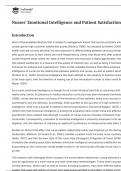
Nurses’ Emotional Intelligence and Patient Satisfaction Research Paper Introduction Most of the available literature that is related to management shows that service providers who have high emotional intelligence usually garner high customer satisfaction scores (Kerfoot, 1996). As indicated by Rowell (2004), service excellence and quality health care are not only decisive, but also important in differentiating between service providers. The service providers who offer good services to their clients are more frequented by clients than those who offer undesirable services to clients. Clients usually frequent areas where the value of their money and resources is highly appreciated. Gessell and Wolosin (2004) state that patient satisfaction is a measure of the quality of medical care, as well as being a forecaster of a number of upbeat outcomes for patients and organizations. There is little available literature that offers evidence of the impact of the emotional intelligence of nurses on the relationship between patients and nurses, as well as patient satisfaction (Wagner et al., 2002; Stratton et al., 2005). Emotional intelligence has been defined as the capacity to examine one’s and other people’s feelings, and to tell them apart, with the intention of making use of this information in order to direct one’s thoughts and action (Salovey and Mayer, 1990). As a result, emotional intelligence is thought to be a vital individual trait that is concerned with fostering nurse-patient relationship; hence, its presence in medical education curriculum has been increased tremendously. According to Goleman (1998), nurses that are more conscious of the emotions of their patients, enjoy more success in their treatment than their counterparts who are oblivious. Accordingly, three quarters of the success of a high achiever is related to emotional intelligence, while only a quarter is related to technical proficiency (Harvard & Rutgers, 2002). As a result, Epstein and Hundert (2002) note that emotional intelligence is among the evaluation items under moral and affective domains. Several medical practitioners have realized that although a number of nurses may be clinically competent, they may lack adequate practical social skills. Consequently, evaluation of emotional intelligence is presently employed in the selection of medical school hopefuls, with the intention of checking an applicant’s proficiency in interpersonal skills (Elan, 2000; Carrathers et al., 2000). Studies on factors that affect the nurse-patient relationship mainly put emphasis on the demographic characteristics of a nurse (Duberstein, Meldrum, & Fiscella et al., 2006); whether a patient visits the same nurse routinely, or not (Kearley, Freeman & Heath, 2001); and the interview style of the nurse style (Graugaard, Holgersen, & Finset, 2006). As a result, it is very important to explore the existing association between emotional intelligence and personal satisfaction between patients and nurses. Expounding on this connection would enable nurses to not only provide clinically sound care, but to be emotionally responsive as well. This research will investigate three concepts; the nurse-patient relationship, caring behaviors of a nurse, as well as the patient’s trust by application of a multi-source and multi-level data methodologies. These three concepts will be explored amongst nursing directors, senior staff, as well as nurses, including surgeons, who cover different specialties. This is contrary to earlier studies that used self-ratings of nurses who were board-certified in psychiatry or family medicine, individual patients, or medical students, as their units of analysis. This study will also take a look at how these concepts associate with each other.
École, étude et sujet
- Établissement
- The Impact of Nursing Informatics on Patient
- Cours
- The Impact of Nursing Informatics on Patient
Infos sur le Document
- Publié le
- 9 août 2023
- Nombre de pages
- 5
- Écrit en
- 2023/2024
- Type
- AUTRE
- Personne
- Inconnu
Sujets
-
nurses’ emotional intelligence and patient satis
-
a
-
nurses’ emotional intelligence and patient
-
nurses’ emotional intelligence

Document également disponible en groupe