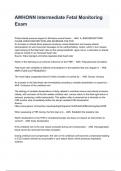
AWHONN Intermediate Fetal Monitoring Exam Questions And Answers
AWHONN Intermediate Fetal Monitoring Exam Questions And Answers If fetal arterial pressure begins to fall below normal levels: - ANS A. BARORECEPTORS CAUSE VASOCONSTRICTION AND INCREASE THE FHR An increase in arterial blood pressure produces vessel distension and causes arterial baroreceptors to send neuronal messages to the cardioinhibitory center, which in turn causes rapid slowing of the fetal heart rate via the parasympathetic vagus nerve. A decrease in arterial pressure results in an increased heart rate. Source: Which of the following is an extrinsic influence on the FHR? - ANS Fetal-placental circulation Fetal heart rate variability is defined as fluctuations in the baseline that are irregular in - ANS AMPLITUDE and FREQUENCY The most highly oxygenated blood in fetal circulation is carried by: - ANS Ductus venosus An increase in the fetal heart rate immediately preceding a variable deceleration is caused by: - ANS Occlusion of the umbilical vein The etiology of variable decelerations is likely related to umbilical venous and arterial occlusion. Initially, with occlusion of the thin-walled umbilical vein, venous return to the fetal right atrium is reduced, producing a reflex tachycardia. This pattern often is observed as a shoulder on the FHR monitor strip immediately before the abrupt variable FHR deceleration Source: When assessing a FHR tracing, the first step
École, étude et sujet
- Établissement
- POEP AWHONN
- Cours
- POEP AWHONN
Infos sur le Document
- Publié le
- 2 mars 2024
- Nombre de pages
- 2
- Écrit en
- 2023/2024
- Type
- Examen
- Contient
- Questions et réponses
Sujets
-
awhonn intermediate fetal monitoring exam

Document également disponible en groupe