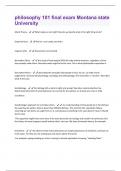
philosophy 101 final exam Montana state University Questions And Answers Rated A+ New Update Assured Satisfaction
Moral Theory - What makes an act right? How do we decide what is the right thing to do? Empirical facts - Not for us to create, but learn Logical truths - discovered, not invented Normative Ethics - the study of how people SHOULD make ethical decisions, regardless of how they actually make them. Describes what ought to be the case. This is what philosophers specialize in. Descriptive Ethics - describing the principles that people in fact, do use , to make moral judgements. Sciences like psychology, sociology, and anthropology. The researcher is "neutral." Describes what IS the case. Sociobiology - Can biology tell us what is right and wrong? Key idea: natural selection has determined what kind of social behavior has survival for the species, or at least your clan or tribe. E.O Wilson Sociobiology's approach to normative ethics - -An understanding of why people do in fact behave the way they do yields a theory about they SHOULD behave. This commits the naturalistic fallacy, assuming we can derive an ought from an is. Just because something is the case doesn't mean it should be the case. -This argument might have more force if we were bound by our biology and couldn't do otherwise. But the history of moral progress would indicate that's not true. We have eliminated slavery, for example. Emotivism - -the doctrine that moral utterances are simply expressions of emotions, and have no truth value , for they are not making any real claims about the world. -For example, saying cheating on a test is wrong is actually equivalent to saying, "cheating? Boo"-The theory of meaning that generated it was the verifiability theory of meaning popular in the mid part of the 20th century, championed by a school of thought called logical positivism: if a sentence cannot be verified (if there is no way to determine what would make it true or false), then it is cognitively meaningless-- that is, neither true nor false. Criticisms of Emotivism - -can't account for any real moral disagreements, which flies in the face of common sense. Saying Hitler was wrong to murder 6 million Jews means more than just "Hitler-Boo" -If this theory is correct, then we can't condemn something like torturing innocent children as genuinely wrong. But is it right? -Common sense can be wrong, but you need good reasons to reject it. Emotivism does not offer any. Objection to using a moral code to decide right from wrong - they can offer guidance, but they can't function as full blown theories of what makes an act right or wrong, for they are often too general or specific to solve a moral problem, and they can offer conflicting advice. -What if my parents tell me to steal? What if the only way to save a bunch of people is to kill one? "Bizarre consequences" of individual realism - -you can never be wrong, (assuming you fully know the situation and have thought it through). -You are morally infallible by definition. -You make an action right simply by agreeing with it. -Moral disagreement is reduced to persuasion and matters of opinion, nothing objective. Most importantly, if taken to its logical conclusion, it leads to judgements no one would accept. Ex; if Hitler thought what murdering Jews was right , then it was right for him.
École, étude et sujet
- Établissement
- Philosophy 101 Montana state University
- Cours
- Philosophy 101 Montana state University
Infos sur le Document
- Publié le
- 21 mai 2024
- Nombre de pages
- 17
- Écrit en
- 2023/2024
- Type
- Examen
- Contient
- Questions et réponses
Sujets
-
philosophy 101 montana state university

Document également disponible en groupe