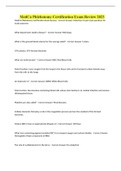
BMAL-590 Week 1 Section 4 Marketing
Research Tools
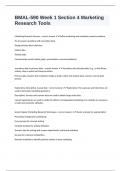
Marketing Research Process - correct answer ✔✔Define marketing and marketing research problem.
Try to answer questions with secondary data.
Design primary data collection.
Collect data
Analyze data
Communicate results (white paper, presentation, recommendations)
secondary date vs primary data - correct answer ✔✔Secondary data already exists (e.g., in the library,
online); they're quick and cheap to obtain.
Primary data requires that marketers design a study, collect and analyze data; answers can be quite
precise.
Exploratory, Descriptive, Causal data - correct answer ✔✔Exploratory: Focus groups and interviews are
used to formulate marketing questions.
Descriptive: Surveys and scanner data are used to obtain large-scale stats.
Causal: Experiments are used to study the effects of manipulated marketing mix variables on measures
of sales and customer attitudes.
Seven Popular Marketing Research Techniques - correct answer ✔✔Cluster analysis for segmentation
Perceptual mapping for positioning
Focus groups for concept testing
Conjoint Analysis for testing attributes
Scanner data for pricing and coupon experiments and brand switching
Surveys for customer satisfaction
Network methods to identify opinion leaders in buzz marketing
, Ideal points - correct answer ✔✔Perceptual maps with ideal points, one point per customer, are
frequently used to identify opportunities. These perceptual maps offer a great deal of descriptive
information about current positions among competitors. A strategic question is to consider possible
repositioning efforts.
conjoint analysis - correct answer ✔✔conjoint studies are run to understand how consumers make
trade-offs among attributes uncovering what combinations of attributes customers value most.
sampling - correct answer ✔✔Probability sample—Implies the probability of selecting any respondent
from the population into the sample is known
Simple random sample—When every population element (e.g., a person) has an equal chance of being
included in the sample
Nonprobability sample—A sample drawn due to specific research considerations and/or the researcher's
judgement (a shopping mall-intercept survey)
Typically, a focus group should include ____.
A 2 - 4 customers.
B 4 - 6 customers.
C 8 - 10 customers.
D more than 15 customers. - correct answer ✔✔C
Information from conjoint analysis is used in the following EXCEPT ______.
A brand extension
B pricing
C sampling
D new product design - correct answer ✔✔C
Positioning studies and perceptual maps are closely related to this marketing research technique
______.
Research Tools
Marketing Research Process - correct answer ✔✔Define marketing and marketing research problem.
Try to answer questions with secondary data.
Design primary data collection.
Collect data
Analyze data
Communicate results (white paper, presentation, recommendations)
secondary date vs primary data - correct answer ✔✔Secondary data already exists (e.g., in the library,
online); they're quick and cheap to obtain.
Primary data requires that marketers design a study, collect and analyze data; answers can be quite
precise.
Exploratory, Descriptive, Causal data - correct answer ✔✔Exploratory: Focus groups and interviews are
used to formulate marketing questions.
Descriptive: Surveys and scanner data are used to obtain large-scale stats.
Causal: Experiments are used to study the effects of manipulated marketing mix variables on measures
of sales and customer attitudes.
Seven Popular Marketing Research Techniques - correct answer ✔✔Cluster analysis for segmentation
Perceptual mapping for positioning
Focus groups for concept testing
Conjoint Analysis for testing attributes
Scanner data for pricing and coupon experiments and brand switching
Surveys for customer satisfaction
Network methods to identify opinion leaders in buzz marketing
, Ideal points - correct answer ✔✔Perceptual maps with ideal points, one point per customer, are
frequently used to identify opportunities. These perceptual maps offer a great deal of descriptive
information about current positions among competitors. A strategic question is to consider possible
repositioning efforts.
conjoint analysis - correct answer ✔✔conjoint studies are run to understand how consumers make
trade-offs among attributes uncovering what combinations of attributes customers value most.
sampling - correct answer ✔✔Probability sample—Implies the probability of selecting any respondent
from the population into the sample is known
Simple random sample—When every population element (e.g., a person) has an equal chance of being
included in the sample
Nonprobability sample—A sample drawn due to specific research considerations and/or the researcher's
judgement (a shopping mall-intercept survey)
Typically, a focus group should include ____.
A 2 - 4 customers.
B 4 - 6 customers.
C 8 - 10 customers.
D more than 15 customers. - correct answer ✔✔C
Information from conjoint analysis is used in the following EXCEPT ______.
A brand extension
B pricing
C sampling
D new product design - correct answer ✔✔C
Positioning studies and perceptual maps are closely related to this marketing research technique
______.