Marketing Nathalie Dens
Principles of Marketing communications
Defining marketing communications
Marketing communication (MC):
management process that organization uses to attempt to engage with various audience, by
conveying significant messages audiences are encouraged to offer attitudinal/behavioral responses
- 3 elements
o Engagement
what are the audiences’ communications needs and is it possible to engage with
them on their terms using one-way, two-way or dialogic communications?
o Audiences
which specific audience do we need to communicate with and what are their various
behaviour and information processing needs?
o Responses
what are desired outcomes of communication process, are they based on changes in
perception, values and beliefs or are changes in behaviour required?
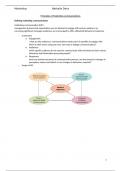
- Scope of MC
1
, Marketing Nathalie Dens
How MC works
3 main interpretations
o Linear model
info is directed and shot at the audiences
o 2-step model
recognizes importance of personal influences when informing and persuading
audiences
o Interaction model
1 important difference with 2-step model: parties interact among themselves and
communication flows among all members = communication network
Encoding:
process of having the sender transform an idea into a set of symbols, very creative process with
many possibilities, automatic VS deliberate process, make the message
Decoding:
process of having the receiver take a set of symbols into an idea, perception = reality, coloured by
own model of the world (our beliefs, attitudes, values), process the message
Opinion leader:
ordinary person who has heightened interest in particular topic, belong to same peer group as the
people they influence
Opinion former:
exert personal influence because their profession, authority, education or status is associated with
the topic
Word of mouth:
interpersonal communication regarding products/services where receiver regards communicator as
impartial
2
Principles of Marketing communications
Defining marketing communications
Marketing communication (MC):
management process that organization uses to attempt to engage with various audience, by
conveying significant messages audiences are encouraged to offer attitudinal/behavioral responses
- 3 elements
o Engagement
what are the audiences’ communications needs and is it possible to engage with
them on their terms using one-way, two-way or dialogic communications?
o Audiences
which specific audience do we need to communicate with and what are their various
behaviour and information processing needs?
o Responses
what are desired outcomes of communication process, are they based on changes in
perception, values and beliefs or are changes in behaviour required?
- Scope of MC
1
, Marketing Nathalie Dens
How MC works
3 main interpretations
o Linear model
info is directed and shot at the audiences
o 2-step model
recognizes importance of personal influences when informing and persuading
audiences
o Interaction model
1 important difference with 2-step model: parties interact among themselves and
communication flows among all members = communication network
Encoding:
process of having the sender transform an idea into a set of symbols, very creative process with
many possibilities, automatic VS deliberate process, make the message
Decoding:
process of having the receiver take a set of symbols into an idea, perception = reality, coloured by
own model of the world (our beliefs, attitudes, values), process the message
Opinion leader:
ordinary person who has heightened interest in particular topic, belong to same peer group as the
people they influence
Opinion former:
exert personal influence because their profession, authority, education or status is associated with
the topic
Word of mouth:
interpersonal communication regarding products/services where receiver regards communicator as
impartial
2