Psychopharm MSN 634 Review Questions with Complete Solutions Rated 100%
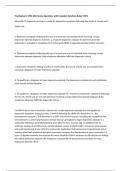
What DSM-5 diagnostic provision is made for depressive symptoms following the death of a loved one?
Select one:
a. Depressive symptoms following the loss of a loved one are excluded from receiving a major
depressive episode diagnosis; however, a proposed diagnostic category for post-bereavement
depression is included in 'Conditions for Further Study (DSM-5 Appendix) pending further research.
b. Depressive symptoms following the loss of a loved one are not excluded from receiving a major
depressive episode diagnosis if the symptoms otherwise fulfill the diagnostic criteria
c. Depressive symptoms lasting less than 2 months after the loss of a loved one are excluded from
receiving a diagnosis of major depressive episode.
d. To qualify for a diagnosis of major depressive episode, the depressive symptoms in such individuals
must include suicidal ideation.
e. To qualify for a diagnosis of major depressive episode, th - Answers b. Depressive symptoms following
the loss of a loved one are not excluded from receiving a major depressive episode diagnosis if the
symptoms otherwise fulfill the diagnostic criteria
-In DSM-IV there was an exclusion criterion for a major depressive episode that was applied to
depressive symptoms lasting less than 2 months following the death of a loved one (i.e., the
bereavement exclusion). This exclusion is in DSM-5 for several reasons, including the recognition that
bereavement is a severe psychosocial stressor that can precipitate a major depressive episode in a
vulnerable individual, generally beginning soon after the loss , and can add an additional risk of
suffering, feelings of worthlessness, suicidal ideation, poorer medical health, and worse interpersonal
and work functioning. It was critical to remove the implication that bereavement typically lasts only 2
months, when both physicians and grief counselors recognize that the duration is more commonly 1-2
years. A detailed footnote has replaced the more simplistic DSM-IV exclusion to aid clinicians in making
the critical distinction between the symptoms characteristic of bereavement and those of major
depressive disorder. (811)
,A precursor substance from which both dopamine and norepinephrine are synthesized through
enzymatic action
Select one:
a. Dopamine
b. Tyrosine
c. Trazodone
d. Serotonin - Answers b. Tyrosine
Tyrosine is a precursor element necessary for the synthesis of both norepinephrine and dopamine. For
serortonin the precursor necessary is tryptophan
Which of the following statements about how grief differs from a major depressive episode (MDE) is
false?
Select one:
a. In grief feelings of worthlessness and self-loathing are common; in MDE, self-esteem is generally
preserved
b. The thought content associated with grief generally features a preoccupation with thoughts and
memories of the deceased rather than the self-critical or pessimistic ruminations seen in MDE
c. The pain of grief may be accompanied by positive emotions and humor that are uncharacteristic of
the pervasive unhappiness and misery characteristic of MDE
d. If a bereaved individual thinks about death and dying, such thoughts are generally focused on the
deceased person and possibly 'joining' the deceased, whereas in MDE such thoughts are focused on
ending one's own life because feeling worthless, undeserving of life, or unable to cope with the pain of
depression.
,e. In grief the predominant a - Answers a. In grief feelings of worthlessness and self-loathing are
common; in MDE, self-esteem is generally preserved
In distinguishing grief from MDE, it is useful to consider that in grief the predominant affect is feelings of
emptiness and loss, while in MDE it is persistent depressed mood and the inability to anticipate
happiness or pleasure. The dysphoria in grief is likely to decrease in intensity over days to weeks and
occurs in waves, the so-called pangs of grief. These waves tend to be associated with thoughts or
reminders of the deceased. The depressed mood of MDE is more persistent and not tied to specific
thoughts or preoccupations. The pain of grief may be accompanied by positive emotions and humor that
are uncharacteristic of MDE. The thought content associated with grief generally features a
preoccupation with thoughts and memories of the deceased rather than the self-critical or pessimistic
ruminations seen in MDE. In grief, self-esteem is generally preserved, whereas in MDE feelings of
worthless and self-loathing are common. If self-derogatory ideation is present in grief, it typically
involves perceived failings vis-à-vis the deceased (e.g., not visiting frequently enough, not telling the
deceased how much he or she was loved.) If a bereaved individual thinks about death and dying, such
thoughts are generally focused on the deceased and possibly about 'joining' the deceased, whereas in
MDE such thoughts are focused on ending one's own life because of feeling worthless, undeserving of
life, or unable to cope with the pain of depression. (161)
A 45 year-old man with classic features of schizophrenia has always experienced co-occurring symptoms
of depression - including feeling 'down in the dumps,' having a poor appetite, feeling hopeless, and
suffering from insomnia - during his episodes of active psychosis. These depressive symptoms occurred
only during his psychotic episodes and only during the 2-year period when the patient was experiencing
active symptoms of schizophrenia. After his psychotic episodes were successfully controlled by
medication, no further symptoms of depression were present. The patient has never met full criteria for
major depressive disorder at any time. What is the appropriate DSM-5 diagnosis?
Select one:
a. Persistent depressive disorder (dysthymia)
b. Schizoaffective disorder
c. Unspecified schizophrenia spectrum and other psychotic disorder
d. Schizophrenia
, e. Schizophrenia and persistent depressive disorder (dysthymia) - Answers d. Schizophrenia
Depressive symptoms are a common associated feature of chronic psychotic disorders (e.g.
schizoaffective disorder, schizophrenia, delusional disorder). A separate diagnosis of persistent
depressive disorder is not made if the symptoms occur only during the course of the psychotic disorder
(including residual phase). (171)
A 45-year-old man is admitted to the hospital with profound hypothyroidism. He is depressed but does
not meet full criteria for major depressive disorder (MDD), the diagnosis given to him by his internist.
The patient has no prior history of mood disorder, and all of the depressive symptoms are temporally
related to the hypothyroidism. Based on this information, you determine that a change in diagnosis - to
depressive disorder due to another medical condition - is warranted, as well as a specifier to indicate
that full criteria for MDD are not met. How would the full diagnosis be recorded
Select one:
a. Hypothyroidism would be coded on Axis III in DSM-5
b. A revision to DSM-5 is planned to deal with this.
c. There is no special coding procedure in DSM-5
d. Medical disorders are not coded as part of a mental disorder diagnosis in DSM-5
e. Hypothyroidism would be recorded as the name of the 'other medical condition' i - Answers e.
Hypothyroidism would be recorded as the name of the 'other medical condition' in the DSM-5 diagnosis
In recording a diagnosis of depressive disorder due to another medical condition, the name of the other
medical condition is inserted in the mental disorder diagnosis (i.e., 'depressed disorder due to
hypothyroidism'). In addition, the other medical condition should be coded and listed separately
immediately before the depression disorder due to the medical condition. In this vignette, the full
coding would be '244.9 (E03.9) hypothyroidism; 293.83 (F06.31) disorder due to hypothyroidism, with
depressive features.' (The 'depressive features' specifier denotes that the full criteria are not met for a
major depressive episode.). There is no longer an Axis III in DSM-5 (181).
Which of the following antidepressants has the most seizurogenic potential?
What DSM-5 diagnostic provision is made for depressive symptoms following the death of a loved one?
Select one:
a. Depressive symptoms following the loss of a loved one are excluded from receiving a major
depressive episode diagnosis; however, a proposed diagnostic category for post-bereavement
depression is included in 'Conditions for Further Study (DSM-5 Appendix) pending further research.
b. Depressive symptoms following the loss of a loved one are not excluded from receiving a major
depressive episode diagnosis if the symptoms otherwise fulfill the diagnostic criteria
c. Depressive symptoms lasting less than 2 months after the loss of a loved one are excluded from
receiving a diagnosis of major depressive episode.
d. To qualify for a diagnosis of major depressive episode, the depressive symptoms in such individuals
must include suicidal ideation.
e. To qualify for a diagnosis of major depressive episode, th - Answers b. Depressive symptoms following
the loss of a loved one are not excluded from receiving a major depressive episode diagnosis if the
symptoms otherwise fulfill the diagnostic criteria
-In DSM-IV there was an exclusion criterion for a major depressive episode that was applied to
depressive symptoms lasting less than 2 months following the death of a loved one (i.e., the
bereavement exclusion). This exclusion is in DSM-5 for several reasons, including the recognition that
bereavement is a severe psychosocial stressor that can precipitate a major depressive episode in a
vulnerable individual, generally beginning soon after the loss , and can add an additional risk of
suffering, feelings of worthlessness, suicidal ideation, poorer medical health, and worse interpersonal
and work functioning. It was critical to remove the implication that bereavement typically lasts only 2
months, when both physicians and grief counselors recognize that the duration is more commonly 1-2
years. A detailed footnote has replaced the more simplistic DSM-IV exclusion to aid clinicians in making
the critical distinction between the symptoms characteristic of bereavement and those of major
depressive disorder. (811)
,A precursor substance from which both dopamine and norepinephrine are synthesized through
enzymatic action
Select one:
a. Dopamine
b. Tyrosine
c. Trazodone
d. Serotonin - Answers b. Tyrosine
Tyrosine is a precursor element necessary for the synthesis of both norepinephrine and dopamine. For
serortonin the precursor necessary is tryptophan
Which of the following statements about how grief differs from a major depressive episode (MDE) is
false?
Select one:
a. In grief feelings of worthlessness and self-loathing are common; in MDE, self-esteem is generally
preserved
b. The thought content associated with grief generally features a preoccupation with thoughts and
memories of the deceased rather than the self-critical or pessimistic ruminations seen in MDE
c. The pain of grief may be accompanied by positive emotions and humor that are uncharacteristic of
the pervasive unhappiness and misery characteristic of MDE
d. If a bereaved individual thinks about death and dying, such thoughts are generally focused on the
deceased person and possibly 'joining' the deceased, whereas in MDE such thoughts are focused on
ending one's own life because feeling worthless, undeserving of life, or unable to cope with the pain of
depression.
,e. In grief the predominant a - Answers a. In grief feelings of worthlessness and self-loathing are
common; in MDE, self-esteem is generally preserved
In distinguishing grief from MDE, it is useful to consider that in grief the predominant affect is feelings of
emptiness and loss, while in MDE it is persistent depressed mood and the inability to anticipate
happiness or pleasure. The dysphoria in grief is likely to decrease in intensity over days to weeks and
occurs in waves, the so-called pangs of grief. These waves tend to be associated with thoughts or
reminders of the deceased. The depressed mood of MDE is more persistent and not tied to specific
thoughts or preoccupations. The pain of grief may be accompanied by positive emotions and humor that
are uncharacteristic of MDE. The thought content associated with grief generally features a
preoccupation with thoughts and memories of the deceased rather than the self-critical or pessimistic
ruminations seen in MDE. In grief, self-esteem is generally preserved, whereas in MDE feelings of
worthless and self-loathing are common. If self-derogatory ideation is present in grief, it typically
involves perceived failings vis-à-vis the deceased (e.g., not visiting frequently enough, not telling the
deceased how much he or she was loved.) If a bereaved individual thinks about death and dying, such
thoughts are generally focused on the deceased and possibly about 'joining' the deceased, whereas in
MDE such thoughts are focused on ending one's own life because of feeling worthless, undeserving of
life, or unable to cope with the pain of depression. (161)
A 45 year-old man with classic features of schizophrenia has always experienced co-occurring symptoms
of depression - including feeling 'down in the dumps,' having a poor appetite, feeling hopeless, and
suffering from insomnia - during his episodes of active psychosis. These depressive symptoms occurred
only during his psychotic episodes and only during the 2-year period when the patient was experiencing
active symptoms of schizophrenia. After his psychotic episodes were successfully controlled by
medication, no further symptoms of depression were present. The patient has never met full criteria for
major depressive disorder at any time. What is the appropriate DSM-5 diagnosis?
Select one:
a. Persistent depressive disorder (dysthymia)
b. Schizoaffective disorder
c. Unspecified schizophrenia spectrum and other psychotic disorder
d. Schizophrenia
, e. Schizophrenia and persistent depressive disorder (dysthymia) - Answers d. Schizophrenia
Depressive symptoms are a common associated feature of chronic psychotic disorders (e.g.
schizoaffective disorder, schizophrenia, delusional disorder). A separate diagnosis of persistent
depressive disorder is not made if the symptoms occur only during the course of the psychotic disorder
(including residual phase). (171)
A 45-year-old man is admitted to the hospital with profound hypothyroidism. He is depressed but does
not meet full criteria for major depressive disorder (MDD), the diagnosis given to him by his internist.
The patient has no prior history of mood disorder, and all of the depressive symptoms are temporally
related to the hypothyroidism. Based on this information, you determine that a change in diagnosis - to
depressive disorder due to another medical condition - is warranted, as well as a specifier to indicate
that full criteria for MDD are not met. How would the full diagnosis be recorded
Select one:
a. Hypothyroidism would be coded on Axis III in DSM-5
b. A revision to DSM-5 is planned to deal with this.
c. There is no special coding procedure in DSM-5
d. Medical disorders are not coded as part of a mental disorder diagnosis in DSM-5
e. Hypothyroidism would be recorded as the name of the 'other medical condition' i - Answers e.
Hypothyroidism would be recorded as the name of the 'other medical condition' in the DSM-5 diagnosis
In recording a diagnosis of depressive disorder due to another medical condition, the name of the other
medical condition is inserted in the mental disorder diagnosis (i.e., 'depressed disorder due to
hypothyroidism'). In addition, the other medical condition should be coded and listed separately
immediately before the depression disorder due to the medical condition. In this vignette, the full
coding would be '244.9 (E03.9) hypothyroidism; 293.83 (F06.31) disorder due to hypothyroidism, with
depressive features.' (The 'depressive features' specifier denotes that the full criteria are not met for a
major depressive episode.). There is no longer an Axis III in DSM-5 (181).
Which of the following antidepressants has the most seizurogenic potential?