Nickel is a metal with a high melting point.
State the block in the Periodic Table that contains nickel.
D block
Explain, in terms of its structure and bonding, why nickel has a
high melting point.
1. There is a strong attraction between the positive metal ions
and the delocalised sea of electrons
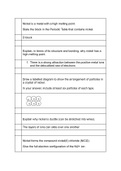
Draw a labelled diagram to show the arrangement of particles in
a crystal of nickel.
In your answer, include at least six particles of each type.
Explain why nickel is ductile (can be stretched into wires).
The layers of ions can slide over one another
Nickel forms the compound nickel(II) chloride (NiCl2).
Give the full electron configuration of the Ni2+ ion
,1s2 2s2 2p6 3s2 3p6 3d8
Complete the electronic configuration of aluminium.
1s2 2s2 2p6 3s2 3p1
State the block in the Periodic Table to which aluminium belongs.
P block
Describe the bonding in metals.
1. Lattice of positive metal ions
2. Surrounded by delocalised electrons
Explain why the melting point of magnesium is higher than that of
sodium.
1. Greater nuclear charge
2. Smaller ions
3. More delocalised electrons
4. Stronger attraction between the ions and the delocalised
electrons
Explain how metals conduct electricity.
The delocalised electrons move in a given direction
, State the meaning of the term first ionisation energy of an atom.
The energy change when an electron is removed to form a uni
positive ion from a gaseous atom
Complete the electron arrangement for the Mg2+ ion.
1s2 2s2 2p6
Identify the block in the Periodic Table to which magnesium
belongs.
S block
Write an equation to illustrate the process occurring when the
second ionisation energy of magnesium is measured.
Mg+ -> Mg2+ +e-
1. Mg2+ ion smaller than Ne atom / Mg2+ e– closer to
nucleus
2. Mg2+ has more protons than Ne
State the block in the Periodic Table that contains nickel.
D block
Explain, in terms of its structure and bonding, why nickel has a
high melting point.
1. There is a strong attraction between the positive metal ions
and the delocalised sea of electrons
Draw a labelled diagram to show the arrangement of particles in
a crystal of nickel.
In your answer, include at least six particles of each type.
Explain why nickel is ductile (can be stretched into wires).
The layers of ions can slide over one another
Nickel forms the compound nickel(II) chloride (NiCl2).
Give the full electron configuration of the Ni2+ ion
,1s2 2s2 2p6 3s2 3p6 3d8
Complete the electronic configuration of aluminium.
1s2 2s2 2p6 3s2 3p1
State the block in the Periodic Table to which aluminium belongs.
P block
Describe the bonding in metals.
1. Lattice of positive metal ions
2. Surrounded by delocalised electrons
Explain why the melting point of magnesium is higher than that of
sodium.
1. Greater nuclear charge
2. Smaller ions
3. More delocalised electrons
4. Stronger attraction between the ions and the delocalised
electrons
Explain how metals conduct electricity.
The delocalised electrons move in a given direction
, State the meaning of the term first ionisation energy of an atom.
The energy change when an electron is removed to form a uni
positive ion from a gaseous atom
Complete the electron arrangement for the Mg2+ ion.
1s2 2s2 2p6
Identify the block in the Periodic Table to which magnesium
belongs.
S block
Write an equation to illustrate the process occurring when the
second ionisation energy of magnesium is measured.
Mg+ -> Mg2+ +e-
1. Mg2+ ion smaller than Ne atom / Mg2+ e– closer to
nucleus
2. Mg2+ has more protons than Ne