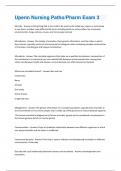
Upenn Nursing Patho/Pharm Exam 3 Questions With 100% Correct Solutions.
Microbe - Answer-A living thing that is too small to be seen by the naked eye; require a microscope to see them; includes many different life forms including bacteria, archea (often live in extreme environments), fungi, protists, viruses, and microscopic animals Microbiome - Answer-The totality of microbes, their genetic information, and the milieu in which they interact; typically consist of environmental or biological niches containing complex communities of microbes; including gut and tongue microbiomes Microbiota - Answer-The microbial organisms that make up a specified microbiome; composition of the microbiota in a community can vary substantially between environmental sites, among host niches and between health and disease; not just bacteria, but often focused on bacteria Where are microbiota found? - Answer-Skin and hair Conjunctiva Nares Airways Oral cavity Entire GI tract Urogenital tract Metagenome - Answer-The genetic information of a complex population, typically from microbes in an environmental or host niche sample, that is made up of the genomes of many individual organims -The human microbial metagenome (all of our micorbes' genes) can be considered a counterpart to the human genome (all of our human genes) Commensalism - Answer-A type of symbiotic relationship between two different organisms in which one species benefits and the other is unaffected Commensal bacteria - Answer-Term that is used to indicate normal/expected microbiota in different environments of the body Describe the usual relationship between humans and microbiota - Answer-Interdependent and mutualisticHow do mutualistic "friendly" bacteria become pathogenic - Answer-Growth becomes uncontrolled or occurs in the wrong anatomical place Phylotype - Answer-Microbial group defined by 16S rRNA sequence similarity (16S rRNA is a component of the 30S small subunit of prokaryotic ribosomes) Dysbiosis - Answer-Disturbed homeostasis of the microbiota composition -major cause: antibiotics and other drugs -Relationship is bi-directional: meds and other factors, including disease, can cause dysbiosis, but dysbiosis can cause disease -Cause and effect not always clear Positive effects of gut microbiome for body - Answer--Protect against pathogens -Train/Stimulate immune function -Supply nutrients, energy, vitamins, and SCFA Negative factors affecting the gut microbiome - Answer--Inflammation (local>systemic) -Oxidative stress -Increase in Gram negative bacteria -Infection (opportunistic/pathogenic) -Altered metabolite production
Geschreven voor
- Instelling
- Upenn Nursing Patho/Pharm
- Vak
- Upenn Nursing Patho/Pharm
Documentinformatie
- Geüpload op
- 28 maart 2024
- Aantal pagina's
- 65
- Geschreven in
- 2023/2024
- Type
- Tentamen (uitwerkingen)
- Bevat
- Vragen en antwoorden
Onderwerpen
-
upenn nursing pathopharm

Ook beschikbaar in voordeelbundel