CHEMICAL EQUALIBRIUM
DYNAMIC EQUALIBRIUM
Dynamic equilibrium – occurs when two processes are occurring
simultaneously at the same rate, in a closed system
Open system – a system in which both energy and matter can be exchanged
between the system and its surroundings
Closed system – a system in which mass is conserved inside the system but
energy can enter or leave the system freely
DYNAMIC CHEMICAL EQUALIBRIUM
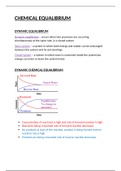
Concentration of reactants is high and rate of forward reaction is high
Reactants being consumed rate of forward reaction decreases
No products at start of the reaction, product is being formed reverse
reaction rate is high
Products are being consumed rate of reverse reaction decreases
, FACTORS THAT EFFECT DYNAMIC EQUALIBRIUM
1) Change in concentration
2) Change in temperature
3) Change in pressure
LE CHATELIERS PRINCIPLE
Le Chateliers principle – when an external stress (change in concentration,
pressure or tempreture) is applied to a system in chemical equilibrium, the
equilibrium point will change in such a way as to counter act the stress
CHANGE IN CONCENTRATION
Formula:
Addition of HCL
This will result in a reaction between the H2O and the HCL creating more
Cl- ions
This will result in the reverse reaction being favoured and an increase in
the rate of the reverse reaction
DYNAMIC EQUALIBRIUM
Dynamic equilibrium – occurs when two processes are occurring
simultaneously at the same rate, in a closed system
Open system – a system in which both energy and matter can be exchanged
between the system and its surroundings
Closed system – a system in which mass is conserved inside the system but
energy can enter or leave the system freely
DYNAMIC CHEMICAL EQUALIBRIUM
Concentration of reactants is high and rate of forward reaction is high
Reactants being consumed rate of forward reaction decreases
No products at start of the reaction, product is being formed reverse
reaction rate is high
Products are being consumed rate of reverse reaction decreases
, FACTORS THAT EFFECT DYNAMIC EQUALIBRIUM
1) Change in concentration
2) Change in temperature
3) Change in pressure
LE CHATELIERS PRINCIPLE
Le Chateliers principle – when an external stress (change in concentration,
pressure or tempreture) is applied to a system in chemical equilibrium, the
equilibrium point will change in such a way as to counter act the stress
CHANGE IN CONCENTRATION
Formula:
Addition of HCL
This will result in a reaction between the H2O and the HCL creating more
Cl- ions
This will result in the reverse reaction being favoured and an increase in
the rate of the reverse reaction