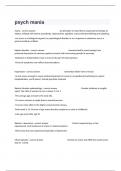
psych mania
mania - correct answer -an alteration in mood that is expressed by feelings of
elation, inflated self-esteem, grandiosity, hyperactivity, agitation, and accelerated thinking and speaking.
-can occur as a biological (organic) or psychological disorder or as a response to substance use or a
general medical condition
bipolar disorder - correct answer -characterized by mood swings from
profound depression to extreme euphoria (mania) with intervening periods of normalcy.
-Delusions or hallucinations may or may not be part of clinical picture.
-Onset of symptoms may reflect seasonal pattern.
hypomania - correct answer -somewhat milder form of mania
-its not severe enough to cause marked impairment in social or occupational functioning to require
hospitalization, and it doesn't include psychotic featured
Bipolar disorder epidemiology - correct answer -Gender incidence is roughly
equal: The ratio of women to men is about 1.2 to 1.
-The average age at onset is the early 20s.
-It is more common in single than in married persons.
-It occurs more often in the higher socioeconomic classes.
-Peak onset is 15-19 years of age some describe symptoms as early as childhood.
-Late age onset after age 50
Bipolar I: depressive - correct answer -Client is experiencing, or has
experienced, a full syndrome of manic or mixed symptoms
-Client may also have experienced episodes of depression.
Mixed episode - correct answer -Criteria for manic and MDD met nearly every
day for 1 week.
, -Requires hospitalization if severe enough
-Psychotic features may develp
Rapid Cycling - correct answer -Extreme forms of mood lability
-Occurrence of four or more mood episodes
-Manic, mixed, hypomanic, depressive
Bipolar II: hypomania - correct answer -Characterized by bouts of major
depression with episodic occurrence of hypomania
-Has never met criteria for full manic episode
Mania-elevated, expansive, or irritable mood - correct answer -Grandiosity
-Speech is pressured
-Flight of ideas
-Talkative and difficult to interrupt or follow thought process
-Need for sleep decreased
-Increase in goal directed activity-cleaning the house, walking the streets, gambling, sex
-Quickly deteriorates into disorganized behavior, agitation, hyperactivity
hypomanic - correct answer -Less severe than manic
-Does not cause social and/or occupational impairment
-Does not require hospitalization
-Sudden onset
-Preceded or followed by a depressive episode
Cyclothymic Disorder - correct answer -Chronic mood disturbance
-At least 2-year duration
-Numerous episodes of hypomania and depressed mood of insufficient severity to meet the criteria for
either bipolar I or II disorder
mania - correct answer -an alteration in mood that is expressed by feelings of
elation, inflated self-esteem, grandiosity, hyperactivity, agitation, and accelerated thinking and speaking.
-can occur as a biological (organic) or psychological disorder or as a response to substance use or a
general medical condition
bipolar disorder - correct answer -characterized by mood swings from
profound depression to extreme euphoria (mania) with intervening periods of normalcy.
-Delusions or hallucinations may or may not be part of clinical picture.
-Onset of symptoms may reflect seasonal pattern.
hypomania - correct answer -somewhat milder form of mania
-its not severe enough to cause marked impairment in social or occupational functioning to require
hospitalization, and it doesn't include psychotic featured
Bipolar disorder epidemiology - correct answer -Gender incidence is roughly
equal: The ratio of women to men is about 1.2 to 1.
-The average age at onset is the early 20s.
-It is more common in single than in married persons.
-It occurs more often in the higher socioeconomic classes.
-Peak onset is 15-19 years of age some describe symptoms as early as childhood.
-Late age onset after age 50
Bipolar I: depressive - correct answer -Client is experiencing, or has
experienced, a full syndrome of manic or mixed symptoms
-Client may also have experienced episodes of depression.
Mixed episode - correct answer -Criteria for manic and MDD met nearly every
day for 1 week.
, -Requires hospitalization if severe enough
-Psychotic features may develp
Rapid Cycling - correct answer -Extreme forms of mood lability
-Occurrence of four or more mood episodes
-Manic, mixed, hypomanic, depressive
Bipolar II: hypomania - correct answer -Characterized by bouts of major
depression with episodic occurrence of hypomania
-Has never met criteria for full manic episode
Mania-elevated, expansive, or irritable mood - correct answer -Grandiosity
-Speech is pressured
-Flight of ideas
-Talkative and difficult to interrupt or follow thought process
-Need for sleep decreased
-Increase in goal directed activity-cleaning the house, walking the streets, gambling, sex
-Quickly deteriorates into disorganized behavior, agitation, hyperactivity
hypomanic - correct answer -Less severe than manic
-Does not cause social and/or occupational impairment
-Does not require hospitalization
-Sudden onset
-Preceded or followed by a depressive episode
Cyclothymic Disorder - correct answer -Chronic mood disturbance
-At least 2-year duration
-Numerous episodes of hypomania and depressed mood of insufficient severity to meet the criteria for
either bipolar I or II disorder