100% tevredenheidsgarantie Direct beschikbaar na je betaling Lees online óf als PDF Geen vaste maandelijkse kosten 4.2 TrustPilot
logo-home
Tentamen (uitwerkingen)

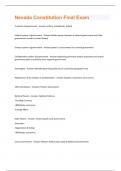
SCM 379 Final Exam | Verified with 100% Correct Answers

Beoordeling
-
Verkocht
-
Pagina's
12
Cijfer
A
Geüpload op
11-11-2024
Geschreven in
2024/2025

SCM 379 Final Exam | Verified with 100% Correct Answers Organizations operating under a just-in-time system, prefer to ship by: A) rail. B) same day air. C) truck. D) next-day air. E) intermodal carriers. Fuel efficiency and energy consumption considerations: A)are a factor in transportation strategy development in many organizations. B)have no impact on transportation strategy in most organizations. C)encourage shippers to focus on increasing LTL shipments. D)lead to disintermediation in the supply chain. E)result in lower use of third party logistics providers. Compared to other modes of transportation, motor carriers provide the advantage of: A) low variable operating costs. B) flexibility of point-to-point service. C) energy efficiency. D) low variable operating costs and flexibility of point-to-point service. E) flexibility of point-to-point service and energy efficiency. A transportation strategy should include consideration of: A) safety on the ground, in the air and on water. B) environmental factors, such as pollution. C) consolidation of freight. D) alternative transport modes. E) safety on the ground, in the air and on water, environmental factors, such as pollution, consolidation of freight and alternative transport modes. Compared to motor carriers, rail: A) is relatively inflexible and slow. B) has higher damage rates. C) is less attractive for hauling large tonnage over long distances. D) is relatively inflexible and slow, and has higher damage rates. E) is relatively inflexible and slow, has higher damage rates and is less attractive for hauling large tonnage over long distances. Integrated carriers (truck-air), such as UPS and Federal Express, are able to capture a larger market share because they: A) utilize their own aircraft. B) have extensive ground networks. C) have accurate, real-time logistics tracking systems. D) have extensive ground networks and have accurate, real-time logistics tracking systems. E) utilize their own aircraft, have extensive ground networks and have accurate, real-time logistics tracking systems. Marine transportation is: A) best suited for hauling large tonnage over long distances. B) disadvantaged because of the need for suitable networks, which are dependent on government support. C) not well suited for hauling commodities. D) best suited for hauling large tonnage over long distances and disadvantaged because of the need for suitable networks, which are dependent on government support. E) disadvantaged because of the need for suitable networks, which are dependent on government support and not well suited for hauling commodities. Demurrage charges: A) are never legitimate because delays are typically caused by the carrier's actions. B) are insignificant and can easily be justified in the buying organization. C) discourage the buyer from using a particular carrier. D) may indicate poor delivery scheduling on the part of the buying organization. E) are growing because of the lengthy delays in most supply chains. The selection of the FOB point is important to the purchaser, because it determines: A) who pays the carrier. B) when legal title to goods being shipped passes to the buyer. C) who is responsible for preparing and pursuing loss or damage claims. D) who routes the freight. E) who pays the carrier, when legal title to goods being shipped passes to the buyer, who is responsible for preparing and pursuing loss or damage claims and who routes the freight. A straight bill of lading : A) is used when the goods have been paid for in advance of shipment and requires delivery. B) is a negotiable instrument that can be used when goods are purchased on credit. C) is used to indicate that cargo was loaded onto a named vessel in good condition. D) is used when the goods have been paid for in advance of shipment and requires delivery, and is a negotiable instrument that can be used when goods are purchased on credit. E) is a negotiable instrument that can be used when goods are purchased on credit and is used to indicate that cargo was loaded onto a named vessel in good condition. Decreasing total business logistics costs as a percentage of the U.S. GDP may be attributed to: A) deregulation of the transportation sector. B) an increase in global supply chains. C) improved logistics technology systems and e-commerce. D) deregulation of the transportation sector and an increase in global supply chains. E) deregulation of the transportation sector, and improved logistics technology systems and e commerce With deregulation of the transportation industry and the development of intermodal service, the focus for the transport buyer is: A) selecting the best mode of transport. B) the carrier's ability to handle multiple parts of the logistics process. C) procuring logistics services at the lowest rates. D) bringing all logistics activities under the management of the VP of Supply. E) shifting responsibility for shipper-carrier relationships to the carrier. Transportation rates: A) are established primarily through negotiation. B) are lower for LTL than TL shipments. C) are established primarily by government regulation. D) typically decrease as delivery speed increases. E) typically do not change when smaller shipments are consolidated. Two effective logistics cost reduction strategies are partnering agreements with logistics services providers and long-term contracts. TRUE Third-party logistics service providers (3PLs) are carriers that always own assets (trucks, airplanes, railcars) and act as intermediaries between trading partners, for example, shippers and carriers. FALSE Transportation costs increase as distance, quantity, and speed increase. TRUE Truckload (TL) shipments are typically for short haul distances compared to less-than truckload (LTL) shipments. FALSE The cost per hundredweight (cwt) is generally higher for LTL shipments compared to TL shipments. TRUE Logistics is the management of inventory in motion and at rest. TRUE Marine transport is best suited for products of high value and/or extremely perishable FALSE Logistics costs can be divided into three categories: inventory carrying costs, administrative costs, and transportation (with transportation costs accounting for the bulk of the costs). TRUE The cost approach to pricing: A) is the only defensible pricing mechanism for ethical companies to use. B) implies that prices are set based on the cost the market will bear. C) means prices are adjusted to ensure the selling organization recoups all costs. D) implies that cost analysis is the only technique to be used to negotiate prices. E) means prices are set to cover direct costs, contribute to indirect costs, and provide a profit Labor and material costs are typically: A) semi-variable costs. B) fixed costs. C) indirect costs. D) direct costs. E) semi-variable costs and fixed costs. If the delivery date is some months or years away and if there is substantial chance of price escalation, a supplier may feel that there is far too much risk of loss to agree to sell under a: A) firm-fixed-price plus incentive fee (FFPIF). B) firm-fixed-price (FFP). C) cost-no-fee (CNF). D) cost-plus-fixed-fee (CPFF). E) cost-plus-incentive-fee (CPIF). This bond guarantees work will be done according to specifications, in the time specified, and if another supplier does rework or completes the order, purchasing is indemnified for these extra costs. A) bid bond. B) performance bond. C) lien bond. D) payment bond. E) surety bond. When using competitive bidding to determine prices, the purchaser should ensure that the bidders are: A) qualified to make the item or service in accordance with the buyer's specifications and able deliver it by the desired date. B) sufficiently reliable. C) numerous enough to ensure a truly competitive price. D) qualified to make the item or service in accordance with the buyer's specifications, able deliver it by the desired date and sufficiently reliable. E) qualified to make the item or service in a accordance with the buyer's specifications, able deliver it by the desired date, sufficiently reliable and numerous enough to ensure a truly competitive price. Items for which prices are comparatively low and the cost of price reduction efforts may exceed any price savings realized are: A) parts, components, and packaging. B) raw materials. C) maintenance, repair, and operating supplies. D) services. E) capital assets. A cash discount allows: A) the seller to secure prompt payment, but has no benefits for the buyer. B) the buyer to pay a lower price per unit, but has no benefits for the seller. C) the seller to secure prompt payment and the buyer to pay a lower price per unit. D) the seller to demand payment in cash on demand (C.O.D.) upon receipt of goods. E) the buyer to always calculate the discount based on the delivery date. Costs incurred in the operation of a production plant or process, but normally cannot be related directly to any given unit of production or service provided, are called: A) direct costs. B) variable costs. C) semivariable costs. D) indirect costs. E) fixed costs. The lowest bid may not receive the order if: A) the buyer discovers the lowest bidder is unreliable. B) the lowest bid is higher than the buyer believes justifiable. C) there is reason to believe the bidders colluded. D) the lowest bid is higher than the buyer believes justifiable and there is reason to believe the bidders colluded. E) the buyer discovers the lowest bidder is unreliable, the lowest bid is higher than the buyer believes justifiable and there is reason to believe the bidders colluded. A cash discount of 1/15, N/30 (1 percent cash discount if payment is made in 15 days, with the gross amount due in 30 days) is the equivalent of what approximate interest rate? A) 24 percent. B) 30 percent. C) 36 percent. D) 45 percent. E) 54 percent. The fairest possible means of treating all suppliers alike in a competitive bidding situation is to: A) establish a policy of firm bidding. B) allow all bidders to change their bids prior to the bid opening. C) allow for negotiation after all bids are received. D) give prospective suppliers target cost. E) none of the above because competitive bidding is not fair. If identical bids are received, the buyer might choose to: A) reject all bids. B) initiate an investigation. C) negotiate with one or more suppliers. D) reject all bids and initiate an investigation. E) reject all bids and negotiate with one or more suppliers. Hedging is a way to: A) ensure lowest price.

Meer zien Lees minder
Instelling
SCM 379
Vak
SCM 379


Oeps! We kunnen je document nu niet laden. Probeer het nog eens of neem contact op met support.

Geschreven voor

Instelling
SCM 379
Vak
SCM 379

Documentinformatie

Geüpload op
11 november 2024
Aantal pagina's
12
Geschreven in
2024/2025
Type
Tentamen (uitwerkingen)
Bevat
Vragen en antwoorden

Onderwerpen

Voorbeeld van de inhoud

SCM 379 Final Exam


Organizations operating under a just-in-time system, prefer to ship by:

A) rail.
B) same day air.
C) truck.
D) next-day air.
E) intermodal carriers.

Fuel efficiency and energy consumption considerations:

A)are a factor in transportation strategy development in many organizations.
B)have no impact on transportation strategy in most organizations.
C)encourage shippers to focus on increasing LTL shipments.
D)lead to disintermediation in the supply chain.
E)result in lower use of third party logistics providers.

Compared to other modes of transportation, motor carriers provide the advantage of:

A) low variable operating costs.
B) flexibility of point-to-point service.
C) energy efficiency.
D) low variable operating costs and flexibility of point-to-point service.
E) flexibility of point-to-point service and energy efficiency.

A transportation strategy should include consideration of:

A) safety on the ground, in the air and on water.
B) environmental factors, such as pollution.
C) consolidation of freight.
D) alternative transport modes.
E) safety on the ground, in the air and on water, environmental factors, such as
pollution, consolidation of freight and alternative transport modes.

Compared to motor carriers, rail:

A) is relatively inflexible and slow.
B) has higher damage rates.
C) is less attractive for hauling large tonnage over long distances.
D) is relatively inflexible and slow, and has higher damage rates.

, E) is relatively inflexible and slow, has higher damage rates and is less attractive for
hauling large tonnage over long distances.

Integrated carriers (truck-air), such as UPS and Federal Express, are able to capture a
larger market share because they:

A) utilize their own aircraft.
B) have extensive ground networks.
C) have accurate, real-time logistics tracking systems.
D) have extensive ground networks and have accurate, real-time logistics tracking
systems.
E) utilize their own aircraft, have extensive ground networks and have accurate, real-
time logistics tracking systems.

Marine transportation is:

A) best suited for hauling large tonnage over long distances.
B) disadvantaged because of the need for suitable networks, which are dependent on
government support.
C) not well suited for hauling commodities.
D) best suited for hauling large tonnage over long distances and disadvantaged
because of the need for suitable networks, which are dependent on government
support.
E) disadvantaged because of the need for suitable networks, which are dependent on
government support and not well suited for hauling commodities.

Demurrage charges:

A) are never legitimate because delays are typically caused by the carrier's actions.
B) are insignificant and can easily be justified in the buying organization.
C) discourage the buyer from using a particular carrier.
D) may indicate poor delivery scheduling on the part of the buying organization.
E) are growing because of the lengthy delays in most supply chains.

The selection of the FOB point is important to the purchaser, because it determines:

A) who pays the carrier.
B) when legal title to goods being shipped passes to the buyer.
C) who is responsible for preparing and pursuing loss or damage claims.
D) who routes the freight.
E) who pays the carrier, when legal title to goods being shipped passes to the buyer,
who is responsible for preparing and pursuing loss or damage claims and who routes
the freight.

A straight bill of lading :
Maak kennis met de verkoper

Seller avatar
De reputatie van een verkoper is gebaseerd op het aantal documenten dat iemand tegen betaling verkocht heeft en de beoordelingen die voor die items ontvangen zijn. Er zijn drie niveau’s te onderscheiden: brons, zilver en goud. Hoe beter de reputatie, hoe meer de kwaliteit van zijn of haar werk te vertrouwen is.
Bri254 Rasmussen College
Volgen Je moet ingelogd zijn om studenten of vakken te kunnen volgen
Verkocht
896
Lid sinds
5 jaar
Aantal volgers
738
Documenten
3385
Laatst verkocht
2 weken geleden
Best Tutorials, Exam guides, Homework help.

When assignments start weighing you down, take a break. I'm here to create a hassle-free experience by providing up-to-date and recent study materials. Kindly message me if you can't find your tutorial and I will help.

4,0

179 beoordelingen

5
106
4
20
3
25
2
5
1
23

Recent door jou bekeken

Waarom studenten kiezen voor Stuvia

Gemaakt door medestudenten, geverifieerd door reviews

Kwaliteit die je kunt vertrouwen: geschreven door studenten die slaagden en beoordeeld door anderen die dit document gebruikten.

Niet tevreden? Kies een ander document

Geen zorgen! Je kunt voor hetzelfde geld direct een ander document kiezen dat beter past bij wat je zoekt.

Betaal zoals je wilt, start meteen met leren

Geen abonnement, geen verplichtingen. Betaal zoals je gewend bent via Bancontact, iDeal of creditcard en download je PDF-document meteen.

Student with book image

“Gekocht, gedownload en geslaagd. Zo eenvoudig kan het zijn.”

Alisha Student

Veelgestelde vragen