DIVERSITY OF REPRODUCTIVE STRATEGIES OF SOME ANIMALS
GENERAL
- Reproduction is biological process where living organism produces offspring.
- An organisms’ genes are transferred to next generation, which is essential for survival
and evolution of particular species.
- Characteristic of all living organisms.
- Successful reproduction is essential to ensure the continued existence of a species.
- Animals use various reproductive strategies to increase their reproductive success in
different environments.
- Reproductive success is measured by number of viable offspring an individual
produces.
- Reproductive strategies are structural, functional and behavioural adaptions that
increase the chances of fertilisation and survival of offspring.
- The success of a reproductive strategy depends on how a species utilises energy to
produce and care for viable offspring.
- Two main types reproductive strategies:
o r-strategy.
o K-strategy.
- Some animals such as turtles expend more energy in producing many offspring, but
they spend little time / energy in parental care.
- Many of offspring will die before adulthood, but sufficient numbers survive to continue
the species.
- This strategy known as r-strategy.
- Other animals [e.g. lions and elephants] however, produce fewer offspring, but
expend enormous amounts of energy for parental care.
- Offspring has better chance of surviving to adulthood.
- This strategy known as K-strategy.
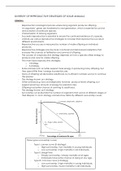
- Survivorship curves illustrate the number of organisms that survive at different stages of
their lifespan. K- and r-strategy animals show distinctly different survivorship curves.
I – humans, elephants, dolphins
1 000
Number of survivors
100
II – small birds, squirrels
10 III – frogs, turtles, plants,
fish
1
0 50 100
young Percentage of maximum life span old
Three types survivorship curves;
- Type I: convex curve [K-strategy]
o High survivorship / low mortality in young individuals.
o Low survivorship / high mortality in old individuals.
- Type II: straight line
o Steady survivorship / steady mortality at all ages.
o Individuals have same chance of dying at any age.
- Type III: concave curve [r-strategy]
o Low survivorship / high mortality in young individuals.
o High survivorship / lower mortality in old individuals.
, - There is a wide range of reproductive strategies employed in different species;
o Courtship.
o External vs internal fertilisation.
o Ovipary, ovovivioary and vivipary.
o Amniotic egg.
o Precocial and altricial development.
o Parental care.
COURTSHIP
- The behavioural patterns of male and female animals that lead to mating and
ultimately offspring.
- Purpose of courtship;
o Ensures both sexes are ready for mating.
o Helps to identify mating partners of same species and so prevent unsuccessful
mating between different species, thus saving energy.
o Helps to choose a suitable mating partner. Females often choose larger,
stronger males w. more attractive physical features that increases the
chances of many healthy offspring.
- Can take place by using;
o Visual stimuli.
o Sound stimuli.
o Chemical stimuli.
o Physical stimuli.
VISUAL STIMULI
- Best example is male peacock who uses his striking, brightly coloured tail feathers to
court the female. The female usually chooses the male w. the most impressive set of
tail feathers.
- In some birds [e.g. egrets], the males develop a special plumage during the mating
season to attract females.
- In nocturnal animals [e.g. fireflies], the males use a specific pattern of light flashes to
find the right mate. Interested females send out the same pattern of light flashes,
indicating their sexual maturity.
SOUND STIMULI
- Male frogs use sounds to attract the females. Each frog species has its own call. The
females make no sounds but are attracted by the male’s calls. The females then
choose a mate from the croaking choir of males.
- Male birds also sing to attract females. Birdsong s not only for courting but also a
signal to demarcate their specific territory.
CHEMICAL STIMULI
- In some insects and mammal species the females secrete chemical substances,
known as pheromones. This is a signal to males that they are sexually mature.
- Male moths can detect by pheromones over long distances by means of their large,
feathery antennae.
- Female lions, dogs and domestic cats also secrete pheromones into the air,
attracting the males.
GENERAL
- Reproduction is biological process where living organism produces offspring.
- An organisms’ genes are transferred to next generation, which is essential for survival
and evolution of particular species.
- Characteristic of all living organisms.
- Successful reproduction is essential to ensure the continued existence of a species.
- Animals use various reproductive strategies to increase their reproductive success in
different environments.
- Reproductive success is measured by number of viable offspring an individual
produces.
- Reproductive strategies are structural, functional and behavioural adaptions that
increase the chances of fertilisation and survival of offspring.
- The success of a reproductive strategy depends on how a species utilises energy to
produce and care for viable offspring.
- Two main types reproductive strategies:
o r-strategy.
o K-strategy.
- Some animals such as turtles expend more energy in producing many offspring, but
they spend little time / energy in parental care.
- Many of offspring will die before adulthood, but sufficient numbers survive to continue
the species.
- This strategy known as r-strategy.
- Other animals [e.g. lions and elephants] however, produce fewer offspring, but
expend enormous amounts of energy for parental care.
- Offspring has better chance of surviving to adulthood.
- This strategy known as K-strategy.
- Survivorship curves illustrate the number of organisms that survive at different stages of
their lifespan. K- and r-strategy animals show distinctly different survivorship curves.
I – humans, elephants, dolphins
1 000
Number of survivors
100
II – small birds, squirrels
10 III – frogs, turtles, plants,
fish
1
0 50 100
young Percentage of maximum life span old
Three types survivorship curves;
- Type I: convex curve [K-strategy]
o High survivorship / low mortality in young individuals.
o Low survivorship / high mortality in old individuals.
- Type II: straight line
o Steady survivorship / steady mortality at all ages.
o Individuals have same chance of dying at any age.
- Type III: concave curve [r-strategy]
o Low survivorship / high mortality in young individuals.
o High survivorship / lower mortality in old individuals.
, - There is a wide range of reproductive strategies employed in different species;
o Courtship.
o External vs internal fertilisation.
o Ovipary, ovovivioary and vivipary.
o Amniotic egg.
o Precocial and altricial development.
o Parental care.
COURTSHIP
- The behavioural patterns of male and female animals that lead to mating and
ultimately offspring.
- Purpose of courtship;
o Ensures both sexes are ready for mating.
o Helps to identify mating partners of same species and so prevent unsuccessful
mating between different species, thus saving energy.
o Helps to choose a suitable mating partner. Females often choose larger,
stronger males w. more attractive physical features that increases the
chances of many healthy offspring.
- Can take place by using;
o Visual stimuli.
o Sound stimuli.
o Chemical stimuli.
o Physical stimuli.
VISUAL STIMULI
- Best example is male peacock who uses his striking, brightly coloured tail feathers to
court the female. The female usually chooses the male w. the most impressive set of
tail feathers.
- In some birds [e.g. egrets], the males develop a special plumage during the mating
season to attract females.
- In nocturnal animals [e.g. fireflies], the males use a specific pattern of light flashes to
find the right mate. Interested females send out the same pattern of light flashes,
indicating their sexual maturity.
SOUND STIMULI
- Male frogs use sounds to attract the females. Each frog species has its own call. The
females make no sounds but are attracted by the male’s calls. The females then
choose a mate from the croaking choir of males.
- Male birds also sing to attract females. Birdsong s not only for courting but also a
signal to demarcate their specific territory.
CHEMICAL STIMULI
- In some insects and mammal species the females secrete chemical substances,
known as pheromones. This is a signal to males that they are sexually mature.
- Male moths can detect by pheromones over long distances by means of their large,
feathery antennae.
- Female lions, dogs and domestic cats also secrete pheromones into the air,
attracting the males.