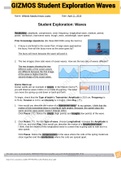
GIZMOS Student Exploration Waves
Name: Wildred Natalia Arroyo Lopez Date: April 11, 2016
Student Exploration: Waves
Vocabulary: amplitude, compression, crest, frequency, longitudinal wave, medium, period,
power, rarefaction, transverse wave, trough, wave, wavelength, wave speed
Prior Knowledge Questions (Do these BEFORE using the Gizmo.)
1. A buoy is anchored to the ocean floor. A large wave approaches
the buoy. How will the buoy move as the wave goes by?
The buoy will move because the wave will push it.
m
er as
2. The two images show side views of ocean waves. How are the two sets of waves different?
co
eH w
The two images showing the two
different sides of the ocean waves
o.
are different because the first image
rs e
of the wave is higher than the
ou urc
second image of the ocean wave.
Gizmo Warm-up
o
Ocean swells are an example of waves. In the Waves Gizmo™,
aC s
you will observe wave motion on a model of a spring. The hand
vi y re
can move the spring up and down or back and forth.
To begin, check that the Type of wave is Transverse, Amplitude is 20.0 cm, Frequency is
0.75 Hz, Tension is 3.0 N, and Density is 1.0 kg/m. Click Play ( ).
ed d
ar stu
1. How would you describe the motion of a transverse wave? In my opinion, I think that the
motion of this transverse wave is moving at right angles. Because, the speed stays the
same and the wave power doesn’t change either.
Click Pause ( ). Notice the crests (high points) and troughs (low points) of the wave.
is
Th
2. Click Reset ( ). For the Type of wave, choose Longitudinal. Increase the Amplitude to
20.0 cm, and click Play. How would you describe the motion of a longitudinal wave?
I think, that the motion of this longitudinal wave is a wave that is going said to side but in a
sh
slow speed.
Click Pause. Notice the compressions in the wave where the coils of the spring model are
close together and the rarefactions where the coils are spread apart.
This study source was downloaded by 100000828331062 from CourseHero.com on 07-20-2021 07:00:02 GMT -05:00
https://www.coursehero.com/file/19977063/Waves-By-Wildred-Arroyo-pdf/
, Get the Gizmo ready:
Activity A: Click Reset. Select Transverse waves.
Measuring waves Set Amplitude to 20.0 cm, Frequency to 1.0 Hz,
Tension to 2.0 N, and Density to 2.0 kg/m.
Question: How do we measure and describe waves?
1. Observe: Click Play. Observe the motions of the hand and of the green dot in the middle.
A. What is the motion of the hand? The motion of the hand is increasing and
decreasing.
B. Turn off the Lights on checkbox and observe the green dot. What is the motion of
the green dot? The motion of the green dot is also decreasing and increasing.
C. Follow the motion of a single crest of the wave. How does the crest move? The crest
m
moves to the right because of the hand’s motion.
er as
co
eH w
In a transverse wave, the motion of the medium (what the wave moves through—in
o.
this case, the spring) is perpendicular to the direction of the wave. So, each point of
rs e
the spring moves up and down as the wave travels from left to right.
ou urc
2. Measure: With the lights on, click Pause. Turn on Show rulers.
o
A. Use the horizontal ruler to measure the horizontal distance between two crests. What
aC s
vi y re
is this distance? 100 cm this is the wavelength of the wave.
B. What is the distance between the two troughs? 110 cm
ed d
The wavelength can be found by measuring the distance between two successive
ar stu
crests, two successive troughs, or any two equivalent points on the wave.
C. Click Reset. Set the Density to 1.0 kg/m. Click Play, and then Pause. What is the
is
wavelength of this wave? 140 cm
Th
3. Measure: Click Reset. The amplitude of a transverse wave is the maximum distance a
point on the wave is displaced, or moved, from its resting position. Turn off the lights. Click
sh
Play, and then click Pause. Use the vertical ruler to measure the height of the green trace,
showing how far the green dot moved up and down.
A. What is the height of the green trace? 40 cm
B. The wave’s amplitude is equal to half of this height. What is the amplitude? 20 cm
This study source was downloaded by 100000828331062 from CourseHero.com on 07-20-2021 07:00:02 GMT -05:00
https://www.coursehero.com/file/19977063/Waves-By-Wildred-Arroyo-pdf/
Name: Wildred Natalia Arroyo Lopez Date: April 11, 2016
Student Exploration: Waves
Vocabulary: amplitude, compression, crest, frequency, longitudinal wave, medium, period,
power, rarefaction, transverse wave, trough, wave, wavelength, wave speed
Prior Knowledge Questions (Do these BEFORE using the Gizmo.)
1. A buoy is anchored to the ocean floor. A large wave approaches
the buoy. How will the buoy move as the wave goes by?
The buoy will move because the wave will push it.
m
er as
2. The two images show side views of ocean waves. How are the two sets of waves different?
co
eH w
The two images showing the two
different sides of the ocean waves
o.
are different because the first image
rs e
of the wave is higher than the
ou urc
second image of the ocean wave.
Gizmo Warm-up
o
Ocean swells are an example of waves. In the Waves Gizmo™,
aC s
you will observe wave motion on a model of a spring. The hand
vi y re
can move the spring up and down or back and forth.
To begin, check that the Type of wave is Transverse, Amplitude is 20.0 cm, Frequency is
0.75 Hz, Tension is 3.0 N, and Density is 1.0 kg/m. Click Play ( ).
ed d
ar stu
1. How would you describe the motion of a transverse wave? In my opinion, I think that the
motion of this transverse wave is moving at right angles. Because, the speed stays the
same and the wave power doesn’t change either.
Click Pause ( ). Notice the crests (high points) and troughs (low points) of the wave.
is
Th
2. Click Reset ( ). For the Type of wave, choose Longitudinal. Increase the Amplitude to
20.0 cm, and click Play. How would you describe the motion of a longitudinal wave?
I think, that the motion of this longitudinal wave is a wave that is going said to side but in a
sh
slow speed.
Click Pause. Notice the compressions in the wave where the coils of the spring model are
close together and the rarefactions where the coils are spread apart.
This study source was downloaded by 100000828331062 from CourseHero.com on 07-20-2021 07:00:02 GMT -05:00
https://www.coursehero.com/file/19977063/Waves-By-Wildred-Arroyo-pdf/
, Get the Gizmo ready:
Activity A: Click Reset. Select Transverse waves.
Measuring waves Set Amplitude to 20.0 cm, Frequency to 1.0 Hz,
Tension to 2.0 N, and Density to 2.0 kg/m.
Question: How do we measure and describe waves?
1. Observe: Click Play. Observe the motions of the hand and of the green dot in the middle.
A. What is the motion of the hand? The motion of the hand is increasing and
decreasing.
B. Turn off the Lights on checkbox and observe the green dot. What is the motion of
the green dot? The motion of the green dot is also decreasing and increasing.
C. Follow the motion of a single crest of the wave. How does the crest move? The crest
m
moves to the right because of the hand’s motion.
er as
co
eH w
In a transverse wave, the motion of the medium (what the wave moves through—in
o.
this case, the spring) is perpendicular to the direction of the wave. So, each point of
rs e
the spring moves up and down as the wave travels from left to right.
ou urc
2. Measure: With the lights on, click Pause. Turn on Show rulers.
o
A. Use the horizontal ruler to measure the horizontal distance between two crests. What
aC s
vi y re
is this distance? 100 cm this is the wavelength of the wave.
B. What is the distance between the two troughs? 110 cm
ed d
The wavelength can be found by measuring the distance between two successive
ar stu
crests, two successive troughs, or any two equivalent points on the wave.
C. Click Reset. Set the Density to 1.0 kg/m. Click Play, and then Pause. What is the
is
wavelength of this wave? 140 cm
Th
3. Measure: Click Reset. The amplitude of a transverse wave is the maximum distance a
point on the wave is displaced, or moved, from its resting position. Turn off the lights. Click
sh
Play, and then click Pause. Use the vertical ruler to measure the height of the green trace,
showing how far the green dot moved up and down.
A. What is the height of the green trace? 40 cm
B. The wave’s amplitude is equal to half of this height. What is the amplitude? 20 cm
This study source was downloaded by 100000828331062 from CourseHero.com on 07-20-2021 07:00:02 GMT -05:00
https://www.coursehero.com/file/19977063/Waves-By-Wildred-Arroyo-pdf/