EKN 120
Chapter 17: Fiscal Policy and the Economics of taxation
Fiscal Policy
Fiscal policy involves decisions about government spending and taxation
There are 2 types
o Expansionary: Increase in government spending and decrease in tax
o Contractionary: Decrease in government spending and increase in tax
Objectives of Fiscal Policy
Full employment
Price stability
Accelerating the rate of economic development
Optimum allocation of resources
Equitable distribution of income and wealth
Economic stability
Capital formation and growth
Encouraging investment
Taxation and Government spending are the tools of fiscal policy
Expansionary Fiscal Policy and AD-AS Model
Expansionary fiscal policy will lead to an increase in the size of a government’s budget deficit
(G>T)
This might lead to a higher inflation in the short run
Expansionary fiscal policy is used to push the economy out of recession (stimulate growth via
AD)
The idea is to put more money into consumer’s hands, so they spend more
Contractionary Fiscal Policy and AD-AS Model
Contractionary fiscal policy will lead to a decrease in the size of a government’s budget deficit
Contractionary fiscal policy is used to slow down economic growth
, They do this to stamp out inflation
Taxes are increased and spending is cut
Problems, Criticisms and Complications of Implementing Fiscal policy
Problems of timing:
o Recognition lag
o Administrative lag
o Operational lag
Political considerations
o Political business cycles
Future policy reversals
Offsetting provincial and local finance
Crowding-out effect
Current thinking on fiscal policy
Crowding-out Effect
Chapter 17: Fiscal Policy and the Economics of taxation
Fiscal Policy
Fiscal policy involves decisions about government spending and taxation
There are 2 types
o Expansionary: Increase in government spending and decrease in tax
o Contractionary: Decrease in government spending and increase in tax
Objectives of Fiscal Policy
Full employment
Price stability
Accelerating the rate of economic development
Optimum allocation of resources
Equitable distribution of income and wealth
Economic stability
Capital formation and growth
Encouraging investment
Taxation and Government spending are the tools of fiscal policy
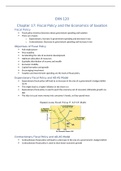
Expansionary Fiscal Policy and AD-AS Model
Expansionary fiscal policy will lead to an increase in the size of a government’s budget deficit
(G>T)
This might lead to a higher inflation in the short run
Expansionary fiscal policy is used to push the economy out of recession (stimulate growth via
AD)
The idea is to put more money into consumer’s hands, so they spend more
Contractionary Fiscal Policy and AD-AS Model
Contractionary fiscal policy will lead to a decrease in the size of a government’s budget deficit
Contractionary fiscal policy is used to slow down economic growth
, They do this to stamp out inflation
Taxes are increased and spending is cut
Problems, Criticisms and Complications of Implementing Fiscal policy
Problems of timing:
o Recognition lag
o Administrative lag
o Operational lag
Political considerations
o Political business cycles
Future policy reversals
Offsetting provincial and local finance
Crowding-out effect
Current thinking on fiscal policy
Crowding-out Effect