PPG WEEK 6
-LECTURE 9
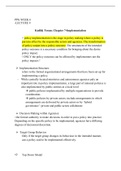
Knill& Tosun: Chapter 7-Implementation
= policy implementation is the stage in policy making where a policy is
put into effect by the responsible actors and agencies. The transformation
of policy output into a policy outcome. The attainment of the intended
policy outcome is a necessary condition for bringing about the desire
policy impact.
! ONLY the policy outcome can be affected by implementers not the
policy impacts !
Implementation Structure:
refers to the formal organizational arrangements that have been set up for
implementing a policy.
- While centrally located ministries and autonomous agencies paly an
important role in policy implementation, a large part of national policies is
also implemented by public entities at a local level
public policies implemented by multiple organizations to provide
coordination-
public policies by private actors; include arrangements in which
arrangements are delivered by private actors or by ‘hybrid
governance’: private and public actors collaborate
Decision Making within Agencies:
=the formal authority to make decisions in order to put a policy into practice.
Depending on the specific policy to be implemented, agencies have differing
degrees of decisional discretion.
Target Group Behavior
Only if the target group changes its behaviour in the intended manner,
can a policy said to be implemented effectively.
Top Down Model
, = concentrates on policy outputs and the extent to which intended objectives
have been achieved over time and why
o Deviations in policy goals are likely if action depends upon a number of
actors required to cooperate
o Implementation will be more successful when the policy output only
requires marginal changes compared with the status quo and when goal
consensus amongst private and public actors is high.
1. address if actions were consisted with the objectives outlined in the
policy
2. the extent to which objectives were attained over time
3.evaluate principal facts affecting policy
4.analyse whether the policy was reformulated based on experience
CRITICS:
o Disregards actions taken earlier in the process
o Implementation is seen as a administrative process ignoring political
aspects
o not taking into account local actors and particular conditions for policy
implementation at the ‘street-level’.
o Dunshire: does not describe how government works, ‘excludes any
consideration of how real people behave’.
Bottom up model
=effective implementation in a process-oriented way that abandons the
divide between policy formulation and implementation.
o Policy objectives are expected to undergo modifications during the
implementation process
o Policy implementation at 2 levels:
1. ‘macrolevel’: central actors that devise a policy output
2. ‘microlevel’: they react to macrolevel policies, develop their own
programmes and implement them ‘principal-agent/agency
problems’
bottom-up’ argument asserting that ‘policy making does not
simply end once a policy is set out, made in the daily encounters of
street-level workers’
-LECTURE 9
Knill& Tosun: Chapter 7-Implementation
= policy implementation is the stage in policy making where a policy is
put into effect by the responsible actors and agencies. The transformation
of policy output into a policy outcome. The attainment of the intended
policy outcome is a necessary condition for bringing about the desire
policy impact.
! ONLY the policy outcome can be affected by implementers not the
policy impacts !
Implementation Structure:
refers to the formal organizational arrangements that have been set up for
implementing a policy.
- While centrally located ministries and autonomous agencies paly an
important role in policy implementation, a large part of national policies is
also implemented by public entities at a local level
public policies implemented by multiple organizations to provide
coordination-
public policies by private actors; include arrangements in which
arrangements are delivered by private actors or by ‘hybrid
governance’: private and public actors collaborate
Decision Making within Agencies:
=the formal authority to make decisions in order to put a policy into practice.
Depending on the specific policy to be implemented, agencies have differing
degrees of decisional discretion.
Target Group Behavior
Only if the target group changes its behaviour in the intended manner,
can a policy said to be implemented effectively.
Top Down Model
, = concentrates on policy outputs and the extent to which intended objectives
have been achieved over time and why
o Deviations in policy goals are likely if action depends upon a number of
actors required to cooperate
o Implementation will be more successful when the policy output only
requires marginal changes compared with the status quo and when goal
consensus amongst private and public actors is high.
1. address if actions were consisted with the objectives outlined in the
policy
2. the extent to which objectives were attained over time
3.evaluate principal facts affecting policy
4.analyse whether the policy was reformulated based on experience
CRITICS:
o Disregards actions taken earlier in the process
o Implementation is seen as a administrative process ignoring political
aspects
o not taking into account local actors and particular conditions for policy
implementation at the ‘street-level’.
o Dunshire: does not describe how government works, ‘excludes any
consideration of how real people behave’.
Bottom up model
=effective implementation in a process-oriented way that abandons the
divide between policy formulation and implementation.
o Policy objectives are expected to undergo modifications during the
implementation process
o Policy implementation at 2 levels:
1. ‘macrolevel’: central actors that devise a policy output
2. ‘microlevel’: they react to macrolevel policies, develop their own
programmes and implement them ‘principal-agent/agency
problems’
bottom-up’ argument asserting that ‘policy making does not
simply end once a policy is set out, made in the daily encounters of
street-level workers’