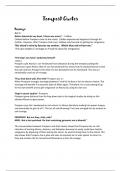
Review day I
↳
mean
· mean
median
population -> .g, N
·
·
L
mode
stand.
·
·
Sample -> X,S, n
↑ dev ·
variance
types 1)
x
Data colours
ranR 2
-
·
& < 2
-Qualitative nominal ordinal measurement -> population -> 0
ata seconds
- Quantitative interval, ratio, censored ->
sample -
2 E(X- x)2
yearstime estimated
=
-
Rounding s
nnx
· -
with
↓ -
n10 -> +1 decimal
population =mean
o standard
=
deviation
sample:X mean
=
standard
s= deviation
mode= frequentvalue
most
median middle value
meanor
all
figures
#Figures
Review days
Distributions discrete
Probability - >
calculations
·
Uniform -> Proutcomes
equal
O= Pr(A) 1
-T 2(pixxi) 1
·
=
=
=
· Addition rule
-promauzenom-comexe,
geinzinganiseasesseen
-> PrCAUB) PrCA) + Pr(B)-PrCANB)
=
independentevents productsee
·
conditional
-> PrCAIB) PCA ePr(x) =
xe
-
M
Review day 3
nina
distribution
one-sided.2A
sided:
-!
2B S= standard deviation
·
(X - N(7,64))
xz
S x2
h.
2- score
-
=
#,.0",*,
·
42
M
=
·
standard error (se) Se standard error
=
<
stanct.dev.
Ep
secFl-noone
o
re
same
=
xlim p =(z
=
* O)
A use 2 -
score to find
P vice versa
samples
two different
Review
day u
·
Decision error
shypothesis No rejected when true
testing -> type I (2)
·
No includes
-
=<p> a -> type 1 (B) No rejected
not when false
↑ we ↓
t his
test always not
rejected
andopenote
·Morescearora
MA CLAIM
·
z
Mo M
=
=
one
·
sample size (n)
&> one-sided en (78)"
=
(zc zB/2 +
-> two-sided n (z) (z(x
= =
z p)2
+
C =
always probability this means i s two
it sided
, Review days Chisquared -
R
Paired
data
↓ alles is gely
Parametric t-test
↓normal distribution
·
of fit
-
goodness -
-> H0: A 0, =
MA.A =0
·
Hodata follows distribution (ex uniform distribution) If it's not
follow distribution
MA doesn't Chi square d
-
-> T
pdF
=
n
= -
1
↓
normally distributed
·
X=E Ej(2 dF k 1
No Watje wilte n ·.
non-parametric Wilcoxin matched pair
Ej
= -
↳ noclasses verwaent
yn1)zz ntl. 1)
+
-(
=
normal distribution
&resample ofi t
verwaching
HA:
↓
·
Parametricit-testtable 3] data
Impaired
F testFollowed by Z-testCT-test
zT
MdF parametric
·
=
Tctdf,0/ztp>d
EF-teapt.No.Inosyargiance.soit
n
=
-
1 -
obtained
->
Mx
=
Itdf;0-confidence
interval
sits an
& less reliable than t-test -
p>0.05 n 12 2
spooled
+ -
·
non-parametric Wilcoxon rankorder table 5)
-> Ttest:MO:MI -
/2 0
=
HA:M1-M2
Find A rank (find 0
-
range ofTCA
/ITC) M1 12
=
Mi M2
x
aT ↓
normal distribution
El-CM
=
parametric
-
There is a
the
significant
n
i
= difference between
two variables
Review day 6 if
yOU Tukey
· Kramer (a)
I have 3 or
Oeway anougparametric (3) more data
frequencies) 2q
1.5x
- nb)
=
(no
silicon
on
·
Ho.
M1 M2 n# samplesper group Jruskal Wallis
Non parametric=
=
M3
=
HA:atleast1 => Ntotal sample size ·
Confidence
-> rank data, sumbank
mean rank
sign diff between individuals =34.3 12 intervals nicRiR V
-1
E(X)
MT -H
=
· =
=
=
-> Scheffe
M. -Mz M1 MIN
TRANSAS dEKH Mable
= -
· SStotal ES(XY) =
2 Mono
N(MA) v
-
dfbetw =k-1
nz reject
SS between ENT. Mi
Tukey-Kramer
=
-
NMP dewithin N-K
->
sres=mswithin
=
reChitns
So within [x EniMis
=
-
X
within Sres = mi-mo xi -xjIq =
->
ANOVA:
Freeposception
Source -> HSD
aantal data
F-table
HSD(ni,nj) qX (hi
h) ↓
paramarorausp
=
+
dF N =
-
k
within 4
ay* 2n z
=
= nantal
samples
chospitals)
Review day 7
mcnemor's (2 matched
group
·
continuity correction (n > 15)
groups with freq
-> sample divided into a a, b, and
of effects/side effects - only outcomes
·
Binomial coccurence ab
sp,
atc
en e
=
x
=
n
-> sample - Zc
c]
=
-zc =
cjCI.M1 -
M2 pi
=
-
P2 = (z +
22/2.
-> (+ x p = = [z zcz p +
·
Outliers
suspected
-
-
Grubbs: I value
youcalanar
set
-> Z independent
6
=1pect- ↑
to not rejected
-> HoT -Me 0 (no -> Dixon's
difference) suspected value
=
samples 71 22
=
QQlimeMonot
HA:M1-M2 0 from
low-high index
-> sort
values
M #72 (difference
rejected
=n-
X x
-a
et Q An
Xn 2
-zaousci-iclEcti
e
-
=
xn -
X3
n0 12
= -
n 13
=
when there
are 2 samples -> Box Approach multiple suspected values
Plot
- (... - Mr pi
=
-
P2 I[z(n+nz)
if
they
+
22/2 pP+
Ptype) -> interquartile
range (IQR) =G3Q,
say more than #
·
Poisson ↓ ifthey sayless than o z-table, 0.05 -> lower limit (x) = Q- , QR upper limit(lu)
IGR
MisamplenzcTxNtoTME**I+ZRCRS
QS +
=
values outside
MA* range between likluare outliers
1x. -
X2) -
1
32
↳
mean
· mean
median
population -> .g, N
·
·
L
mode
stand.
·
·
Sample -> X,S, n
↑ dev ·
variance
types 1)
x
Data colours
ranR 2
-
·
& < 2
-Qualitative nominal ordinal measurement -> population -> 0
ata seconds
- Quantitative interval, ratio, censored ->
sample -
2 E(X- x)2
yearstime estimated
=
-
Rounding s
nnx
· -
with
↓ -
n10 -> +1 decimal
population =mean
o standard
=
deviation
sample:X mean
=
standard
s= deviation
mode= frequentvalue
most
median middle value
meanor
all
figures
#Figures
Review days
Distributions discrete
Probability - >
calculations
·
Uniform -> Proutcomes
equal
O= Pr(A) 1
-T 2(pixxi) 1
·
=
=
=
· Addition rule
-promauzenom-comexe,
geinzinganiseasesseen
-> PrCAUB) PrCA) + Pr(B)-PrCANB)
=
independentevents productsee
·
conditional
-> PrCAIB) PCA ePr(x) =
xe
-
M
Review day 3
nina
distribution
one-sided.2A
sided:
-!
2B S= standard deviation
·
(X - N(7,64))
xz
S x2
h.
2- score
-
=
#,.0",*,
·
42
M
=
·
standard error (se) Se standard error
=
<
stanct.dev.
Ep
secFl-noone
o
re
same
=
xlim p =(z
=
* O)
A use 2 -
score to find
P vice versa
samples
two different
Review
day u
·
Decision error
shypothesis No rejected when true
testing -> type I (2)
·
No includes
-
=<p> a -> type 1 (B) No rejected
not when false
↑ we ↓
t his
test always not
rejected
andopenote
·Morescearora
MA CLAIM
·
z
Mo M
=
=
one
·
sample size (n)
&> one-sided en (78)"
=
(zc zB/2 +
-> two-sided n (z) (z(x
= =
z p)2
+
C =
always probability this means i s two
it sided
, Review days Chisquared -
R
Paired
data
↓ alles is gely
Parametric t-test
↓normal distribution
·
of fit
-
goodness -
-> H0: A 0, =
MA.A =0
·
Hodata follows distribution (ex uniform distribution) If it's not
follow distribution
MA doesn't Chi square d
-
-> T
=
n
= -
1
↓
normally distributed
·
X=E Ej(2 dF k 1
No Watje wilte n ·.
non-parametric Wilcoxin matched pair
Ej
= -
↳ noclasses verwaent
yn1)zz ntl. 1)
+
-(
=
normal distribution
&resample ofi t
verwaching
HA:
↓
·
Parametricit-testtable 3] data
Impaired
F testFollowed by Z-testCT-test
zT
MdF parametric
·
=
Tctdf,0/ztp>d
EF-teapt.No.Inosyargiance.soit
n
=
-
1 -
obtained
->
Mx
=
Itdf;0-confidence
interval
sits an
& less reliable than t-test -
p>0.05 n 12 2
spooled
+ -
·
non-parametric Wilcoxon rankorder table 5)
-> Ttest:MO:MI -
/2 0
=
HA:M1-M2
Find A rank (find 0
-
range ofTCA
/ITC) M1 12
=
Mi M2
x
aT ↓
normal distribution
El-CM
=
parametric
-
There is a
the
significant
n
i
= difference between
two variables
Review day 6 if
yOU Tukey
· Kramer (a)
I have 3 or
Oeway anougparametric (3) more data
frequencies) 2q
1.5x
- nb)
=
(no
silicon
on
·
Ho.
M1 M2 n# samplesper group Jruskal Wallis
Non parametric=
=
M3
=
HA:atleast1 => Ntotal sample size ·
Confidence
-> rank data, sumbank
mean rank
sign diff between individuals =34.3 12 intervals nicRiR V
-1
E(X)
MT -H
=
· =
=
=
-> Scheffe
M. -Mz M1 MIN
TRANSAS dEKH Mable
= -
· SStotal ES(XY) =
2 Mono
N(MA) v
-
dfbetw =k-1
nz reject
SS between ENT. Mi
Tukey-Kramer
=
-
NMP dewithin N-K
->
sres=mswithin
=
reChitns
So within [x EniMis
=
-
X
within Sres = mi-mo xi -xjIq =
->
ANOVA:
Freeposception
Source -> HSD
aantal data
F-table
HSD(ni,nj) qX (hi
h) ↓
paramarorausp
=
+
dF N =
-
k
within 4
ay* 2n z
=
= nantal
samples
chospitals)
Review day 7
mcnemor's (2 matched
group
·
continuity correction (n > 15)
groups with freq
-> sample divided into a a, b, and
of effects/side effects - only outcomes
·
Binomial coccurence ab
sp,
atc
en e
=
x
=
n
-> sample - Zc
c]
=
-zc =
cjCI.M1 -
M2 pi
=
-
P2 = (z +
22/2.
-> (+ x p = = [z zcz p +
·
Outliers
suspected
-
-
Grubbs: I value
youcalanar
set
-> Z independent
6
=1pect- ↑
to not rejected
-> HoT -Me 0 (no -> Dixon's
difference) suspected value
=
samples 71 22
=
QQlimeMonot
HA:M1-M2 0 from
low-high index
-> sort
values
M #72 (difference
rejected
=n-
X x
-a
et Q An
Xn 2
-zaousci-iclEcti
e
-
=
xn -
X3
n0 12
= -
n 13
=
when there
are 2 samples -> Box Approach multiple suspected values
Plot
- (... - Mr pi
=
-
P2 I[z(n+nz)
if
they
+
22/2 pP+
Ptype) -> interquartile
range (IQR) =G3Q,
say more than #
·
Poisson ↓ ifthey sayless than o z-table, 0.05 -> lower limit (x) = Q- , QR upper limit(lu)
IGR
MisamplenzcTxNtoTME**I+ZRCRS
QS +
=
values outside
MA* range between likluare outliers
1x. -
X2) -
1
32