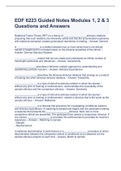
EDF 6223 Guided Notes Modules 1, 2 & 3 Questions and Answers
Relational Frame Theory (RFT) is a theory of _________________stimulus relations proposing that such relations are inherently verbal and that the accumulated experience with relational exemplars creates generalized repertoires of relating. - Answer- Derived A _________________is a relation between two or more stimuli that is not directly trained or taught and is not based solely on the physical properties of the stimuli. - Answer- Derived Stimulus Relation _________________means that we can create and understand an infinite number of meaningful sentences and utterances. - Answer- Generativity ________________describes a behavior analytic approach to understanding and establishing symbolic function. - Answer- Stimulus Equivalence _________________describes the stimulus-stimulus relations that emerge as a product of training two other stimulus-stimulus relations. - Answer- Transitivity _________________is a type of stimuli-to-stimulus relation in which the learner - without any prior or training or reinforcement - demonstrates the reversibility of the sample stimulus and the comparison stimulus. - Answer- Symmetry _________________is a type of stimuli-to-stimulus relation in which the learner - without any prior or training or reinforcement - selects a stimulus that is the same as the sample stimulus. - Answer- Reflexivity _________________is a discrete trial procedure for investigating conditional relations and stimulus equivalence. A matching-to-sample trial begins with the participant making a response that presents the _________________stimulus. Next, two or more comparison stimuli are presented. The participant then selects a comparison stimulus. If it is correct, _________________is provided. No reinforcement is provided for incorrect responses. - Answer- - Matching to sample - Sample - Reinforcement Conditional discrimination is performance in a _________________ procedure in which discrimination between the comparison stimuli is conditional on (or depends on) the sample stimulus present on each trial. - Answer- Match to sample RFT treats relational responding as a______,and thus appeals to a history of multiple-exemplar training. - Answer- generalized operant _______________means responding to one stimulus based on its relation to another stimulus or stimuli - Answer- Relational responding ______________refers to the derived bidirectionality of some stimulus relations, and as such it is a generic term for the concept of "symmetry" in stimulus equivalence. - Answer- Mutual entailment _______________refers to instances in which two or more relations that have acquired the property of mutual entailment mutually combine. It is the generic term for what is called "transitivity" and "equivalence" in stimulus equivalence. - Answer- Combinatorial Entailment _____________are the functions a stimulus has for a person that can be transformed or changed on the basis of how it is related to other stimuli. - Answer- Transformation of functions A_________ involves responding to stimuli or events based on arbitrary relations among them and in a manner that includes the interesting characteristics listed above (mutual entailment, combinatorial entailment, and transformation of stimulus functions). - Answer- Relational Fame Theory The clue in arbitrary respondingin RFT is called________. - Answer- contextual cue A model is an__________that evokes imitative behavior. - Answer- antecedent stimulus A property of imitation is that the model and the behavior must have _______ - Answer- formal similarity Formal similarity occurs when the ________and the behavior physically resemble each other and are in the same sense mode. - Answer- model ________ is the process of systematically and differentially reinforcing successive approximations to a terminal behavior. - Answer- Shaping _____________ is a procedure in which reinforcement is provided for responses that share a predetermined dimension or quality, and in which reinforcement is withheld for responses that do not demonstrate that quality. - Answer- differential reinforcement A ________________ the end product of shaping - can be claimed when the topography, frequency, latency, duration, or magnitude of the target behavior reaches the predetermined criterion level. - Answer- terminal behavior Differential reinforcement has two effects: ___________ similar to those that have been reinforced occur with greater frequency, and responses resembling the unreinforced members are emitted less frequently (also known as __extinction_). - Answer- responses ___________ is a science-based system for shaping behaviors using a handheld device that produces a click sound to signal reinforcement. - Answer- clicker training A __________ is a specific sequence of discrete responses where each response is associated with a particular stimulus condition. - Answer- behavior chain Each component in the chain, except the first and last stimulus in the chain, serves as both a conditioned reinforcer and a ______________ - Answer- discriminative stimulus (SD) A behavior chain with ___________ requires that each component is done correctly and within a specified time. - Answer- limited hold

Geschreven voor
- Instelling
- EDF 6223
- Vak
- EDF 6223
Documentinformatie
- Geüpload op
- 13 april 2023
- Aantal pagina's
- 3
- Geschreven in
- 2022/2023
- Type
- Tentamen (uitwerkingen)
- Bevat
- Vragen en antwoorden
Onderwerpen
-
edf 6223
-
edf 6223 guided notes modules 1
-
2 amp 3 questions and answers
-
relational frame theory rft is a theory of stimulus relations proposing that such relations are inherently

Ook beschikbaar in voordeelbundel