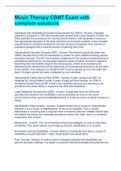
Music Therapy CBMT Exam with complete solutions
Individuals with Disabilities Education Improvement Act (IDEA) - Answer- Originally passed by Congress in 1975 and reauthorized several times, most recently in 2004, the IDEA specifies the procedures for insuring that all children with disabilities receives a free appropriate education in the least restrictive environment possible. It also includes requirements for parental involvement and due process procedures when parents or guardians disagree with a school's decision regarding their child. Individualized Education Program (IEP) - Answer- The federal special education law (IDEA) requires that an IEP be developed by a team for each student receiving special education services. The IEP must contain a statement of the student's present levels of educational performance, annual goals related to areas of deficit, short-term objective describing the intermediate steps to the annual goals, criteria and procedures for determining the achievement of the objectives, and educational services to be provided to the student. Any changes to a student's IEP must be agreed upon by the entire IEP team. Changes cannot be made unilaterally by one individual. Individualized Family Service Plan (IFSP) - Answer- A plan, similar to an IEP, by designed for young children (under 3 years of age) and their families. An IFSP is somewhat broader than an IEP in that it also specifies services and resource to be provided to the entire family in support of the child with disabilities. Least Restrictive Environment (LRE) - Answer- A legal term from the IDEA that specifies that students with disabilities must be educated as close to the same environment as their typical (nondisabled) peers. It is this provision on which inclusion is based. Manifestation Determination - Answer- A determination that a student's inappropriate behavior is not a result, or manifestation, of his or her disability. This is usually determined in a hearing and is required when a student's behavior violates school rules and before the school can undertake disciplinary action that might result in a student's suspension from school. Mnemonics - Answer- The use of memory-enhancing strategies or cues to remember something. This might include such things as rhymes, visualization or acronyms. Nonverbal Learning Disabilities - Answer- Refers to individuals who have a cluster of disabilities in social interaction, math, visual-spatial and tactual tasks. Peer Tutoring - Answer- A method used to integrate students with disabilities into general education settings. It is based on research that demonstrates that students can effectively tutor one another. It maximizes active student engagement with an academic task and can also improve social and communication skills. One particularly effective form is Classwide Peer Tutoring (CWPT). Positive Behavioral Support (PBS) - Answer- Using methods and techniques that support desirable and appropriate behavior rather than punishing undesirable or inappropriate behavior. It usually consists of determining what types of reinforcers would promote appropriate student behavior and then using those reinforcers to help the student engage in that behavior. Seizure - Answer- A sudden alternation of consciousness, usually accompanied by motor activity and/or sensory phenomena, caused by an abnormal discharge of electrical energy in the brain. Spina Bifida - Answer- A congenital midline defect resulting from failure of the bony spinal column to close completely during fetal development. It may occur anywhere from the head to the lower end of the spine. Because the spinal column is not closed, the spinal card can protrude, resulting in damage to the nerves and paralysis and/or lack of function or sensation below the site of the defect. Stereotypic Behaviors - Answer- Any of a variety of repetitive behaviors that are sometimes found in individuals who are have autism, blindness, or who are severely mentally retarded. May include such things as rubbing eyes, hand flapping, swaying from side to side, etc. Supported Employment - Answer- A method of integrating people with disabilities who cannot work independently into competitive employment. Includes the use of a job coach who helps the person with disabilities train for and succeed on the job. Systematic Instruction - Answer- Teaching that involves instructional prompts, consequences, or reinforcement,for performance, and transfer of stimulus control. It is usually used with individuals with mental retardation. Traumatic Brain Injury (TBI) - Answer- An injury through the brain due to an accident (not conditions present at birth, birth trauma, or degenerative disease). Results in total or partial disability that affects educational performance. It may affect any or all areas of cognition, language, memory, attention, judgment, motor skills, behavior, emotions, problem solving, or speech. Because as the brain heals the symptoms will change over time TBI requires close communication among education, medical and other professionals, and parents/guardians. Individual Transition Plan (ITP) - Answer- The IDEA requires that, no later than age 16 (or earlier if appropriate), each student's IEP should contain a statement of needed transition services. In addition, the ITP must include a statement of linkages and responsibilities for each appropriate agency for provide those services. The intent is to have a plan in place to facilitate the individual's successful transition from the school setting to the community. Job Coach - Answer- A person who assists workers with disabilities to be successful in a job setting. A job coach provides vocational assessment, instruction, planning, interaction and communication assistance with employers, and other services to support the individual in a job. Americans with Disabilities Act (ADA) - Answer- The ADA is a civil rights law for persons with disabilities to protect them from discrimination in a wide range of activities, such as employment, transportation, public accommodations, and telecommunications. This is not the primary law that provides protection and safeguards educational rights of students in schools. That law is the IDEA. Carl D. Perkins Vocational and Technical Education Act - Answer- Signed into law in 1998, this law provides federal funds for occupationally-relevant equipment, vocational curriculum materials, materials for learning labs, curriculum development or modification, staff development, career counseling and guidance activities, efforts for academic-vocational integration, supplemental services for special populations, hiring vocational staff, remedial classes, and expansion of tech prep programs. In special education its primary benefit is that it requires schools, and distributes funds, to provide vocational training, planning and placement for students with special needs. Applied Behavior Analysis - Answer- An approach often used with children with autism, although it can be used for other purposes as well. It breaks a skill or task down into smaller units or steps. The teacher practices each step with the child, helping the child to connect the smaller steps with the larger task or skill. The teacher uses prompts and reinforcements to assist and encourage the child to correctly perform each step with the prompts and reinforcers gradually reduced until the skill is self-maintained by the child P.L. 99-457 - Answer- Passed in 1986, this law (Education of the Handicapped Act Amendments) established early intervention for young children from birth to age three and their families. TEKS - Answer- Texas Essential Knowledge and Skills, these is the state required curriculum for all public schools in Texas. The TEKS lists the skills students should have mastered at various grade levels in all academic subjects. The TEKS do not provide information about resources to teach the skills or how to evaluate them. It is simply a list of those skills. A teacher can tell, for children at any grade level, the prerequisite skills the students should already have mastered and which skills the students will need to master next. Attention Deficit-Hyperactivity Disorder (ADHD) - Answer- ADHD is a neurological disorder that can result in lack of attention, impulsivity and/or hyperactivity. The three types of ADHD, as defined by the DSM-IV-, are Predominately Inattentive Type, Predominately Hyperactive-Impulsive Type, and Combined Type, which incorporates the all the characteristics of the other two types. ADHD is not an identified disability under the IDEA, but students with the disability may be served under the Other Health Impaired category of the IDEA, or under the Learning Disabilities or Seriously Emotionally Disordered categories since there is a large overlap between ADHD and these other disabilities. Perseveration - Answer- Perseveration means to keep doing the same thing again and again. This is a common characteristic of individuals with autism spectrum disorder, as well as other types of disabilities. It may manifest itself in repeating an action multiple times and not being able to stop. Echolalia - Answer- Echolalia is to repeat back something that has already been said, exactly as it is said. You might ask, "What's your name?" and the person will reply back, "What's your name?" While many children with autism exhibit this characteristic, it does not fit the definition in the question stem and, thus, it is not the correct word for this question. Encephalitis - Answer- Encephalitis literally means an inflammation of the brain, but it usually refers to brain inflammation caused by a virus. It has no impact on the sense of thirst. Asthma - Answer- Asthma is caused by an inflammation or obstruction of the air passages, making it difficult to breath. It does not affect thirst. Diabetes - Answer- This disorder, caused by the body's inability to produce insulin can sometimes result in insulin shock, which is sometimes signaled by an increased level of thirst. Both asthma and cystic fibrosis are breathing disorders not related to thirst. Cystic Fibrosis - Answer- Cystic fibrosis results from a buildup of mucus in the lungs or gastrointestinal tract that interferes with breathing or digestion. Epilepsy - Answer- Epilepsy is a neurological condition, which affects the nervous system. Epilepsy is also known as a seizure disorder . It is usually diagnosed after a person has had at least two seizures that were not caused by some known medical condition like alcohol withdrawal or extremely low blood sugar. The seizures in epilepsy may be related to a brain injury or a family tendency, but most of the time the cause is unknown. Obsessive-Compulsive Disorder - Answer- Obsessive-Compulsive Disorder, OCD, is an anxiety disorder and is characterized by recurrent, unwanted thoughts (obsessions) and/or repetitive behaviors (compulsions). Repetitive behaviors such as hand washing, counting, checking, or cleaning are often performed with the hope of preventing obsessive thoughts or making them go away. Performing these so-called "rituals," however, provides only temporary relief, and not performing them markedly increases anxiety. Ecological Assessment - Answer- An ecological assessment refers to an assessment of the child's environment. We know that a student's school achievement is affected, not just by the school alone, but also by many other factors in the child's environment. In order to obtain a true and complete picture of the child's ability and needs it is helpful to collect information on these factors, as well. Prerefferal - Answer- Prereferral is when a school has a systematic process of assisting the classroom teacher with students who are having problems in the regular classroom. It involves collecting existing information of the child and assisting with the development of strategies and interventions to help the child to be successful. Research has shown that when the process is down well it reduces the number of students referred for special education because their problems are solved without special education being necessary. Transition - Answer- In special education transition refers to any time a student is transitioning from one type of program or service to another. There are two main times when this term used in relation to students with disabilities. One is when the individual is transitioning from school to a post-school setting, such as the community. This process is usually guided by the Individual Transition Plan required as part of the IEP when the student turns 16 (or younger if appropriate). The other time the term transition is used is when a child with disabilities transitions from an early childhood, center-based, or home-based program into a public school setting. This transition process requires careful and continuous communication on the part of the previous service providers, the new service providers, and the parents/guardians. Generalization - Answer- Generalization is the process by which a skill learned in one setting is transferred, or generalized, to other settings. Individuals with mental retardation, for example, do not generalize well. They tend not to be able to transfer a skill learned in one setting to another, unfamiliar, setting. Community-Based Instruction - Answer- Because individuals with mental retardation do not generalize well, community-based instruction is the appropriate way to teach community and independent living skills. In community-based instruction individuals with disabilities are given the opportunity to learn skills such as transportation, shopping, eating, work, etc., in the actual settings in which those skills will be used. Strategy Instruction - Answer- Because many students with disabilities, particularly those with learning disabilities, tend to be poor strategic thinkers, strategy instruction has emerged as a highly effective technique for helping them learn many skills, both academic and social. A strategy is a tool, plan, or method used for accomplishing a task. It includes a set of steps to accomplish a particular task, such as taking a test, comprehending text, and writing a story. Memory strategies are usually called mnemonics and are often combined with other learning strategies. For example, a first-letter mnemonic is often used to help the learner follow the steps of the strategy. Functional Curriculum - Answer- A functional curriculum is one that addresses skills students will need in everyday life. Functional skills are the variety of skills that are frequently demanded in natural domestic, vocational, and community environments. Functional skills are built around real life experiences. The skills involve cooperation between students and teachers in the planning of learning experiences. Instructional programs, especially those for many students with mental retardation, should be built around functional activities that involve skills of immediate usefulness to students and employ teaching materials that are real. Activities center on small groups or individuals. The activities often include teams of teachers guiding students through active participation. Collaborative Consultation - Answer- A special educator and a regular educator working together to develop strategies for teaching students with disabilities. The relationship between the two is characterized by shared responsibility and decision-making. Co-Teaching - Answer- A special educator teaching side-by-side with a general educator in a classroom with both teachers providing instruction to all students. Itinerant Teacher - Answer- A special education teacher who visits several different schools to provide instruction for students with disabilities. This model is often used for students with low-incidence disabilities such as visual impairments. Perkins Brailler - Answer- A machine with six keys, one for each of the six dots of the Braille alphabet cell. The keys leave an embossed print on paper. Total Communication - Answer- An approach blending both oral and manual communication it is used to teach children with hearing impairments. Inclusion - Answer- An approach that describes the education of students with disabilities with their same-age peers without disabilities. Students without disabilities are taught in general education classrooms with medications and services provided in that setting rather than in a separate setting. Catheterization - Answer- The insertion of a tube into the urethra to drain the bladder. Tourette's Syndrome - Answer- A neurological disorder beginning in childhood that involves stereotypical, repetitive motor movements (tics). These are often accompanied by multiple vocal outbursts such grunting or inappropriate words such as swearing. It is about three times more prevalent in boys than in girls. Down Syndrome - Answer- A genetic condition occurring as a result of an abnormality in the twenty-first pair of chromosomes. It is characterized by mental retardation and physical characteristics such as eyes that appear slanted, hypotonia, a single crease across the palm of the hand, short stature and a tendency for being obese. Mental Retardation - Answer- A condition resulting in low cognitive ability and low adaptive behavior skills. Individuals with mental retardation may have other related physical, behavioral, and language disorders, as well, although the condition varies widely among individuals. The disability can be mild to severe and is can be caused by a number of factors including genetics, environment, trauma, neglect, etc. The evaluation of someone for mental retardation would include an IQ test and a measure of adaptive behavior skills. Learning Disabilities - Answer- Assumed to be caused by central nervous system dysfunction that results in processing problems, learning disabilities can take a number of forms and impact a number of academic, behavioral, and social areas. It is usually manifested in a significant discrepancy between a person's ability (as measured by an IQ test) and his or her achievement. Individuals with learning disabilities often have difficulty processing language, organization, visual and/or auditory perception and discrimination, and social skills. The characteristics and severity of a learning disability can take many different forms and not all students with a learning disability have the same learning needs. Autism - Answer- One of five disorders along the autism spectrum it is characterized by extreme social withdrawal and impairments in communication. Individuals with autism often have stereotypical behaviors, over reaction to environmental or sensory stimuli and any changes to their routine. It is usually manifested by age three and can vary widely in its level of severity. Individuals with autism often (but not always) have impairments in cognitive ability, language and social skills. Direct Instruction - Answer- A teaching method which focuses on drill and practice with lots of immediate feedback and student response. Lessons are fast-paced, highly sequenced, and scripted. It is most often used to teach academic subjects such as reading and math. Conduct Disorder - Answer- A disorder characterized by overt, aggressive behavior or obvious antisocial behavior that may include such things as lying, stealing, and destruction of property. This behavior may be overt or covert. Behavioral Inhibition - Answer- The ability to stop an intended response, or an ongoing response, to protect an ongoing response from interruption, and the inability to refrain from responding immediately to a stimulus, thought, or impulse. It makes it difficult for an individual to delay gratification and can interfere with executive functions. It is usually delayed or impaired in students with ADHD. Braille - Answer- A communication system in which raised dots on a page allow and individual who is blind to read with their fingertips. It consists of guadrangular cell containing from one to six dots. The way the dots are arranged denotes different letters or symbols. Cerebral Palsy - Answer- A condition characterized by paralysis,

Geschreven voor
- Instelling
- CBMT
- Vak
- CBMT
Documentinformatie
- Geüpload op
- 13 april 2023
- Aantal pagina's
- 92
- Geschreven in
- 2022/2023
- Type
- Tentamen (uitwerkingen)
- Bevat
- Vragen en antwoorden
Onderwerpen
-
music therapy cbmt
-
music therapy cbmt exam with complete solutions
-
individuals with disabilities education improvement act idea
-
individualized education program iep
-
individualized family service p

Ook beschikbaar in voordeelbundel