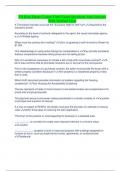
Hematology Exam | 150 Questions with 100% correct Answers | Updated and verified
Define Hematology - The science dealing with the morphology of blood and blood forming tissues and their physiology and pathology. State the difference in types of cells found in peripheral blood and bone marrow. - The peripheral blood contains mature leukocytes, mature erythrocytes, and mature platelets. The bone marrow contains immature precursor cells and matures cells. Identify the 3 types of cellular elements found normally in peripheral blood - Leukocytes, erythrocytes and platelets Identify the 6 types of white blood cells found normally in peripheral blood. - Neutrophils, band neutrophils, eosinophils, basophils, lymphocytes, and monocytes. State the function of each cell found on a normal peripheral blood smear. - Erythrocyte-transport oxygen and carbon dioxide Platelet-blood clotting Leukocyte-immune defense Identify the anticoagulant used most in hematology. - EDTA Differentiate between serum and plasma. - Plasma is the medium of blood in vivo. Serum is nonanticoagulated blood. Coagulation factors I, II, V, VIII, and XIII are not present in serum. Describe three methods of preparing peripheral blood smears. - Wedge smear, coverslip, and spun smear Describe the characteristics of a well-prepared wedge blood smear and recognize inadequately-prepared smears, and how to correct them. - 2/3-3/4 of smear, straight/even feather edge, at least 2.5 cm

Geschreven voor
- Instelling
- Hematology
- Vak
- Hematology
Documentinformatie
- Geüpload op
- 5 juli 2023
- Aantal pagina's
- 19
- Geschreven in
- 2022/2023
- Type
- Tentamen (uitwerkingen)
- Bevat
- Vragen en antwoorden
Onderwerpen
-
hematology

Ook beschikbaar in voordeelbundel