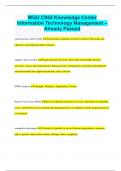
WGU C954 Knowledge Center Information Technology Management – Already Passed
WGU C954 Knowledge Center Information Technology Management – Already Passed critical success factor (CSF) Crucial steps companies perform to achieve their goals and objectives and implement their strategies. support value activities Found along the top of the value chain and includes business processes, such as firm infrastructure, human resource management, technology development, and procurement that support the primary value activities SWOT analysis Strengths, Weakness, Opportunity, Threats Porter's Five Forces Model threat of substitute products or services, the threat of established rivals, and the threat of new bargaining power of suppliers and the bargaining power of customers. competitive advantage A feature of a product or service that an organization's customers place a greater value on than similar offerings from a competitor Porter's three generic strategies Generic business strategies that are neither organization nor industry specific and can be applied to any business, product, or service. value chain analysis Views a firm as a series of business processes that each add value to the product or service. primary value activities Found at the bottom of the value chain, these include business processes that acquire raw materials and manufacture, deliver, market, sell, and provide after-sales services. effectiveness MIS metric Measures the impact MIS has on business processes and activities including customer satisfaction, conversion rates, and sell-through increases. Efficiency MIS metrics Measure the performance of MIS itself, such as throughput, transaction speed, and system availability Supply Chain Design The ability to view all areas up and down the supply chain in real time. supply chain planning systems use advanced mathematical algorithms to improve the flow and efficiency of the supply chain while reducing inventory supply chain execution systems ensure supply chain cohesion by automating the different activities of the supply chain Joint Application Development (JAD) A session where employees meet, sometimes for several days, to define or review the business requirements for the system. conversion The process of transferring information from a legacy system to a new system. Systems Development Life Cycle (SDLC) The overall process for developing information systems from planning and analysis through implementation and maintenance SDLC planning phase Involves establishing a high-level plan of the intended project and determining project goals. Analysis Phase of SDLC Involves analyzing end-user business requirements and refining project goals into defined functions and operations of the intended system requirements definition document prioritizes all of the business requirements by order of importance to the company Data Flow Diagram (DFD) illustrates the movement of information between external entities and the processes and data stores within the system Design Phase (SDLC) Involves describing the desired features and operations of the system Development Phase (SDLC) Involves taking all of the detailed design documents from the design phase and transforming them into the actual system control objectives for information and related technologies (COBIT) A set of best practices that helps an organization to maximize the benefits of an information system, while at the same time establishing appropriate controls to ensure minimum errors. object-oriented languages group data and corresponding processes into objects fourth-generation language (4GL) A computer language type that includes database query languages and report generators. Testing Phase of SDLC Involves bringing all the project pieces together into a special testing environment to eliminate errors and bugs, and verify that the system meets all of the business requirements defined in the analysis phase implementation phase sldc Involves placing the system into production so users can begin to perform actual business operations with the system. Maintenance Phase (SDLC) involves performing changes, corrections, additions, and upgrades to ensure the system continues to meet the business goals SDLC Phases planning, analysis, design, development, testing, implementation, and maintenance discovery prototyping builds a small-scale representation or working model of the system to ensure it meets the user and business requirements iterative development consists of a series of tiny projects agile methodology Aims for customer satisfaction through early and continuous delivery of useful software components developed by an iterative process using the bare minimum requirements rapid application development (RAD) (also called rapid prototyping) methodology Emphasizes extensive user involvement in the rapid and evolutionary construction of working prototypes of a system to accelerate the systems development process. Extreme programming (XP) methodology Breaks a project into tiny phases, and developers cannot continue on to the next phase until the first phase is complete rational unified process (RUP) methodology Provides a framework for breaking down the development of software into four gates scrum methodology uses small teams to produce small pieces of software using a series of "sprints," or 30-day intervals, to achieve an appointed goal KC extensible markup language (XML) A markup language for documents, containing structured information. project management office (PMO) An internal department that oversees all organizational projects Nonrepudiation A contractual stipulation to ensure that ebusiness participants do not deny their online actions teergrubbing anti-spamming approach where the receiving computer launches a return attack against the spammer, sending email messages back to the computer that originated the suspected spam Information Systems Audit and Control Association (ISACA) A set of guidelines and supporting tools for IT governance that is accepted worldwide and generally used by auditors and companies as a way to integrate technology to implement controls and meet specific business objectives. Information Technology Infrastructure Library (ITIL) A framework provided by the government of the United Kingdom that offers eight sets of management procedures. Committee of Sponsoring Organizations (COSO) Key for evaluating internal controls such as human resources, logistics, information technology, risk, legal, marketing and sales, operations, financial functions, procurement, and reporting. Capability Maturity Model Integration (CMMI) method A process improvement approach that contains 22 process areas. grid computing A collection of computers, often geographically dispersed, that are coordinated to solve a common problem smart grid delivers electricity using two-way digital technology cloud fabric The software that makes the benefits of cloud computing possible, such as multi-tenancy. ITIL IT Infrastructure library lifecycle strategy Design Transition Operation RUP lifecycle inception, elaboration, construction, transition ERP (Enterprise Resource Planning) integrate all of the organizational systems production, hr, planning, inventory management, reporting, crm, sales marketing, finance accounting Decision support systems (DSS) computer program applications used by middle and higher management to compile information from a wide range of sources to support problem solving and decision making. A DSS is used mostly for semi-structured and unstructured decision problems. Executive information systems (EIS) a reporting tool that provides quick access to summarized reports coming from all company levels and departments such as accounting, human resources and operations. Office automation systems (OAS) support communication and productivity in the enterprise by automating workflow and eliminating bottlenecks. OAS may be implemented at any and all levels of management. Enterprise Resource Planning (ERP) software facilitates the flow of information between all business functions inside the boundaries of the organization and manage the connections to outside stakeholders. EIS visualize critical success factors unstructured, long-term, non-routine decisions APS advanced planning and scheduling scheduling resources allocated depending on demand TPS Transaction Processing system Divide work into operations OAPS operations approval portal transparency and approval BI business intelligence gather, store, access and analyze corporate data to aid in decision-making RAD Rapid App development Planning, Design, Construction, Cutover PROTOTYPING RUP - Rational Unified Process Inception, Elaboration, Construction, Transition GATES CRM phase Waterfall method requirements, analysis, design, coding/implementation, testing, Operation/ deployment, maintenance Workflow modeling describes how work is completed and illustrates how something moves from one step to another Simulation use various inputs such as data and business rules to demonstrate how a solution operates Storyboarding illustrates a series of activities by different users of the solution Paper prototyping is the least expensive and time-consuming approach to prototyping and uses paper and pencil to describe an interface or a process Kim Stevens Breadth, systems thinking, courage Mandy Edwards Risk management, business acumen, decision making, new technology navigation De prins Quality, specialization, working as a team, hatch the egg, marketing your value Dan olley speak with non customers IT Global Strategic Plan These include global customers, global products, global operations & resources, and global collaboration ITIL 8 management procedures (1) service delivery, (2) service support, (3) service management, (4) Information and Communication Technology (ICT) infrastructure management, (5) software asset management, (6) business perspective, (7) security management, and (8) application management. CoBIT Control Objectives for IT A set of control objectives and best practices in IT. ISACAA Information Systems Audit and Control Association set of general IT governance guidelines and rubrics applicable to most IT environments. CMMI (Capability Maturity Model Integration) An application development structure based on 22 different process or maturity areas.

Geschreven voor
- Instelling
- WGU C954
- Vak
- WGU C954
Documentinformatie
- Geüpload op
- 3 augustus 2023
- Aantal pagina's
- 13
- Geschreven in
- 2023/2024
- Type
- Tentamen (uitwerkingen)
- Bevat
- Vragen en antwoorden
Onderwerpen
-
wgu c954 knowledge center information technology m

Ook beschikbaar in voordeelbundel