Formative questions week 2
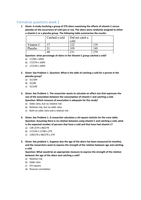
1. Given: A study involving a group of 279 skiers examining the effects of vitamin C versus
placebo on the occurrence of cold (yes or no). The skiers were randomly assigned to either
a vitamin C or a placebo group. The following table summarizes the results:
Question: what percentage of skiers in the Vitamin C group catched a cold?
a) 17/48 x 100%
b) 17/279 x 100%
c) 17/139 x 100%
2. Given: See Problem 1. Question: What is the odds of catching a cold for a person in the
placebo group?
a) 31/109
b) 31/48
c) 31/140
3. Given: See Problem 1. The researcher wants to calculate an effect size that expresses the
size of the association between the consumption of vitamin C and catching a cold.
Question: Which measure of association is adequate for this study?
a) Odds ratio, but no relative risk
b) Relative risk, but no odds ratio
c) Both an odds ratio and a relative risk
4. Given: See Problem 1. A researcher calculates a chi-square statistic for the cross table.
Question: Assuming there is no relation between using vitamin C and catching a cold, what
is the expected number of persons that have a cold and that have had vitamin C?
a) 139 /279 x 48/279
b) 17/139 x 17/48 x 279
c) 139/279 x 48/279 x 279
5. Given: See problem 1. Suppose also the age of the skiers has been measured (in months),
and the researchers want to express the strength of the relation between age and catching
a cold.
Question: What would be an appropriate measure to express the strength of the relation
between the age of the skiers and catching a cold?
a) Relative risk
b) Odds ratio
c) Chi-square
d) Pearson correlation
1. Given: A study involving a group of 279 skiers examining the effects of vitamin C versus
placebo on the occurrence of cold (yes or no). The skiers were randomly assigned to either
a vitamin C or a placebo group. The following table summarizes the results:
Question: what percentage of skiers in the Vitamin C group catched a cold?
a) 17/48 x 100%
b) 17/279 x 100%
c) 17/139 x 100%
2. Given: See Problem 1. Question: What is the odds of catching a cold for a person in the
placebo group?
a) 31/109
b) 31/48
c) 31/140
3. Given: See Problem 1. The researcher wants to calculate an effect size that expresses the
size of the association between the consumption of vitamin C and catching a cold.
Question: Which measure of association is adequate for this study?
a) Odds ratio, but no relative risk
b) Relative risk, but no odds ratio
c) Both an odds ratio and a relative risk
4. Given: See Problem 1. A researcher calculates a chi-square statistic for the cross table.
Question: Assuming there is no relation between using vitamin C and catching a cold, what
is the expected number of persons that have a cold and that have had vitamin C?
a) 139 /279 x 48/279
b) 17/139 x 17/48 x 279
c) 139/279 x 48/279 x 279
5. Given: See problem 1. Suppose also the age of the skiers has been measured (in months),
and the researchers want to express the strength of the relation between age and catching
a cold.
Question: What would be an appropriate measure to express the strength of the relation
between the age of the skiers and catching a cold?
a) Relative risk
b) Odds ratio
c) Chi-square
d) Pearson correlation