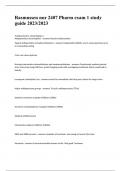
Rasmussen nur 2407 Pharm exam 1 study guide 2023/2023
Antipsychotics (neuroleptics) Antipsychotics (neuroleptics) - answers Resolve hallucinations Typical Antipsychotics (nonphenothiazines) - answers Haloperidol (Haldol): use in acute psychosis since it is immediate acting Crisis can cause dystonia Nursing intervention: phenothiazines and nonphenothiazines - answers Psychotropic washout period: since many have long half-lives, avoid changing meds with overlapping treatment which could lead to toxicity Lorazepam (anxiolytics) use - answers works for immediate relief but poor choice for longer term Major antidepressant groups - answers Tricyclic antidepressants (TCAs) Selective serotonin reuptake inhibitors (SSRIs) Serotonin norepinephrine reuptake inhibitors (SNRIs) Atypical antidepressant Monoamine oxidase inhibitors (MAOIs) SSRIs and SNRIs prevent - answers reuptake of serotonin, increasing its level in the brain Serotonin - answers A neurotransmitter known as the "feel good" hormone Momoamine oxidase enzymes - answers break down neurotransmitters like dopamine, norepinephrine, and serotonin in the brain leading to low levels. These low levels have been linked with depression and anxiety. Tricyclic antidepressants side effects - answers Include dry mouth and eyes, GI distress (anticholinergic effects) Monoamine oxidase inhibitors - answers Maintain levels of dopamine, norepinephrine, and serotonin in the brain Food interactions with MAOIs - answers Food that contains tyramine can cause hypertensive crisis. includes some cheeses, yogurt, cream, coffee, chocolate, bananas, raisins, Italian green beans, liver, pickled foods, sausage, soy sauce, yeast, beer and red wine Mood stabilizer: Lithium toxicity - answers Can cause arrhythmia, slurred speech, unsteadiness, appetite suppression Side effects of aspirin - answers Swelling of the eyes, face, lips, tongue, throat Ringing in the ears, loss of hearing Wheezing, difficulty breathing, hoarseness, fast breathing Fast heartbeat Cold, clammy skin Hives, rash Bloody vomit, vomit resembling coffee grounds Bright red blood in stools, black or tarry stools Pediatric pharmacokinetics: distribution - answers Neonates and infants have less body fat, therefore low protein binding capability making the available drug high Pediatric pharmacokinetics: metabolism - answers Liver metabolism, higher metabolic rate -> increased rate of drug breaking down and availability Pediatric pharmacokinetics: excretion - answers Infants have decreased renal blood flow & glomerular filtration rate -> drug buildup Nursing implications of pediatric drug administration - answers Considering developmental and cognitive differences Maintaining safety while ensuring comfort Family-centered care Nursing implications: older adult - answers Adherence: patient may not fully understand drug regimen 4 processes of pharmacokinetics - answers 1. Absorption 2. Distribution 3. Metabolism 4. Excretion Absorption - answers The movement of the drug into the bloodstream after administration Dissolution - answers A process where a drug in a solid form disintegrates into small particles and combines with a liquid to form a solution Rate of dissolution - answers The time it takes the drug to disintegrate and dissolve to become available for the body to absorb Drug absorption is slower for - answers very young and very old adults because they have less gastric acidity Enteric-coated drugs - answers resist disintegration in the gastric acid of the stomach, so disintegration does not occur until the drug reaches the alkaline environment of the small intestine. Never crush!! Most oral drugs are absorbed in - answers the small intestine through passive transport, active transport, or pinocytosis Passive transport - answers Occurs through diffusion + facilitated diffusion and does not require energy to move drugs across the membrane Active transport - answers Requires a carrier in the form of an enzyme or protein to move the drug against the concentration gradient Energy is required Pinocytosis - answers A process where cells carry a drug across their membrane by engulfing the drug particles in a vesicle Factors that affect absorption - answers Blood circulation Pain Stress Food texture Fat content Temperature pH Route of administration Once absorbed in the GI tract, drugs pass from the _________ ________ to the ________ via the _________ _____ - answers intestinal lumen liver portal vein First-pass effect - answers Some drugs are metabolized by the liver to an inactive form and are excreted, reducing the amount of active drug Bioavailability - answers The percentage of administered drug available for activity Distribution - answers The movement of the drug from the circulatory system to body tissues -> influenced by the rate of blood flow to the tissue, the drug's affinity to the tissue, and protein binding Protein binding - answers As drugs are distributed in the plasma, many bind with plasma proteins. Acidic drugs and neutral drugs bind with - answers albumin or lipoproteins Basic drugs bind to - answers alpha 1 acid glycoprotein (AGP) Highly protein-bound drugs - answers More than 90% bound to protein Weakly protein-bound drugs - answers Less than 10% bound to protein Active (free) drug - answers The portion of the drug that is unbound to a protein Able to exit blood vessels and reach their site of action Different highly protein bound drugs should not be given together because - answers they will compete for binding sites and lead to an increase of free drug in circulation -> results in drug accumulation and toxicity Blood-brain barrier (BBB) - answers Blood vessels in the brain have a special endothelial lining where the cells are pressed together tightly (tight junctions) -> the lining is the BBB Metabolism (biotransformation) - answers The process by which the body chemically changes drugs into a form that can be excreted Primary metabolic site - answers Liver Half-life - answers The time it takes for the amount of drug in the body to be reduced by half Loading dose - answers An initial dose that is significantly larger than the maintenance dosing Excretion - answers Elimination of drugs from the body Main route of excretion - answers Kidneys Other routes of excretion - answers Bile, the lungs, saliva, sweat, breastmilk Common tests used to determine renal function - answers Creatinine and blood urea nitrogen (BUN) Creatinine - answers Metabolic by-product of muscle that is excreted by the kidneys Urea nitrogen - answers Metabolic breakdown product of protein metabolism Potency - answers The amount of drug needed to elicit a specific physiological response

Geschreven voor
- Instelling
- Nur 2407
- Vak
- Nur 2407
Documentinformatie
- Geüpload op
- 26 december 2023
- Aantal pagina's
- 11
- Geschreven in
- 2023/2024
- Type
- Tentamen (uitwerkingen)
- Bevat
- Vragen en antwoorden
Onderwerpen
-
rasmussen nur 2407 pharm exam 1 study guide 20232

Ook beschikbaar in voordeelbundel