NASM Flexibility Exam 1 (2024) || All Questions & Answers (100% Correct)
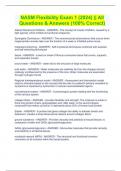
NASM Flexibility Exam 1 (2024) || All Questions & Answers (100% Correct) NASM Flexibility Exam 1 (2024) || All Questions & Answers (100% Correct) Altered Reciprocal Inhibition - ANSWER - The concept of muscle inhibition, caused by a tight agonist, which inhibits its functional antagonist. Synergistic Dominance - ANSWER - The neuromuscular phenomenon that occurs when inappropriate muscles take over the function of a weak or inhibited prime mover. Integrated stretching - ANSWER - Self-myofascial techniques combined with assisted and self-stretching techniques fascia - ANSWER - a band or sheet of fibrous connective tissue that covers, supports, and separates muscle bound water - ANSWER - water tied to the structure of large molecules bulk water - ANSWER - Water molecules are relatively far from the charges and are relatively uninfluenced by the presence of the ions. Water molecules are associated through hydrogen bonds Regional interdependence model - ANSWER - Assessment and intervention model used by clinicians based on the concept that the site of a patient's primary complaint or symptoms is impacted by dysfunction in remote musculoskeletal regions. neurophysical system - ANSWER - A physiological system dealing with the functioning of the nervous system. collagen fibers - ANSWER - provides flexibility and strength: The molecule is made of three long protein chains (polypeptides) and, after water, is the second largest component that makes up fascia. It represents about 30% of human body protein. Elastin - ANSWER - A protein that gives collagen the ability to tolerate stretch and distension; creates a three-dimensional network around collagen fibers. ground substance - ANSWER - Provides viscosity and plasticity to fascial tissues; is composed of water and GAGs (glycosaminoglycans). GAGs (glycosaminoglycans) - ANSWER - Mucus-like molecules that provide viscosity and plasticity in all fascial tissues myofacial network (MFN) - ANSWER - The structural and functional common connection of all muscles within the fascial system. superficial front net (SFN) - ANSWER - The SFN is comprised of the following muscles and their fasciae: scalp, sternocleidomastoid, sternum (sternalis and sternochondral joints), rectus abdominis, rectus femoris/quadriceps, patellar tendon, tibialis anterior, anterior crural compartment, and toe extensors (Frederick et al., 2017) (Figure 4.4). Any movement that is largely composed of extension would elongate or stretch the SFN. Conversely, general flexion movements (e.g., being seated and hunched over a computer) will shorten the SFN. Given that modern society is flexion dominant, SFN tightness or hypomobility is common. To gain better extension or if a client desires to exercise the extensors (i.e., gluteus muscles, spinal extensors, etc.), stretching the SFN is advised. exercise: superman Deep Front Net (DFN) - ANSWER - The DFN is comprised of the following muscles and their fasciae: deep neck muscles and scalenes, throat muscles, lungs and chest muscles, heart, diaphragm, anterior spine, psoas, iliacus, pectineus, pelvic floor, hip adductors, popliteus, tibialis posterior, and long toe flexors (Frederick et al., 2017) (Figure 4.5). Like the SFN, any movement that is largely composed of extension would elongate or stretch the DFN and flexion shortens the DFN. Thus, in the case of shorten and restricted DFN, stretching is advised prior to certain movements. However, it should be noted that restrictions to extension are compounded due to the additional deeper and more extensive tissues. exercise: floor cobra BACK NET (BN) - ANSWER - The BN is comprised of the following superficial and deep muscles and their fasciae: cranial fascia, deep spinal intrinsic muscles, erector spinae, sacrolumbar fascia, deep lateral hip rotators, sacrotuberous ligament, hamstrings, gastrocnemius and soleus, Achilles tendon, plantar fascia, and short toe flexors (Frederick et al., 2017) (Figure 4.6). Any movement that is largely composed of flexion would elongate or stretch the BN, such as bending forward to touch the toes or pulling one knee up to the chest. As stated above, modern society is flexion dominant, thus the BN is frequently lengthened or hypermobile. In these cases, strengthening the extensors may be recommended over stretching. EXERCISES: toe touch, supine knees to chest) Lateral Net - ANSWER - The LN is comprised of the following muscles and their fasciae: sternocleidomastoid, scalenes, splenius capitis, intercostals, lateral abdominal obliques, quadratus lumborum, gluteus medius, gluteus maximus (superior fibers), greater trochanter (femur), tensor fasciae latae (TFL), iliotibial tract, and fibularis (peroneus) (Frederick et al., 2017) (Figure 4.7). Any movement that is largely composed of a lateral or side bend would elongate or stretch the LN. Often, clients have uneven or greatly restricted ROM bilaterally, which benefits greatly from stretching the LN. It should be noted that walking, running, and climbing stairs often require a great deal of stability from the LN. Thus, assessments should be relied on to determine when and where stretching should be applied. exercise: overhead side bend, side bend

Geschreven voor
- Instelling
- NASM stretching Flexibility
- Vak
- NASM stretching Flexibility
Documentinformatie
- Geüpload op
- 23 januari 2024
- Aantal pagina's
- 22
- Geschreven in
- 2023/2024
- Type
- Tentamen (uitwerkingen)
- Bevat
- Vragen en antwoorden
Onderwerpen
-
nasm flexibility exam 1 2024 questions answers
-
nasm flexibility exam 1 2024 questions
-
nasm flexibility exam 1 2024 answers
-
nasm flexibility exam 1 questions answers

Ook beschikbaar in voordeelbundel