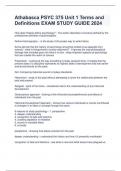
Athabasca PSYC 375 Unit 1 Terms and Definitions EXAM STUDY GUIDE 2024
How does Popper define psychology? - The author describes it as being defined by the professional activities of psychologists. Define historiography. - is the study of the proper way to write history Some ppl feel that the history of psychology should be looked at as separate from science - what is Hergenham's counter-argument? - It ignores the vast philosophical heritage that moulded psyc into what it is now - skips important aspects pf psychology that are outside the realm of science Presentism - Looking at the way something is today (present time). It implies that the present state of a discipline represents its highest state of development and that earlier events led directly to this state. Def. Comparing historical events to todays standards. Historicism - study of the past without attempting to show the relationship between the past and present. Zeitgeist - spirit of the times - considered vital to the understanding of any historical development. Great-person approach - looking at the influential accomplishments and effects of individuals from the past Historical Development Approach - shows how various individuals or events contributed to changes in an idea or concept through the years. 6 reasons to study psychology - 1. perspective 2. deeper understanding 3. recognition of fads and fashions 4. avoiding repetition of mistakes 5. source of valuable ideas 6. curiosity perspective - showing how ideas evolved from the past deeper understanding - understand the history and how it it presently manifested recognition of fads and fashions - see what is new and what issues have plagued us. avoiding repetitions and mistakes - those who can't remember the past are doomed to repeat it a source of valuable ideas - may discover ideas were developed earlier but remained dominant for some reason. curiosity - why not study the past Why did Galileo and Kant claim that psychology could never be a science? - bc of it's subjective nature Empirical Observation - direct observation of nature in order to understand it Theory - set of assumptions about a particular idea Rationalism - the belief that mental operations (or principles) must be employed before knowledge can be attained. Def. Knowledge can only be attained by engaging in mental activity Empiricism - believes the source of all knowledge is sensory observation (experiencing life) Scientific Law - observed relationship btwn two (or more) empirical events - when X occurs, Y tends to also occur - public observation - the scientific law must be available for anybody to observe - relationships that are publicly verifiable Correlational Laws - relationship between empirical events - don't need to be casually related - Casual Law - describing casual relationships, allows for predictions and controlled events Determinism - assumption that what is being studied can be explained by casual laws Def. Belief that everything happens bc of a cause - if the cause of event is known, then can be prevented Poppers objection to traditional view of scientific activity - believed observation needs direction and is selective Karl Popper did NOT believe - that scientific activity started with empirical observation

Geschreven voor
- Instelling
- PSYC 375
- Vak
- PSYC 375
Documentinformatie
- Geüpload op
- 17 februari 2024
- Aantal pagina's
- 9
- Geschreven in
- 2023/2024
- Type
- Tentamen (uitwerkingen)
- Bevat
- Vragen en antwoorden
Onderwerpen
-
athabasca psyc 375 unit 1
-
athabasca psyc 375
-
psyc 375 unit 1
-
psyc 375
-
athabasca psyc 375 unit 1 terms and definitions
-
psyc 375 unit 1 terms and definitions

Ook beschikbaar in voordeelbundel