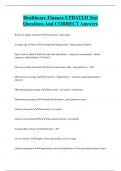
Holistic Health Assessment Test #1 Questions With Complete Answers.
Holistic Health Assessment Test #1 Questions With Complete Answers. Assessment, Diagnosis, Outcome Identification, Planning, Implementation, Evaluation List the steps in the nursing process Complete (total health) database This type of database includes a complete health history and a full physical examination. It describes the current and past health state and forms a baseline against which all future changes can be measured. It yields the first diagnoses. Focused or Problem-Centered database This type of database is for a limited or short-term problem. Here you collect a "mini" database, smaller in scope and more targeted than the complete database. Follow-Up Database This type of database is used in all settings to follow up both short-term and chronic health problems. Emergency Database This type of database is an urgent, rapid collection of crucial information and often is compiled concurrently with lifesaving measures. Diagnostic reasoning This is the process of analyzing health data and drawing conclusions to identify diagnoses Medical Diagnosis This deals with disease or medical condition. For example: If a patient had a stroke, this would provide info about the patients' pathology. Nursing Diagnosis This deals with human response to actual or potential health problems and life processes Subjective Data This type of data relates to what the person says about himself or herself Objective Data This type of data relates to what the professional obtains through physical examination Modify communication techniques as indicated by each patient's developmental stage, special needs, or cultural practices. with older adults avoid "elder-speak" (similar to baby talk), face hearing impaired clients so they can read lips, 1. providing false assurance or reassurance 2. giving unwanted advice 3. using authority 4. using avoidance language 5. engaging in distancing 6. using professional jargon 7. using leading or biased questions 8. talking too much 9. interrupting 10. using "why" questions What are the ten traps of interviewing? health literacy This is the ability to understand instructions, navigate the health care system, and communicate concerns with the health care provider. Discuss working with and without an interpreter to overcome communication barriers. Avoid an untrained interpreter (e.g., family member). address questions to client not the interpreter. never use a minor as an interpreter. Collect subjective data and combine it with objective data from physical examination and diagnostic tests What's the purpose of the complete health history? 1. biographical data 2. source of history 3. reason of seeking care 4. present history of patient: symptom analysis may be needed 5. past health events 6. family history 7. review of systems 8. functional assesment List the categories of information contained in a health history name, birthday, gender, and race What information must be gathered for biological data? record who gives the information What information must be gathered for source of history? Sxs/signs, record whatever the pt says, include time-frame. What information must be gathered for reason for seeking care? health of close family members: heart disease, high BP, mental illness, seizures, cancer, What information must be gathered for family history? Provocative or Palliative- what brings it on? what makes it better/worse? Quality or Quantity- how does it look, feel, or sound? how intense or severe is it? Region or Radiation- where is it? does it spread anywhere? Severity Scale- (pain scale) is it getting worse/better/or staying the same? Timing- onset, frequency, duration. Understand Patient's Perception (of the problem)- what do you think it means? What information must be gathered for present patient history? Childhood illness, accidents or injuries, chronic illnesses, hospitalizations, operations, obstetric HX, immunizations, allergies, current meds, last exam date What information must be gathered for past health events? absence/presence of all symptoms What information must be gathered for review of symptoms? self concept/self esteem, occupational health, activity and exercise, sleep and rest, nutrition and elimination, interpersonal relationships and resources, coping and stress management, environment and work hazards, spiritual resources, personal habits, illicit drugs, intimate partner violence What information must be gathered for functional assessment? location, character or quality, quantity or severity, timing, setting, aggravating or relieving factors, associated factors, patient's perception Describe the eight critical characteristics included in the summary of each patient symptom

Geschreven voor
- Instelling
- Holistic Health Assessment
- Vak
- Holistic Health Assessment
Documentinformatie
- Geüpload op
- 29 maart 2024
- Aantal pagina's
- 17
- Geschreven in
- 2023/2024
- Type
- Tentamen (uitwerkingen)
- Bevat
- Vragen en antwoorden
Onderwerpen
-
holistic health assessment test 1 questions with