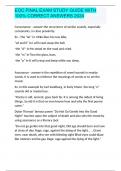
EOC FINAL EXAM STUDY GUIDE WITH 100% CORRECT ANSWERS 2024
Consonance - answer-the recurrence of similar sounds, especially consonants, in close proximity. Ex. -The "ke" in -Mike likes his new bike. "wl and ll" in-I will crawl away the ball. -the "d"- in-He stood on the road and cried. -the "ss" in-Toss the glass, boss. -the "p" in-It will creep and beep while you sleep. Assonance - answer-is the repetition of vowel sounds in nearby words. It is used to reinforce the meanings of words or to set the mood. Ex. In this example by Carl Sandburg, in Early Moon, the long "o" sounds old or mysterious. "Poetry is old, ancient, goes back far. It is among the oldest of living things. So old it is that no man knows how and why the first poems came." Dylan Thomas' famous poem "Do Not Go Gentle into the Good Night" touches upon the subject of death and also sets the mood by using assonance as a literary tool: "Do not go gentle into that good night, Old age should burn and rave at close of day; Rage, rage, against the dying of the light. . . .Grave men, near death, who see with blinding sight Blind eyes could blaze like meteors and be gay, Rage, rage against the dying of the light." Alliteration - answer-the occurrence of the same letter or sound at the beginning of adjacent or closely connected words. Onomatopoeia - answer-- onomatopoeic words, such as "buzz" or "boom," always mimic the noises to which they refer. Dialogue - answer--conversation between two or more people as a feature of a book, play, or movie. Lambic Pentameter - answer--a line of verse with five metrical feet, each consisting of one short (or unstressed) syllable followed by one long (or stressed) syllable, for example Two households, both alike in dignity. ***Dialogue in Shakespeare's plays is often in unrhymed iambic pentameter*** Tone - answer-The tone in a story can be joyful, serious, humorous, sad, threatening, formal, informal, pessimistic, and optimistic. Your tone in writing will be reflective of your mood as you are writing. Imagery - answer-in a literary text, is an author's use of vivid and descriptive language to add depth to their work. It appeals to human senses (sight, sound, hearing, feeling, tasting) to deepen the reader's understanding of the work. Couplets - answer-Couplets generally appear in poetry, and quite frequently they rhyme and have the same meter. The two lines often belong together, and share some sort of similar idea. comic relief - answer---is the inclusion of a humorous character, scene, or witty dialogue in an otherwise serious work, often to relieve tension. Soliloquy - answer--- is a super important monologue given by a character in a play who is alone on the stage. Because they're alone when they deliver these speeches, a character might reveal some very key thoughts, feelings, and opinions to us audience members during a soliloquy monologue - answer--is any speech of some duration addressed by a character to a second person. A soliloquy is a type of monologue in which a character directly addresses an audience or speaks his thoughts aloud while alone or while the other actors keep silent. 13. Direct characterization- - answer-the author tells the audience what the personality of the character is. indirect characterization - answer-tells the audience what the personality of the character is. character motivation - answer-is defined as a reason behind a character's specific action or behavior. foil character - answer--is a character who contrasts with another character —usually the protagonist— in order to highlight particular qualities of the other character. 17. Shakespearean tragedy - answer--Tragedy is a serious play or drama typically dealing with the problems of a central character, leading to an unhappy or disastrous ending brought on, as in ancient drama, by fate and a tragic flaw in this character, or, in modern drama, usually by moral weakness, psychological maladjustment, or social pressures." Shakespearean Sonnets - answer-- The sonnets are almost all constructed from three quatrains, which are four-line stanzas, and a final couplet (14 lines in all) composed in iambic pentameter. The rhyme scheme is abab cdcd efef gg. Often, the beginning of the third quatrain marks the volta ("turn"), or the line in which the mood of the poem shifts, and the poet expresses a revelation or epiphany. narrative poems - answer-- a form of poetry that tells a story, often making the voices of a narrator and characters as well; the entire story is usually written in metered verse. Narrative poems do not have to follow rhythmic patterns. ... Narrative poems include epics and ballads tanka - answer-There are five lines in a Tanka poem. Tanks poems are written about nature, seasons, love, sadness and other strong emotions. This form of poetry dates back almost 1200 years ago. villanelle - answer-is a nineteen-line poetic form consisting of five tercets (3 lines) followed by a quatrain. There are two refrains and two repeating rhymes, with the first and third line of the first tercet repeated alternately until the last stanza, which includes both repeated lines. protagonist - answer-- the central character or leading figure in poetry, narrative, novel or any other story. antagonist - answer-- is a person or a group of people who opposes a protagonist. aside - answer-a remark or passage by a character in a play that is intended to be heard by the audience but unheard by the other characters in the play. paradox - answer-is self-contradictory because it often contains two statements that are both true, but in general, cannot both be true at the same time. Ex. Can someone be both a compulsive liar yet telling the truth at the same time? A rich man is no richer than a poor man. Nobody goes to that restaurant because it is too crowded. Tragic hero and tragic flaw - answer-Tragic flaw is a literary device that can be defined as a trait in a character leading to his downfall and the character is often the hero of the literary piece. This trait could be the lack of self-knowledge, lack of judgment and often it is hubris (pride). Ex. Julius Caesar's tragic flaw was his "overconfidence." Romeo's tragic flaw was acting without thinking. drawing conclusions - answer-is using information that is implied or inferred to make meaning out of what is not clearly stated. Writers give readers hints or clues that help them read between the lines, since not everything is explicitly stated or spelled out all the time. inference - answer-a literary device used commonly in literature and in daily life where logical deductions are made based on premises assumed to be true. figurative language - answer-language that uses words or expressions with a meaning that is different from the literal interpretation. personification - answer-- Giving something, nonhuman or an object, human characteristics hyperbole - answer-An exaggeration so dramatic that no one would believe its true. metaphor - answer-A statement that is a comparison of two things that are not alike. simile - answer-compare two things using like or as repetition - answer-- a literary device that repeats the same words or phrases a few times to make an idea clearer. Used in speaking, poetry, and literature. restatement - answer-a rhetorical device-the act of stating something again or differently, especially more clearly or convincingly. revision - answer-is the stage in the writing process where the author reviews, alters, and amends her or his message, according to what has been written in the draft. Revision follows drafting and precedes editing. Drafting and revising often form a loop as a work moves back and forth between the two stages pronoun agreement - answer-make sure the pronoun and noun agree in number, and gender parallelism - answer-make sure the structure of the parts of the sentence agree. Ex. verbs match with verbs, adj. with adj., prepositional phrases with prepositional phrases. Ex. I came; I saw; I conquered. Ask not what your country can do for you; ask what you can do for your country. Active and Passive Voice- - answer-Active voice describes a sentence where the subject performs the action stated by the verb. In passive voice sentences, the subject is acted upon by the verb. colons - answer-- The colon is used to introduce a list of items. Ex. The bookstore specializes in three subjects: art, architecture, and graphic design. The colon is used to separate two independent clauses when the second explains or illustrates the first. In such usage, the colon functions in much the same way as the semicolon. As with the semicolon, do not capitalize the first word after the colon unless the word is ordinarily capitalized. Ex. I have very little time to learn the language: my new job starts in five weeks. When two or more sentences follow a colon, capitalize the first word following the colon. Ex. He made three points: First, the company was losing over a million dollars each month. Second, the stock price was lower than it had ever been. Third, no banks were willing to loan the company any more money. semicolons - answer-is used to join two or more ideas (parts) in a sentence, those ideas are then given equal position or rank. Ex. Some people write with a word processor; others write with a pen or pencil. Use a semicolon between two independent clauses that are connected by conjunctive adverbs or transitional phrases. Ex. (;) is used to connect independent clauses. It shows a closer relationship between the clauses than a period would show. John was hurt ; he knew she only said it to upset him. ellipsis - answer-- The ellipses mark (. . .) is generally represented by three periods, although it is occasionally demonstrated with three asterisks (***). Ellipses are used: • In writing or printing to indicate an omission, especially of letters or words. • Within quotations to jump from one phrase to another, omitting unnecessary words that do not interfere with the meaning. • Students writing research papers or newspapers quoting parts of speeches will often employ ellipses to avoid copying lengthy text that is not needed clauses (relative) - answer-)- are clauses starting with the relative pronouns who*, that, which, whose, where, when. They are most often used to define or identify the noun that precedes them. subject/verb agreement - answer-read the sentence and "listen" to it. You can often find an error by "listening to the sentence. expository writing - answer--the main characteristic of expository writing is that it is predominantly used to explain. Writing in which author's purpose is to inform or explain the subject to the reader. descriptive writing - answer--descriptive writing as the name implies is all about description. A type of expository writing that uses the five senses to paint a picture for the reader. This writing incorporates imagery and specific details. persuasive writing - answer-- writing that states the opinion of the writer and attempts to influence the reader. Uses a concerned tone. narrative writing - answer-writing in which the author tells a story. The story could be fact or fiction. facts - answer-statements that can be proven true statistics - answer-numerical data experts testimony/opinions - answer-statements from recognized authority examples/case studies - answer-stories that illustrate a specific concept rhetorical devices - answer-- A rhetorical device is a technique that an author or speaker uses to convey to the listener or reader a meaning with the goal of persuading him or her towards considering a topic from a different perspective. tone - answer-The writer's position toward the subject matter. For example, if I were arguing against oil drilling, my tone would reflect my position on the matter. Tone is typically created through diction, but image or figurative language can create tone too. Tone helps us understand the writer's stance on an issue. restatement - answer-stating what is important more than once for emphasis. parallelism - answer-- is the repetition of a chosen grammatical form within a sentence. By making each compared item or idea in your sentence follow the same grammatical pattern, you create a parallel construction. simile - answer-adding a simile or two creates powerful imagery. ethos - answer-This is one corner of the "rhetorical triangle." In persuasion, this is the "ethical" appeal. It is created through devices (such as quotes from experts, personal credentials, establishment of common ground, avoidance of logical fallacies) to create this ethical appeal. A writer aims to make a reader trust him/her by creating ethos. pathos - answer-This is one corner of the "rhetorical triangle." In persuasion, this is the "emotional appeal. It is created through devices (such as anecdote and image) to create this emotional appeal. This creates an emotional argument. logos - answer-- This is one corner of the "rhetorical triangle." In persuasion, this is the "logical" appeal. It is created through devices (such as facts, statistics, quotes from experts, refutation, and deductive and inductive reasoning) to create this logical appeal. This creates a logical argument. clauses - answer-a clause is the smallest grammatical unit that can express a complete proposition. A typical clause consists of a subject and a predicate, the latter typically a verb phrase, a verb with any objects and other modifiers phrases - answer-- is a group of words that stand together as a single unit, typically as part of a clause or a sentence. A phrase does not contain a subject and verb and, consequently, cannot convey a complete thought. A phrase contrasts with a clause. A clause does contain a subject and verb, and it can convey a complete idea. paraphrase - answer-- Paraphrasing involves taking a set of facts or opinions and rewording them. When paraphrasing, it is important to keep the original meaning and to present it in a new form. Basically, you are simply writing something in your own words that expresses the original idea. authors argument - answer-- An argument is the main statement of a poem, an essay, a short story, or a novel that usually appears as an introduction or a point on which the writer will develop his work in order to convince his readers. connotation - answer-he associated or secondary meaning of a word or expression in addition to its explicit or primary meaning: A possible connotation of "home" is "a place of warmth, comfort, and affection.". Something suggested or implied by a word or thing, rather than being explicitly named or described. Dictionary Skills - answer-A dictionary is a collection of words in one or more specific languages, often 1. arranged alphabetically 2. information on definitions 3. usage 4. Etymologies 5. Phonetics and pronunciations 6. word origin temp - answer-time omni - answer-all fract,frag - answer-break tort - answer-twist capt - answer-take,hold ten - answer-hold cred - answer-believe dur - answer-harden, to last, lasting soph - answer-wise homo - answer-like,alike,same phil - answer-love,friend scend - answer-climb,go archy - answer-rule, government path - answer-feeling, emotio cor/cord - answer-heart man - answer-hand mem - answer-remember ex - answer-from, out em/lm - answer-to proceed from, as a source of foundation, to take origin, to arise, to originate equi - answer-equal or equally mal - answer-bad ben - answer-good di/bi - answer-two pre - answer-before post - answer-after in/im/il/ir - answer-meaning not en - answer-inside, inwards suc/sub - answer-under, lower than, inferior to fore - answer-in front, previous, earlier counter - answer-against or opposite trans - answer-across, beyond, through per - answer-through, thoroughly, utterly, very ab - answer-away inter - answer-between com - answer-with or together pro - answer-advancing or projecting foward or outward fig - answer-off, away or apart spect - answer-see or look stru - answer-build sum - answer-use ped/pod - answer-feet ob/op - answer-toward, to, over, against, in the way ity - answer-condition or quality of being ent - answer-inclined to performing/causing able/ible - answer-able to do something ive - answer-having the characteristics of ous - answer-possessing or full of ence/ance - answer-state or condition, action al/ial - answer-of the kind of, pertaining to, having the form or character of ion - answer-action or condition ment - answer-denote an action or resulting state (abridgment; refreshment), a product (fragment), or means (ornament) ful - answer-full of or having a quantity that would fill something ile - answer-pertaining to or characteristic of ant - answer-characterized by or serving in the capacity of or - answer-denoting a condition or property of things or persons ic - answer-having some characteristics of ary - answer-pertaining to, connected with dom - answer-- a suffix forming nouns which refer to domain (kingdom), collection of persons (officialdom), rank or station (earldom), or general condition (freedom) en - answer-made from less - answer-without ness - answer-the state of ly - answer-every

Geschreven voor
- Instelling
- EOC
- Vak
- EOC
Documentinformatie
- Geüpload op
- 19 mei 2024
- Aantal pagina's
- 20
- Geschreven in
- 2023/2024
- Type
- Tentamen (uitwerkingen)
- Bevat
- Vragen en antwoorden
Onderwerpen
-
eoc final exam study guide

Ook beschikbaar in voordeelbundel