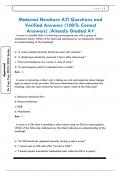
1. Which of the following is a property of both gases and liquids?
a. Definite shape b. Indefinite shape
c. Definite volume d. Indefinite volume
ANSWER: b
2. In which of the following pairs of properties are both properties chemical properties?
a. Freezes at 10°C and is nonflammable
b. Decomposes at 500°C and reacts with bromine
c. Poor conductor of heat and is reddish brown in color
d. Has a low density and is very hard
ANSWER: b
3. When a substance undergoes a chemical change it is always true that
a. it liquifies
b. it changes from a solid to a gas
c. it is converted to a new kind of matter with a different composition
d. the temperature of the substance increases
ANSWER: c
4. The description "two substances present, two phases present" is correct for
a. heterogeneous mixtures b. homogeneous mixtures
c. elements d. compounds
ANSWER: a
5. Which of the following statements about heterogeneous and homogeneous mixtures is correct?
a. It is possible to have heterogeneous mixtures in which all the components are liquids.
b. A homogeneous mixture contains visibly different parts, or phases.
, c. All of the phases in a heterogeneous mixture must be in the same state.
d. No two phases in a heterogeneous mixture can be in the same state.
ANSWER: a
6. Which of the following statements is correct?
a. Elements, but not compounds, are pure substances.
b. Compounds, but not elements, are pure substances.
c. Both elements and compounds are pure substances.
d. Neither elements nor compounds are pure substances.
ANSWER: c
7. An element is a substance that
a. can be broken down into simpler substances by physical means.
b. cannot be broken down into simpler substances by physical means.
c. can be broken down into simpler substances by chemical means.
d. cannot be broken down into simpler substances by chemical or physical means.
ANSWER: d
8. A pure substance F is found to change upon heating into two new pure substances M and Y.
Both M and Y may be decomposed by chemical means. From this we may conclude that:
a. F is an element, M and Y are compounds.
b. F is a compound, M and Y are elements.
c. F, M, and Y are all elements.
d. F, M, and Y are all compounds.
ANSWER: d
9. Which of the following statements concerning the known elements is correct?
, a. No new elements have been identified within the last 40 years.
b. Most elements occur naturally.
c. 108 elements are known at present.
d. Scientists have synthesized all possible non-natural elements.
ANSWER: b
10. The most abundant elements in the universe and in the Earth's crust are, respectively,
a. oxygen and iron. b. hydrogen and helium.
c. helium and carbon. d. hydrogen and oxygen.
ANSWER: d
11. In which of the following sequences of elements does each element have a two-letter
chemical symbol?
a. barium, iron, nitrogen b. selenium, nickel, strontium
c. silicon, zinc, hydrogen d. iodine, xenon, titantium
ANSWER: b
12. In which of the following sequences of elements does each element have a one-letter chemical
symbol?
a. indium, carbon, silver b. iodine, boron, tungsten
c. antimony, boron, nitrogen d. nitrogen, germanium, bromine
ANSWER: b
13. Which one of the following statements about atoms is incorrect?
a. An atom is the smallest "piece" of an element that can exist and still have the
properties of the element.
b. Free isolated atoms are rarely encountered in nature.
c. Atoms may be decomposed using chemical change.
, d. Only one kind of atom may be present in a homoatomic molecule.
ANSWER: c
14. Which one of the following statements about heteroatomic molecules is correct?
a. Two atoms in a heteroatomic molecule may be the same.
b. Upon chemical subdivision, heteroatomic molecules always yield two or more kinds
of atoms.
c. Heteroatomic molecules maintain the properties of their constituent elements.
d. Molecules of certain elements are heteroatomic.
ANSWER: b
15. Which of the following pairings of chemical formulas and "molecular descriptions" is
incorrect?
a. LiCN and "triatomic" b. KCl and "heteroatomic"
c. N2 and "homoatomic" d. SiO2 and "diatomic"
ANSWER: d
16. In which of the following pairs of chemical formulas do both formulas represent compounds?
a. O2 and O3 b. CO2 and O2
c. HCN and N2 d. N2O4 and NO2
ANSWER: d
17. Which of the following is a correct description of a sample of ice cubes in water?
a. One phase present, one substance present
b. One phase present, two substances present
c. Two phases present, one substance present
d. Two phases present, two substances present
ANSWER: c
a. Definite shape b. Indefinite shape
c. Definite volume d. Indefinite volume
ANSWER: b
2. In which of the following pairs of properties are both properties chemical properties?
a. Freezes at 10°C and is nonflammable
b. Decomposes at 500°C and reacts with bromine
c. Poor conductor of heat and is reddish brown in color
d. Has a low density and is very hard
ANSWER: b
3. When a substance undergoes a chemical change it is always true that
a. it liquifies
b. it changes from a solid to a gas
c. it is converted to a new kind of matter with a different composition
d. the temperature of the substance increases
ANSWER: c
4. The description "two substances present, two phases present" is correct for
a. heterogeneous mixtures b. homogeneous mixtures
c. elements d. compounds
ANSWER: a
5. Which of the following statements about heterogeneous and homogeneous mixtures is correct?
a. It is possible to have heterogeneous mixtures in which all the components are liquids.
b. A homogeneous mixture contains visibly different parts, or phases.
, c. All of the phases in a heterogeneous mixture must be in the same state.
d. No two phases in a heterogeneous mixture can be in the same state.
ANSWER: a
6. Which of the following statements is correct?
a. Elements, but not compounds, are pure substances.
b. Compounds, but not elements, are pure substances.
c. Both elements and compounds are pure substances.
d. Neither elements nor compounds are pure substances.
ANSWER: c
7. An element is a substance that
a. can be broken down into simpler substances by physical means.
b. cannot be broken down into simpler substances by physical means.
c. can be broken down into simpler substances by chemical means.
d. cannot be broken down into simpler substances by chemical or physical means.
ANSWER: d
8. A pure substance F is found to change upon heating into two new pure substances M and Y.
Both M and Y may be decomposed by chemical means. From this we may conclude that:
a. F is an element, M and Y are compounds.
b. F is a compound, M and Y are elements.
c. F, M, and Y are all elements.
d. F, M, and Y are all compounds.
ANSWER: d
9. Which of the following statements concerning the known elements is correct?
, a. No new elements have been identified within the last 40 years.
b. Most elements occur naturally.
c. 108 elements are known at present.
d. Scientists have synthesized all possible non-natural elements.
ANSWER: b
10. The most abundant elements in the universe and in the Earth's crust are, respectively,
a. oxygen and iron. b. hydrogen and helium.
c. helium and carbon. d. hydrogen and oxygen.
ANSWER: d
11. In which of the following sequences of elements does each element have a two-letter
chemical symbol?
a. barium, iron, nitrogen b. selenium, nickel, strontium
c. silicon, zinc, hydrogen d. iodine, xenon, titantium
ANSWER: b
12. In which of the following sequences of elements does each element have a one-letter chemical
symbol?
a. indium, carbon, silver b. iodine, boron, tungsten
c. antimony, boron, nitrogen d. nitrogen, germanium, bromine
ANSWER: b
13. Which one of the following statements about atoms is incorrect?
a. An atom is the smallest "piece" of an element that can exist and still have the
properties of the element.
b. Free isolated atoms are rarely encountered in nature.
c. Atoms may be decomposed using chemical change.
, d. Only one kind of atom may be present in a homoatomic molecule.
ANSWER: c
14. Which one of the following statements about heteroatomic molecules is correct?
a. Two atoms in a heteroatomic molecule may be the same.
b. Upon chemical subdivision, heteroatomic molecules always yield two or more kinds
of atoms.
c. Heteroatomic molecules maintain the properties of their constituent elements.
d. Molecules of certain elements are heteroatomic.
ANSWER: b
15. Which of the following pairings of chemical formulas and "molecular descriptions" is
incorrect?
a. LiCN and "triatomic" b. KCl and "heteroatomic"
c. N2 and "homoatomic" d. SiO2 and "diatomic"
ANSWER: d
16. In which of the following pairs of chemical formulas do both formulas represent compounds?
a. O2 and O3 b. CO2 and O2
c. HCN and N2 d. N2O4 and NO2
ANSWER: d
17. Which of the following is a correct description of a sample of ice cubes in water?
a. One phase present, one substance present
b. One phase present, two substances present
c. Two phases present, one substance present
d. Two phases present, two substances present
ANSWER: c