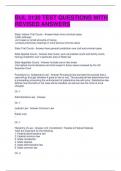
BUL 3130 TEST QUESTIONS WITH
REVISED ANSWERS
State: Inferior Trial Courts - Answer-Hear minor criminal cases
-traffic offenses
-civil cases w/ small amounts of money
-conduct preliminary hearings in more serious criminal cases
State Trial Courts - Answer-have general jurisdiction over civil and criminal cases
State Special Courts - Answer-trial courts, such as probate courts and family courts,
having jurisdiction over a particular area of State law
State Appellate Courts - Answer-Include one or two levels
-the highest courts decisions are final except in those cases reviewed by the US
Supreme Court
Procedural vs. Substantive Law - Answer-Procedural law provides the process that a
case will go through (whether it goes to trial or not). The procedural law determines how
a proceeding concerning the enforcement of substantive law will occur. Substantive law
defines how the facts in the case will be handled, as well as how the crime is to be
charged.
Ch. 1
Administrative Law - Answer-
Ch. 1
Judicial Law - Answer-Common Law
-
Equity Law
-
Ch. 1
Hierarchy of Law - Answer-U.S. Constitution: Treaties & Federal Statutes
-both are important for the following
1. Federal administrative law
2. Federal common law
3. State constitution
4. State statutes
5. State administrative law
6. State common law
Ch. 2
, Ethics - Answer-Study of what is right or good for human beings
Ch. 2
Business Ethics - Answer-study of what is right and good in a business setting; includes
the moral issues that arise from business practices, institutions, and decision making
Ch. 2
REVISED ANSWERS
State: Inferior Trial Courts - Answer-Hear minor criminal cases
-traffic offenses
-civil cases w/ small amounts of money
-conduct preliminary hearings in more serious criminal cases
State Trial Courts - Answer-have general jurisdiction over civil and criminal cases
State Special Courts - Answer-trial courts, such as probate courts and family courts,
having jurisdiction over a particular area of State law
State Appellate Courts - Answer-Include one or two levels
-the highest courts decisions are final except in those cases reviewed by the US
Supreme Court
Procedural vs. Substantive Law - Answer-Procedural law provides the process that a
case will go through (whether it goes to trial or not). The procedural law determines how
a proceeding concerning the enforcement of substantive law will occur. Substantive law
defines how the facts in the case will be handled, as well as how the crime is to be
charged.
Ch. 1
Administrative Law - Answer-
Ch. 1
Judicial Law - Answer-Common Law
-
Equity Law
-
Ch. 1
Hierarchy of Law - Answer-U.S. Constitution: Treaties & Federal Statutes
-both are important for the following
1. Federal administrative law
2. Federal common law
3. State constitution
4. State statutes
5. State administrative law
6. State common law
Ch. 2
, Ethics - Answer-Study of what is right or good for human beings
Ch. 2
Business Ethics - Answer-study of what is right and good in a business setting; includes
the moral issues that arise from business practices, institutions, and decision making
Ch. 2