1|Page | © copyright 2024/2025 | Grade A+
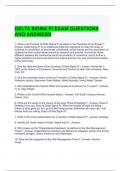
N172 week 3 evolve quiz DM
Questions and Answers Grade A+
Which nursing instruction would the nurse provide to a diabetic client who
developed renal disease? Select all that apply. One, some, or all responses
may be correct.
-Recommend the client drink boiled water
-Suggest the client go for morning walks.
-Instruct the client to check their blood pressure regularly.
-Direct the client to contact their primary health care provider before taking
ibuprofen.
-Encourage the client to undergo a microalbuminuria test yearly.
Master01 | October, 2024/2025 | Latest update
, 1|Page | © copyright 2024/2025 | Grade A+
✓ -Instruct the client to check their blood pressure regularly.
✓ -Direct the client to contact their primary health care provider before
taking ibuprofen.
✓ -Encourage the client to undergo a microalbuminuria test yearly.
✓
✓ Rationale
✓ High blood pressure affects normal kidney function. Clients with renal
disease must monitor blood pressure because increased blood
pressure can damage the vessel walls of the kidneys, thereby causing
kidney damage and leading to kidney failure. Clients with renal
disease would be encouraged to check their blood pressure regularly.
Drugs such as ibuprofen are potent nephrotoxic agents; therefore the
client must contact their primary health care provider before ingestion
to avoid further complications. Diabetic clients would undertake a
microalbuminuria test yearly to determine the risk of developing end-
stage kidney disease. Drinking boiled water may reduce the risk of
infections; however, this instruction is less beneficial than the other
interventions. Going for a walk will improve the overall health of the
client, but it is not a specific intervention related to kidney function.
Master01 | October, 2024/2025 | Latest update
, 1|Page | © copyright 2024/2025 | Grade A+
Which advice will the nurse provide to a client who is taking an oral
hypoglycemic daily for type 2 diabetes who develops an infection with
anorexia? Select all that apply. One, some, or all responses may be correct.
-Avoid solid food.
-Continue to take the oral medication.
-Drink fluids throughout the day.
-Monitor capillary glucose levels.
-Do not take medication until tolerating food.
Master01 | October, 2024/2025 | Latest update
, 1|Page | © copyright 2024/2025 | Grade A+
✓ Continue to take the oral medication.
✓ Drink fluids throughout the day.
✓ Monitor capillary glucose levels.
✓
✓ Rationale
✓ Physiological stress increases gluconeogenesis, requiring continued
pharmacological therapy despite an inability to eat; fluids prevent
dehydration; monitoring of glucose levels permits early intervention if
necessary. Skipping the oral hypoglycemic agent may precipitate
hyperg lycemia.
✓ Food intake will be attempted to prevent acidosis. Delaying an oral
hypoglycemic agent may precipitate hyperglycemia.
Which statement by a client with type 2 diabetes indicates to the nurse that
additional dietary teaching is needed?
"| can eat as much dietetic fruit as I want."
"I can have a lettuce salad whenever I want it."
"I know that half of my diet should be carbohydrates."
"I need to reduce the amounts of saturated fats in my diet."
Master01 | October, 2024/2025 | Latest update
N172 week 3 evolve quiz DM
Questions and Answers Grade A+
Which nursing instruction would the nurse provide to a diabetic client who
developed renal disease? Select all that apply. One, some, or all responses
may be correct.
-Recommend the client drink boiled water
-Suggest the client go for morning walks.
-Instruct the client to check their blood pressure regularly.
-Direct the client to contact their primary health care provider before taking
ibuprofen.
-Encourage the client to undergo a microalbuminuria test yearly.
Master01 | October, 2024/2025 | Latest update
, 1|Page | © copyright 2024/2025 | Grade A+
✓ -Instruct the client to check their blood pressure regularly.
✓ -Direct the client to contact their primary health care provider before
taking ibuprofen.
✓ -Encourage the client to undergo a microalbuminuria test yearly.
✓
✓ Rationale
✓ High blood pressure affects normal kidney function. Clients with renal
disease must monitor blood pressure because increased blood
pressure can damage the vessel walls of the kidneys, thereby causing
kidney damage and leading to kidney failure. Clients with renal
disease would be encouraged to check their blood pressure regularly.
Drugs such as ibuprofen are potent nephrotoxic agents; therefore the
client must contact their primary health care provider before ingestion
to avoid further complications. Diabetic clients would undertake a
microalbuminuria test yearly to determine the risk of developing end-
stage kidney disease. Drinking boiled water may reduce the risk of
infections; however, this instruction is less beneficial than the other
interventions. Going for a walk will improve the overall health of the
client, but it is not a specific intervention related to kidney function.
Master01 | October, 2024/2025 | Latest update
, 1|Page | © copyright 2024/2025 | Grade A+
Which advice will the nurse provide to a client who is taking an oral
hypoglycemic daily for type 2 diabetes who develops an infection with
anorexia? Select all that apply. One, some, or all responses may be correct.
-Avoid solid food.
-Continue to take the oral medication.
-Drink fluids throughout the day.
-Monitor capillary glucose levels.
-Do not take medication until tolerating food.
Master01 | October, 2024/2025 | Latest update
, 1|Page | © copyright 2024/2025 | Grade A+
✓ Continue to take the oral medication.
✓ Drink fluids throughout the day.
✓ Monitor capillary glucose levels.
✓
✓ Rationale
✓ Physiological stress increases gluconeogenesis, requiring continued
pharmacological therapy despite an inability to eat; fluids prevent
dehydration; monitoring of glucose levels permits early intervention if
necessary. Skipping the oral hypoglycemic agent may precipitate
hyperg lycemia.
✓ Food intake will be attempted to prevent acidosis. Delaying an oral
hypoglycemic agent may precipitate hyperglycemia.
Which statement by a client with type 2 diabetes indicates to the nurse that
additional dietary teaching is needed?
"| can eat as much dietetic fruit as I want."
"I can have a lettuce salad whenever I want it."
"I know that half of my diet should be carbohydrates."
"I need to reduce the amounts of saturated fats in my diet."
Master01 | October, 2024/2025 | Latest update