Ch. 21: Peripheral Vascular System and Lymphatic
System (Jarvis)- Questions & Answers
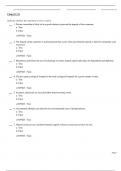
1. Which statement is true regarding the arterial system?
a. Arteries are large-diameter vessels.
b. The arterial system is a high-pressure system.
c. The walls of arteries are thinner than those of the veins.
d. Arteries can greatly expand to accommodate a large blood volume increase. Correct Ans-
b. The arterial system is a high-pressure system.
The pumping heart makes the arterial system a high-pressure system.
2. The nurse is reviewing the blood supply to the arm. The major artery supplying the arm is the
_____ artery.
a. Ulnar
b. Radial
c. Brachial
d. Deep palmar Correct Ans-c. Brachial
,The major artery supplying the arm is the brachial artery. The brachial artery bifurcates into the
ulnar and radial arteries immediately below the elbow. In the hand, the ulnar and radial arteries
form two arches known as the superficial and deep palmar arches.
3. The nurse is preparing to assess the dorsalis pedis artery. Where is the correct location for
palpation?
a. Behind the knee
b. Over the lateral malleolus
c. In the groove behind the medial malleolus
d. Lateral to the extensor tendon of the great toe Correct Ans-d. Lateral to the extensor
tendon of the great toe
The dorsalis pedis artery is located on the dorsum of the foot. The nurse should palpate just
lateral to and parallel with the extensor tendon of the big toe. The popliteal artery is palpated
behind the knee. The posterior tibial pulse is palpated in the groove between the malleolus and
the Achilles tendon. No pulse is palpated at the lateral malleolus.
4. A 65-year-old patient is experiencing pain in his left calf when he exercises that disappears
after resting for
a few minutes. The nurse recognizes that this description is most consistent with _______ the
left leg.
a. Venous obstruction of
, b. Claudication due to venous abnormalities in
c. Ischemia caused by a partial blockage of an artery supplying
d. Ischemia caused by the complete blockage of an artery supplying Correct Ans-c. Ischemia
caused by a partial blockage of an artery supplying
Ischemia is a deficient supply of oxygenated arterial blood to a tissue. A partial blockage creates
an insufficient
supply, and the ischemia may be apparent only during exercise when oxygen needs increase.
5. The nurse is reviewing venous blood flow patterns. Which of these statements best describes
the
mechanism(s) by which venous blood returns to the heart?
a. Intraluminal valves ensure unidirectional flow toward the heart.
b. Contracting skeletal muscles milk blood distally toward the veins.
c. High-pressure system of the heart helps facilitate venous return.
d. Increased thoracic pressure and decreased abdominal pressure facilitate venous return to the
heart. Correct Ans-a. Intraluminal valves ensure unidirectional flow toward the heart.
Blood moves through the veins by (1) contracting skeletal muscles that proximally milk the
blood; (2) pressure
System (Jarvis)- Questions & Answers
1. Which statement is true regarding the arterial system?
a. Arteries are large-diameter vessels.
b. The arterial system is a high-pressure system.
c. The walls of arteries are thinner than those of the veins.
d. Arteries can greatly expand to accommodate a large blood volume increase. Correct Ans-
b. The arterial system is a high-pressure system.
The pumping heart makes the arterial system a high-pressure system.
2. The nurse is reviewing the blood supply to the arm. The major artery supplying the arm is the
_____ artery.
a. Ulnar
b. Radial
c. Brachial
d. Deep palmar Correct Ans-c. Brachial
,The major artery supplying the arm is the brachial artery. The brachial artery bifurcates into the
ulnar and radial arteries immediately below the elbow. In the hand, the ulnar and radial arteries
form two arches known as the superficial and deep palmar arches.
3. The nurse is preparing to assess the dorsalis pedis artery. Where is the correct location for
palpation?
a. Behind the knee
b. Over the lateral malleolus
c. In the groove behind the medial malleolus
d. Lateral to the extensor tendon of the great toe Correct Ans-d. Lateral to the extensor
tendon of the great toe
The dorsalis pedis artery is located on the dorsum of the foot. The nurse should palpate just
lateral to and parallel with the extensor tendon of the big toe. The popliteal artery is palpated
behind the knee. The posterior tibial pulse is palpated in the groove between the malleolus and
the Achilles tendon. No pulse is palpated at the lateral malleolus.
4. A 65-year-old patient is experiencing pain in his left calf when he exercises that disappears
after resting for
a few minutes. The nurse recognizes that this description is most consistent with _______ the
left leg.
a. Venous obstruction of
, b. Claudication due to venous abnormalities in
c. Ischemia caused by a partial blockage of an artery supplying
d. Ischemia caused by the complete blockage of an artery supplying Correct Ans-c. Ischemia
caused by a partial blockage of an artery supplying
Ischemia is a deficient supply of oxygenated arterial blood to a tissue. A partial blockage creates
an insufficient
supply, and the ischemia may be apparent only during exercise when oxygen needs increase.
5. The nurse is reviewing venous blood flow patterns. Which of these statements best describes
the
mechanism(s) by which venous blood returns to the heart?
a. Intraluminal valves ensure unidirectional flow toward the heart.
b. Contracting skeletal muscles milk blood distally toward the veins.
c. High-pressure system of the heart helps facilitate venous return.
d. Increased thoracic pressure and decreased abdominal pressure facilitate venous return to the
heart. Correct Ans-a. Intraluminal valves ensure unidirectional flow toward the heart.
Blood moves through the veins by (1) contracting skeletal muscles that proximally milk the
blood; (2) pressure