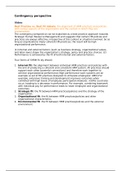
Contingency perspective
Video
Best Practice vs. Best Fit debate: the alignment of HRM practices and policies
with various aspects of the organization and the context in which they are
implemented.
The contingency perspective can be explained as a best-practice approach towards
Strategic Human Resource Management and suggests that certain HR policies and
practices are always effective, irrespective of the context or situation involved. So as
long as organizations imply coherent HR practices, the result will be high
organizational performance.
(1) Internal and external factors (such as business strategy, organizational values,
and labor laws) shape the organization’s strategy, policy and practice choices. (2)
Performance is achieved by the fit of both internal and external factors.
Four forms of SHRM fit (by Wood):
1. Internal fit: the alignment between individual HRM practices and policies with
the aim of producing a coherent and consistent HRM system. All practices should
support each other (powerful connections) and therefore work together to
achieve organizational performance.High-performance work systems are an
example (a set of HR practices designed to stimulate employees’ AMO).For
example, extensive training and development improves outcomes when
combined with high levels of employee participation.However, misfits could also
occur, leading to a decrease in performance. For example, combining teamwork
with individual pay for performance leads to lower employee and organizational
outcomes.
2. Strategic fit: the fit between HRM practices/policies and the strategy of the
organization.
3. Organizational fit: the fit between HRM practices/policies and other
organizational characteristics.
4. Environmental fit: the fit between HRM practices/policies and the external
environment.
, Summary literature Contingency perspective
HRM and Performance by Peccei, R., & van de Voorde, K. (2014) - book
chapter
Workshop
Video
Best Practice vs. Best Fit debate: the alignment of HRM practices and policies
with various aspects of the organization and the context in which they are
implemented.
The contingency perspective can be explained as a best-practice approach towards
Strategic Human Resource Management and suggests that certain HR policies and
practices are always effective, irrespective of the context or situation involved. So as
long as organizations imply coherent HR practices, the result will be high
organizational performance.
(1) Internal and external factors (such as business strategy, organizational values,
and labor laws) shape the organization’s strategy, policy and practice choices. (2)
Performance is achieved by the fit of both internal and external factors.
Four forms of SHRM fit (by Wood):
1. Internal fit: the alignment between individual HRM practices and policies with
the aim of producing a coherent and consistent HRM system. All practices should
support each other (powerful connections) and therefore work together to
achieve organizational performance.High-performance work systems are an
example (a set of HR practices designed to stimulate employees’ AMO).For
example, extensive training and development improves outcomes when
combined with high levels of employee participation.However, misfits could also
occur, leading to a decrease in performance. For example, combining teamwork
with individual pay for performance leads to lower employee and organizational
outcomes.
2. Strategic fit: the fit between HRM practices/policies and the strategy of the
organization.
3. Organizational fit: the fit between HRM practices/policies and other
organizational characteristics.
4. Environmental fit: the fit between HRM practices/policies and the external
environment.
, Summary literature Contingency perspective
HRM and Performance by Peccei, R., & van de Voorde, K. (2014) - book
chapter
Workshop